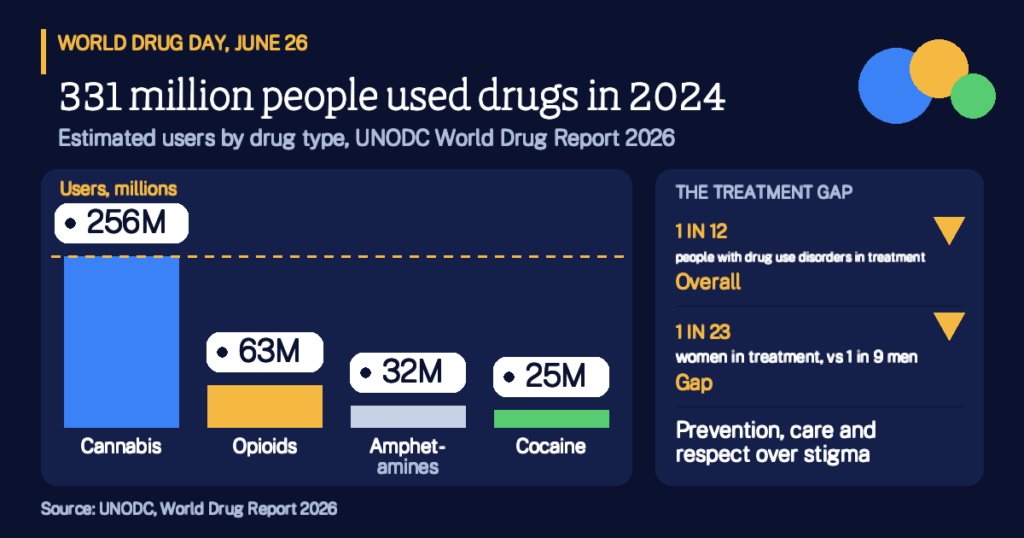
Drugs touch more lives than most people assume. In 2024, an estimated 331 million people used them, according to the UN Office on Drugs and Crime (UNODC), and the number keeps growing. The International Day against Drug Abuse and Illicit Trafficking, also called World Drug Day, is observed every June 26 to turn that fact into action: better prevention, better health care and stronger cooperation against criminal networks. It is a close cousin of World No Tobacco Day, since both days ask how societies protect people from substances that harm health.
From a global conference to a UN day
By resolution 42/112 of December 7, 1987, the UN General Assembly decided to observe June 26 as the International Day against Drug Abuse and Illicit Trafficking. The resolution expressed the Assembly’s determination to strengthen action and cooperation toward an international society free of drug abuse, and it grew out of the 1987 International Conference on Drug Abuse and Illicit Trafficking.
The day rests on a much older legal framework. The Commission on Narcotic Drugs was created in 1946, and the 1961, 1971 and 1988 international drug control conventions set the rules most countries follow today. UNODC, the UN agency that works on drugs and crime, uses the day to bring the issue into public view. In 2026 it released its flagship World Drug Report on June 26 itself.
What the day is really about
The name has two halves. “Drug abuse” points to the health side: people whose substance use harms them and who may need care. “Illicit trafficking” points to the supply side: the production, transport and sale of controlled drugs outside the law. The 2026 message from UN Secretary-General António Guterres holds the two together. He said that illicit drug trafficking is not a victimless crime, and that the spread of synthetic drugs and the growth of online trafficking networks are compounding the crisis.
The 2026 theme asks the world to build solutions grounded in foresight, innovation and solidarity. In practice that means using technology to stop cyber-trafficking, working with police to disrupt criminal networks and the manufacture of synthetic drugs, and investing more in prevention, harm reduction and treatment.
The numbers behind the day
The World Drug Report 2026 estimates that 331 million people used drugs in 2024. That is 6.2 percent of the world population aged 15 to 64, up from 5.2 percent a decade ago. Cannabis remains the most widely used drug, with 256 million users, followed by opioids at 63 million, amphetamines at 32 million, cocaine at 25 million and ecstasy at 21 million.
Example 1: what 6.2 percent looks like. In a town of 10,000 adults aged 15 to 64, 6.2 percent is about 620 people, compared with about 520 at the rate of a decade ago. The town is made up and the numbers are round and illustrative, but the arithmetic shows how a one-point rise adds up across a world population of billions.
A market that keeps changing
Drug markets are shifting quickly. In 2024, authorities identified 755 new psychoactive substances, including 118 reported for the first time, and the number of different drugs detected in seizures is now five times higher than before the year 2000. Methamphetamine seizures have grown by an average of 13 percent a year.
Opium supply has moved too. After Afghanistan’s 2022 ban on opium cultivation, illicit heroin production fell sharply, while opium production in Myanmar rose from 420 tonnes in 2021 to more than 1,000 tonnes in 2025. Afghanistan had produced more than 6,000 tonnes in 2022. UNODC Executive Director Monica Juma has warned of an unprecedented spike in new types of drugs, some of them more potent or dangerous than before.
- 331 millionpeople used drugs in 2024
- 6.2%of people aged 15 to 64, up from 5.2% a decade ago
- 755new psychoactive substances identified in 2024
- 1 in 12people with drug use disorders are in treatment
The treatment gap
Treatment is where the distance between need and care is starkest. UNODC reports that only one in 12 people with drug use disorders are in treatment. The gap is wider for women: just one in 23 women with drug use disorders are in treatment, compared with one in nine men. Women who inject drugs are also 20 percent more likely to be living with HIV than men.
Example 2: closing a gap. Imagine a region with 1,200 people who have drug use disorders. At one in 12, about 100 are in treatment and 1,100 are not. Adding 100 places would double the number treated, yet 1,000 people would still wait. The figures are round and illustrative, but they show why the day calls for more investment in services.
Justice, health and the cost of stigma
Drug policy also shows up in the justice system. In 2024, an estimated 5.9 million people were in formal contact with the criminal justice system for criminal drug offenses, about two thirds of them for drug use or possession. Around 3.7 million were prosecuted and about 2.2 million were convicted.
The UN campaign for World Drug Day argues that people who use drugs deserve respect and empathy. It calls for evidence-based, voluntary services for all, alternatives to punishment, a priority on prevention and leadership with compassion. Stigma matters because people who fear judgment are less likely to ask for help.
Example 3: a court docket. Picture a court that hears 1,000 drug cases in a year, with two thirds, about 667, involving only use or possession. If a health referral program diverted even a quarter of those, about 167 people would reach services instead of a cell. The case counts are invented and round, and real programs vary widely, but they show the choice behind the policy debate.
How the day is marked
Every June 26, governments, health agencies, schools and civil society groups hold events. In 2026, for example, UNODC worked with Kenya’s national authority on drug abuse to mark the day, and youth camps and school sessions elsewhere focused on prevention. You can take part by learning the facts, sharing accurate information and talking about drugs without stigma. If you or someone close to you is struggling with substance use, a local health service or helpline can help. In the United States, the SAMHSA National Helpline is 1-800-662-4357.
Key Takeaways
- Drug use is at a record high. An estimated 331 million people used drugs in 2024, or 6.2 percent of people aged 15 to 64.
- The day has a clear origin. Resolution 42/112 of December 7, 1987 set June 26 as the international day.
- Markets move fast. 755 new psychoactive substances were identified in 2024, and production hubs for opium have shifted.
- Treatment lags behind need. Only one in 12 people with drug use disorders are in treatment.
- Women face a wider gap. One in 23 women with drug use disorders are in treatment, against one in nine men.
- Health and justice meet. About 5.9 million people had formal justice contact over drug offenses in 2024, two thirds for use or possession.
- Respect opens the door to help. Reducing stigma and funding prevention and voluntary care are central to the UN message.
How solid is this? Figures are estimates from UNODC’s World Drug Report 2026 and are revised in each edition. The treatment ratios come from the report’s findings summary, which gives no separate year for them, and the percentages in the graphic are rounded from those ratios. The three worked examples use round, made-up numbers to show an idea. See also World No Tobacco Day, the International Days hub and the International Days Calendar.
More in Health
- UN News, Global drug use reaches record high as increasingly potent synthetic drugs spread (June 26, 2026)
- UNODC, World Drug Report 2026: Findings in Brief
- United Nations, International Day against Drug Abuse and Illicit Trafficking
- United Nations, World Drug Day: Background
- United Nations, World Drug Day: Messages, Secretary-General 2026