Most of the world’s businesses are small. They are the corner shop, the farmer who sells at the weekly market, the tailor with two apprentices and the freelancer who has just hired a first employee. Together they provide more jobs than the giant companies that fill the headlines, yet they find it hardest to borrow, to grow and to survive a bad year. Micro-, Small and Medium-sized Enterprises Day, observed every June 27, asks the world to notice them. It pairs naturally with International Day of Banks, because the money small firms need usually has to come from a lender.
How the day began
In April 2017 the United Nations General Assembly adopted resolution A/RES/71/279 and designated June 27 as Micro-, Small and Medium-sized Enterprises Day. The UN says the aim is to raise awareness of the tremendous contribution these firms make to the Sustainable Development Goals, and to highlight their pivotal role and explore opportunities for their further advancement. The abbreviation MSMEs is used throughout the UN system.
The day is marked each year with meetings and campaigns. In 2025 the UN held events in New York on June 24 and in Geneva on June 27, under the theme “Enhancing the role of Micro-, Small and Medium-sized Enterprises (MSMEs) as drivers of Sustainable Growth and Innovation.” Themes change from year to year, so the UN observance page is the place to check the current one.
What counts as a small business
There is no single worldwide definition. The International Labour Organization (ILO) notes that small and medium-sized enterprises typically have fewer than 250 employees. Micro firms sit at the bottom of the scale, often an owner working alone or with family. Countries set their own limits using headcount, sales or assets, which is why figures from different sources can differ. When you compare numbers, check which definition each one uses.
Many of these firms are informal, meaning they are not registered or covered by labor and tax rules. The ILO reports that the majority of SMEs are informal enterprises, and that they provide livelihoods for 60 percent of the world’s workers. That is one reason the day matters: the people who depend on small firms are often the least protected.
The numbers behind the day
The UN observance page, drawing on World Bank estimates, says MSMEs account for 90 percent of businesses, 60 to 70 percent of employment and 50 percent of GDP worldwide. The ILO, in a 2019 analysis, put micro and small enterprises together with own-account workers at 70 percent of employment worldwide. In emerging market and developing economies, the World Bank said in November 2026 that MSMEs make up 90 percent of businesses and employ 75 percent of workers. The estimates differ because definitions and data years differ, but they point the same way.
Example 1: counting the jobs. Suppose a district has 1,000 firms and 900 of them are small, in line with the 90 percent figure. If those small firms employ 6 people each, they provide 5,400 jobs, while the 100 larger firms, at 20 people each, provide 2,000. The numbers are round and illustrative, but they show how a handful of large employers can be outweighed by a crowd of small ones.
Jobs for a growing workforce
The UN page says 600 million jobs will be needed by 2030, and that in emerging markets SMEs create 7 out of 10 jobs. The World Bank adds that 1.2 billion young people in developing countries will reach working age over the next 10 to 15 years. Large firms and governments alone cannot absorb a cohort that size. Small firms, which hire locally and train on the job, are where most of those first jobs will have to appear.
The finance problem
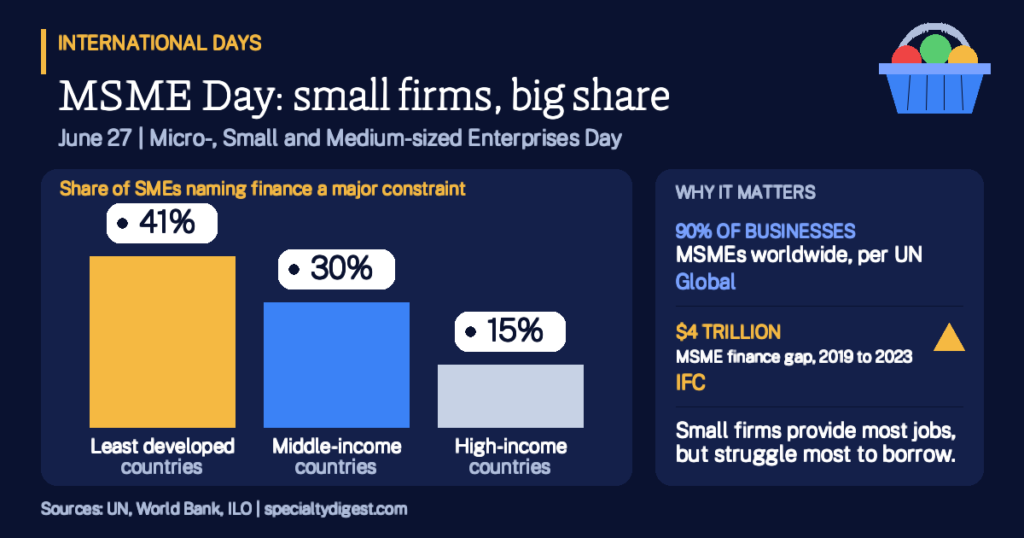
Growth takes money, and this is where small firms stumble. In its credited figures the UN page reports that 41 percent of SMEs in least developed countries name access to finance as a major constraint, against 30 percent in middle-income countries and 15 percent in high-income countries. A lender cannot easily judge a business with no credit history, no collateral and no formal accounts, so it often says no.
The scale of the shortfall is large. A November 2026 World Bank release, citing the IFC report on the MSME finance gap, says that between 2019 and 2023 the gap reached $4 trillion in developing economies. The same release reports that having a formal loan can raise a firm’s employment by an average of 12 percent and its sales and profits by about 18 percent, citing the World Bank’s Finance and Prosperity 2026 report.
- $4 trillionMSME finance gap, 2019 to 2023 (IFC, via World Bank)
- 600 millionjobs needed worldwide by 2030 (UN)
- 7 in 10jobs created by SMEs in emerging markets (UN)
- 1 in 3formal businesses owned and led by women, at most (ILO, 2019)
Example 2: one loan. Imagine a workshop with 25 employees and $200,000 in yearly sales that receives a formal loan. At the average effects above, it would add about 3 jobs and about $36,000 in sales. The workshop is made up and the numbers are round, but they show why lenders and development agencies treat small-firm credit as a jobs policy, not only a banking one.
Who is left behind
Credit is not the only gap. The ILO reports that women own and lead up to one third of businesses in the formal economy worldwide, which means they are a minority among owners and often face extra hurdles in raising capital. Risk is another gap. The World Bank says financial losses not covered by insurance exceeded 80 percent in parts of Africa, Asia and Latin America over the last decade, so a flood, a fire or a theft can end a small business that a larger firm would survive.
Safety is a third. The ILO notes that in Europe 82 percent of all occupational injuries and 90 percent of fatal accidents occur in SMEs, because small firms have fewer resources for safety training and equipment. Small does not always mean safe, and the day is a reminder that decent work has to reach small workplaces too.
What progress needs
Based on the problems above, the policy menu is fairly clear: simpler business registration so that informal firms can step into the system, credit information that lets a lender judge a borrower without land as collateral, affordable insurance, and support for women entrepreneurs. The World Bank Group said it launched a new MSME strategy in October 2026 to work on finance for these firms.
Ordinary people can help too. Buying from local producers, paying small suppliers on time and asking how a public contract could be opened to small bidders all strengthen the firms the day celebrates.
Example 3: the finance gap per 100 firms. Take 100 SMEs in a least developed country and 100 in a high-income country. Using the UN-reported shares, about 41 of the first group and 15 of the second call finance a major constraint, a difference of 26 firms in every 100. If a program cut that difference in half, 13 more firms in each hundred could focus on growing rather than on finding money. The program is hypothetical and the arithmetic is only an illustration.
Key Takeaways
- Small firms are the economy’s bulk. The UN, crediting the World Bank, says MSMEs account for 90 percent of businesses and 50 percent of GDP.
- They are the main source of jobs. They provide 60 to 70 percent of employment, and the UN says 600 million jobs will be needed by 2030.
- Definitions vary. The ILO says SMEs typically have fewer than 250 employees, but countries set their own limits, so compare numbers with care.
- Finance is the bottleneck. 41 percent of SMEs in least developed countries name it a major constraint, against 15 percent in high-income countries.
- Credit pays off. A formal loan is linked to 12 percent more employment and about 18 percent higher sales and profits on average.
- Some owners face extra barriers. Women lead at most one third of formal businesses, and uninsured losses can end small firms.
- You can act locally. Buying local and paying small suppliers promptly supports the firms the day was created to recognize.
How solid is this? The headline shares of businesses, jobs and GDP are global estimates that vary by definition and by data year, and the ILO figures come from a 2019 analysis. The finance gap and loan effects are from the World Bank’s November 2026 release and the reports it cites. The three worked examples use round, made-up numbers. See also the International Days hub and the International Days Calendar.
More in Society
- United Nations, Micro-, Small and Medium-sized Enterprises Day
- UN News, UN General Assembly creates International Day for small, medium-sized enterprises (2017)
- UN DESA, 2025 MSME Day Event
- World Bank, MSMEs in Developing Countries Face $4 Trillion Finance Gap (November 17, 2026)
- ILO, The power of small: Unlocking the potential of SMEs (2019)