Imagine losing, or never having, the two senses that bring most information from a distance: sight and hearing. For people with deafblindness, that is daily life, and it is far more varied than the word suggests. Deafblindness is not simply deafness plus blindness. It is a distinct disability that shapes how a person learns, moves, communicates and connects with others. The International Day of Deafblindness, observed every year on June 27, asks the world to notice people who are easy to overlook because they are few in number, hard to count and often missing from the rooms where decisions are made. It pairs naturally with World Braille Day, which honors one of the tools many people with sight loss rely on.
Why June 27
The date honors Helen Keller, who was born on June 27, 1880, in Tuscumbia, Alabama. The United Nations describes her (1880 to 1968) as one of the most iconic figures in the deafblindness community. Her story is also a lesson in access.
The community marked the date long before governments did. The World Federation of the Deafblind (WFDB) has described June 27 as celebrated in her honor to raise public awareness of the rights of people with deafblindness. The United Nations made it official when the General Assembly adopted resolution A/RES/79/294, proclaiming June 27 of each year the International Day of Deafblindness.
What deafblindness means
The WFDB adopts the Nordic definition, which calls deafblindness “a distinct disability arising from a dual sensory impairment” severe enough that one sense cannot easily make up for the other. That is why it cannot be understood by adding a deaf experience to a blind experience. Some people are born with both impairments. Others are born deaf and lose sight later, or are born blind and lose hearing, and many people lose both gradually with age.
Because the combination varies so much, so do the ways people communicate. Some use tactile sign language, in which the signs are felt by hand. Others use speech with amplification, braille, large print, touch cues, or a trained guide and interpreter. No single method fits everyone, and the best support starts by asking the person what works.
How many people, and why the count is uncertain
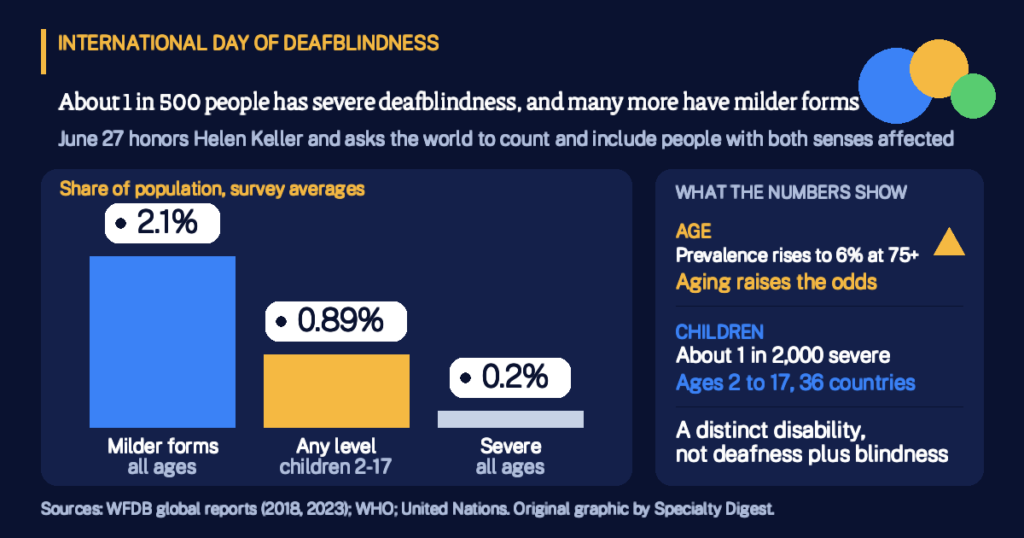
There is no single agreed global head count, and the best estimates come from surveys. The WFDB’s first global report in September 2018 drew on nationally representative population surveys from 22 countries. On average, 0.2 percent of the population of all ages had severe deafblindness, and 2.1 percent may experience milder forms. Prevalence climbs steeply with age: less than 0.1 percent for people aged 40 and under, rising to 6 percent for people aged 75 and over.
The second global report, published in March 2023, looked at children aged 2 to 17 in 36 countries, covering more than 442,000 children. It found severe deafblindness in 0.05 percent, which is about 1 child in 2,000, moderate in 0.14 percent and mild in 0.7 percent, for a combined 0.89 percent. The report warns that these child figures are not suitable for comparing countries, and that it is not known how common deafblindness is in children younger than two.
- 0.2%average share of people with severe deafblindness, 22-country surveys (WFDB, 2018)
- 2.1%may experience milder forms (WFDB, 2018)
- 1 in 2,000children aged 2 to 17 with severe deafblindness (WFDB, 2023)
- 6%of people aged 75 and over (WFDB, 2018)
Example 1: a town of 100,000. Apply the 2018 averages to a town of 100,000 people. About 200 would have severe deafblindness and about 2,100 might have milder forms. The numbers are round and illustrative, and real towns differ.
Two senses, one growing challenge
The World Health Organization counts vision and hearing separately, yet its figures show the scale of the problem behind deafblindness. WHO’s 2019 world report on vision found that at least 2.2 billion people have a vision impairment or blindness, and at least 1 billion of those cases could have been prevented or have yet to be addressed. For hearing, WHO projects that nearly 2.5 billion people, or 1 in 4, will live with some degree of hearing loss by 2050, and that more than 700 million of them will need hearing rehabilitation. WHO also notes that over 25 percent of people older than 60 are affected by disabling hearing loss.
As populations age, more people will live with loss in both senses. That is consistent with the WFDB finding that deafblindness is most common among people aged 75 and over, and it makes the day relevant far beyond the small group who are born with it.
Example 2: a care district. Suppose a district has 1,000 residents aged 75 and over. If the 6 percent figure held, about 60 of them would have deafblindness. Many might be mistaken for confused or withdrawn when they are in fact cut off from sound and sight. The figures are illustrative.
Who is left behind
The WFDB’s first global report carried a pointed title: “At risk of exclusion from CRPD and SDGs implementation,” a reference to the UN Convention on the Rights of Persons with Disabilities and the Sustainable Development Goals. The second report repeats its central finding that people with deafblindness, representing 0.2 percent to 2 percent of the population, are more likely to be poor, unemployed and have low education outcomes.
Part of the reason is invisibility. Standard surveys often miss people who cannot answer by phone or in a crowded interview, and many children are never identified. When a group is not counted, it is not planned for, and when it is not planned for, services such as interpreters, accessible information and trained teachers never arrive. Being counted is the first step toward being included.
Prevention, care and how the day is marked
Much sensory loss can be prevented or treated. WHO says nearly 60 percent of hearing loss in children has avoidable causes, from immunization and maternal care to ear infections that are caught early. On vision, the 2019 report points to cataract, trachoma and refractive error as the main targets for prevention and care. WHO estimates that scaling up hearing care costs under US$1.40 per person per year and returns nearly US$16 for every dollar invested over 10 years.
When loss cannot be reversed, rehabilitation matters. WHO lists hearing aids, cochlear implants, sign language, captioning and counseling on the hearing side, and magnifiers, braille and white canes with orientation and mobility training on the vision side. For people with deafblindness, these tools are combined and adapted, often with the help of trained interpreters and guides.
Example 3: the value of early screening. A clinic screens 1,000 newborns and finds that 2 have a hearing difference, so those families start language support in the first months. Without screening, the same children might be identified at age 3. The numbers are round and illustrative.
The day itself is a chance for schools, services and families to learn how to communicate with people who are deafblind. Observances vary by organization. In the United States, for example, the Helen Keller National Center’s 2026 DeafBlind Awareness Week campaign used the theme “Connected by Touch.”
Key Takeaways
- Deafblindness is its own disability. It is not deafness plus blindness; the combination changes how a person learns and communicates.
- June 27 honors Helen Keller. The UN proclaimed the day in resolution A/RES/79/294, turning a community date into a global one.
- Numbers are estimates. Surveys suggest 0.2 percent of people have severe deafblindness and 2.1 percent milder forms, and counting is incomplete.
- Age raises the odds. Prevalence rises to 6 percent among people aged 75 and over, so an aging world will see more of it.
- Exclusion is the larger problem. The WFDB finds people with deafblindness more likely to be poor, unemployed and less educated.
- Prevention and support work. Immunization, early care, rehabilitation and trained communication partners all change outcomes.
- Ask, then adapt. There is no single method; the person knows best what works for them.
How solid is this? Prevalence figures are survey-based averages from the WFDB’s 2018 and 2023 global reports and are not comparable across countries. WHO figures count vision and hearing separately and include projections for 2050. The text of resolution A/RES/79/294 was not available for this article, so its adoption date and invitation wording are not stated here. The three worked examples use round, made-up numbers. See also International Day of Persons with Disabilities, the International Days hub and the International Days Calendar.
More in Society
- United Nations, International Day of Deafblindness (resolution A/RES/79/294)
- World Federation of the Deafblind, June 27th: a historic day (2020)
- World Federation of the Deafblind, global report (2018)
- World Federation of the Deafblind, second global report (2023)
- WHO, Deafness and hearing loss fact sheet (2026)
- WHO, 1 in 4 people projected to have hearing problems by 2050 (2021)
- WHO, World report on vision (2019)