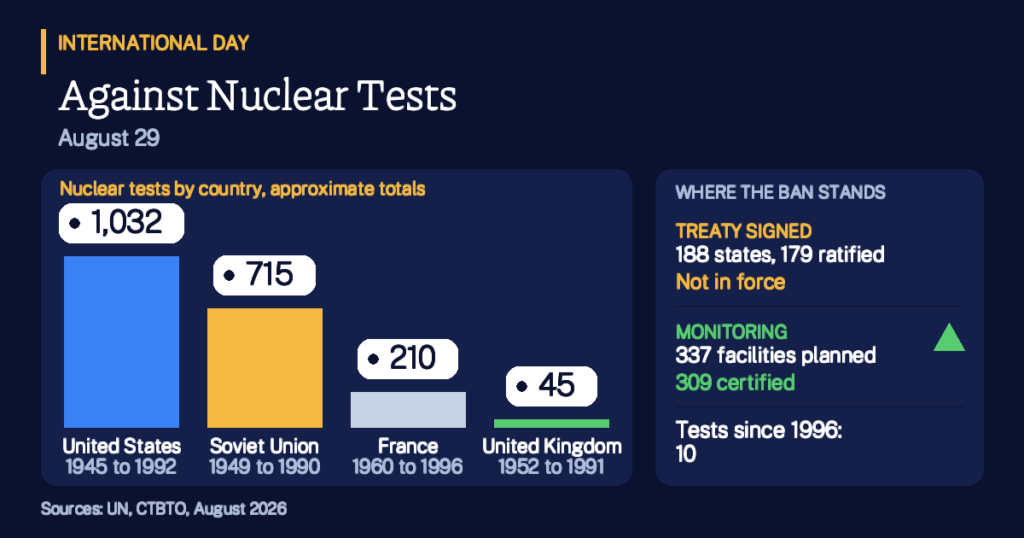
Between 1945 and 1996, the world detonated nearly 2,050 nuclear explosions, according to the Comprehensive Nuclear-Test-Ban Treaty Organization (CTBTO). Each one tested a weapon, and each one also sent a message to rivals and neighbors. The International Day against Nuclear Tests, observed every August 29, asks a simple question: after so many tests, why is the ban that would end them still not in force? It sits alongside the work described in our piece on Disarmament and Non-Proliferation Awareness Day.
Why August 29
The date is a memorial to a closure. On August 29, 1991, the Semipalatinsk nuclear test site in Kazakhstan was shut down. According to the United Nations, the General Assembly unanimously adopted resolution 64/35 on December 2, 2009, designating August 29 as the day, on the initiative of Kazakhstan, to commemorate that closure. The first observance followed in 2010.
Semipalatinsk was not a minor site. The International Atomic Energy Agency (IAEA) reports that between 1949 and 1989 the former Soviet Union conducted over 450 nuclear tests there, both in the atmosphere and underground, across a zone of about 19,000 square kilometers in the northeast of the country. The IAEA notes that testing released radiation over local Kazakh communities. Today its facilities are being converted to peaceful uses under Kazakhstan’s National Nuclear Centre.
What a nuclear test is, and why it matters
A nuclear test is a deliberate nuclear explosion carried out to develop, prove or improve a weapon. Tests do not only shape arsenals. They show a country’s technical progress, and each new test can push others to match it. That is why a ban on testing is regarded as a brake on the arms race: a weapon design that cannot be tested is harder to refine and harder to trust.
The effects reach beyond the site. According to the UN, over 500 of the tests, about a quarter of the total, took place in the atmosphere, where radioactive material can spread well beyond a test range. The UN says about 75 percent of Cold War tests were underground. Communities near test sites, including Indigenous and remote populations, carried the lasting burden of that history.
The numbers behind the day
The CTBTO counts nearly 2,050 nuclear explosions between 1945 and 1996, and notes that its figures are approximate. By its totals, the United States conducted 1,032 tests (1945 to 1992), the Soviet Union 715 (1949 to 1990), France 210 (1960 to 1996), the United Kingdom 45 (1952 to 1991) and China 45 (1964 to 1996). India carried out one test in 1974. The UN reports that from 1955 to 1989 the average was 55 tests a year, and that 1962 alone saw as many as 178.
Example 1: the pace of testing. At the Cold War average of 55 tests a year, a single decade would bring about 550 tests. Since the treaty opened in 1996, the CTBTO reports 10 tests in total: two by India and two by Pakistan in 1998, and six by North Korea between 2006 and 2017. Ten tests over roughly thirty years is about one every three years. The arithmetic is rounded and illustrative, but it shows how far the norm has held.
The treaty that is not yet in force
The Comprehensive Nuclear-Test-Ban Treaty (CTBT) was adopted by the General Assembly on September 10, 1996. It bans all nuclear explosions, for any purpose, anywhere. As of August 2026, the UN reports that 188 countries have signed it and 179 have ratified it. Yet it has not entered into force.
The reason is a built-in condition. The treaty names 44 states, known as Annex 2 states, that must all sign and ratify before it takes effect. The CTBTO says nine have not completed that step: China, Egypt, India, Iran, Israel, North Korea, Pakistan, the Russian Federation and the United States. Of these, North Korea, India and Pakistan have not signed. The UN history page also notes that the Russian Federation revoked its ratification in November 2023.
- 188countries have signed the treaty, August 2026
- 179countries have ratified it
- 44named states must all ratify before entry into force
- 9of those states have not yet ratified
Example 2: the last signature. Imagine a club of 44 members that agrees a pact will start only when every member has signed. Suppose 35 have, and 9 have not. Hundreds of outside friends may also have signed, but the pact still waits on the nine. The numbers are made up for illustration, and they mirror how the Annex 2 rule works: broad support elsewhere cannot substitute for the named states.
Listening for a test: the monitoring network
A ban is only as good as the ability to detect a violation. The treaty therefore created an International Monitoring System (IMS) of 337 facilities planned worldwide. The UN says 309 are certified and transmitting, and that the network is more than 90 percent complete. The system relies on four technologies: seismic stations that feel ground vibrations, hydroacoustic stations that listen underwater, infrasound stations that detect very low sound waves in the air, and radionuclide stations and laboratories that sample particles and gases.
Example 3: finding a location. Suppose three stations each time a ground wave and convert it to a distance: 1,000, 1,500 and 2,000 kilometers. Draw a circle of each radius around its station, and the point where the three circles meet marks the source. The distances are round and illustrative, but this is the basic logic behind locating an event from several listening posts.
Who is affected, and how the day is marked
The people who live nearest to test sites bear the longest consequences, which is why Kazakhstan, a country that lived this history, brought the resolution to the General Assembly. The UN describes the day as an occasion for symposia, conferences, exhibits, competitions, publications, lectures and media broadcasts that raise awareness of the effects of nuclear testing and the need to end it. We did not find a single annual theme published on the UN observance page, so none is stated here.
Progress rests on a norm that has largely held. The CTBTO says North Korea is the only country to have tested this century. The last tests by the original five test states came in 1990 for the Soviet Union, 1991 for the United Kingdom, 1992 for the United States, and 1996 for France and China, according to the UN. What remains is the legal step: turning a widely respected habit into binding law.
Key Takeaways
- The date marks a closure. August 29 commemorates the 1991 shutdown of the Semipalatinsk test site in Kazakhstan.
- The scale was vast. Nearly 2,050 nuclear explosions took place between 1945 and 1996, by CTBTO count.
- Testing has nearly stopped. Only 10 tests have occurred since the treaty opened in 1996, and only North Korea has tested this century.
- The treaty is widely backed but not in force. 188 states have signed and 179 have ratified, as of August 2026.
- Nine named states hold the key. Entry into force needs all 44 Annex 2 states to ratify, and nine have not.
- Detection is real. A network of 337 planned facilities, 309 certified, listens for any explosion.
- Remembering supports prevention. The day keeps the human and environmental cost of testing in public view.
How solid is this? Test counts are approximate figures from the CTBTO, and signature and ratification totals reflect the UN status as of August 2026, which can change. The Semipalatinsk figures come from an IAEA report and describe over 450 tests, not an exact count. The three worked examples use round, made-up numbers to illustrate ideas. See also the International Days hub and the International Days Calendar.
More in History