Decisions that touch billions of lives rest on a number: how many children need a school, how many homes lack clean water, how fast prices are rising. Most people never see the work behind those numbers. World Statistics Day exists to change that. It is observed on October 20, but unlike most United Nations days it arrives only once every five years: 2010, 2015, 2020 and 2025 so far, with 2030 next under the rule. That rhythm makes the day a stocktake of whether the world’s data systems are keeping pace with its problems. Statistics are the quiet infrastructure under every global goal, from the sanitation counts behind World Toilet Day to the literacy and poverty figures that guide schools and budgets.
From a Commission decision to a global day
The idea began inside the UN Statistical Commission. At its 41st session in February 2010, the Commission proposed celebrating October 20, 2010 as World Statistics Day (Decision 41/109). On June 3, 2010, the General Assembly adopted resolution 64/267, which designated that date as the first World Statistics Day under the theme “Celebrating the many achievements of official statistics.”
Five years later, resolution 69/282 designated October 20, 2015 as the second day, under the theme “Better data, better lives,” and decided to celebrate the day every five years on October 20. The 2020 observance carried the theme “Connecting the world with data we can trust.” The fourth, in 2025, was themed “Driving change with quality statistics and data for everyone” and was marked by a 24-hour webinar marathon hosted, for the first time, by the UN Regional Commissions. Because the rule is every five years, there is no observance in 2026. The next one falls on October 20, 2030.
What “official statistics” means
Official statistics are the numbers that national statistical offices and related agencies publish for public use: population counts, employment, prices, health, school enrollment, trade. What makes them official is not a stamp but a set of rules about how they are made. Those rules are the Fundamental Principles of Official Statistics, ten in all. They were first developed and adopted by the Conference of European Statisticians in 1991, adopted by the Statistical Commission in 1994, and formally endorsed by the General Assembly in resolution 68/261 on January 29, 2014.
In short, the ten principles cover relevance, impartiality and equal access; professional standards and ethics; accountability and transparency; prevention of misuse; the choice of data sources; confidentiality of individual data; public legislation; national coordination; use of international standards; and international cooperation. In his 2025 message for the day, the Secretary-General named three of them: impartiality, professionalism, and commitment to scientific principles and professional ethics.
Example 1: the confidential survey. Suppose a statistics office surveys 10,000 households about income. The confidentiality principle means no one’s answers may be passed to a tax office or a landlord, and results appear only as group totals. That promise is why a family can answer honestly, and honest answers are why the final figure, say a poverty rate of 12 percent, deserves trust. The numbers are round and illustrative.
What the numbers let us see
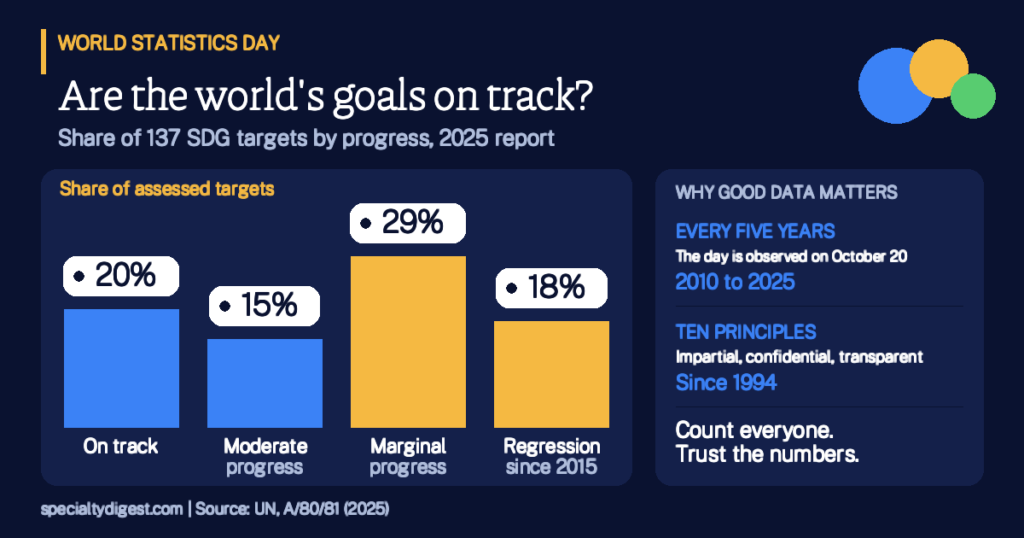
The best argument for good statistics is what they reveal. The Secretary-General’s 2025 report on the Sustainable Development Goals assessed 137 targets using data for 2025 or the latest year available. Only 35 percent were on track or showing moderate progress: 20 percent on track and 15 percent moderate. Another 29 percent showed marginal progress, 18 percent showed stagnation and 18 percent had regressed below the 2015 baseline. In the report’s words, progress on 47 percent of the targets is insufficient.
A statistic that tells you where things stand also tells you who is waiting. In 2024, 2.1 billion people lacked safely managed drinking water and 3.4 billion lacked safely managed sanitation. In 2023, 3.8 billion people were unprotected by social protection. In 2024, 754 million adults could not read, and women made up 63 percent of them.
- 137SDG targets assessed in the 2025 report
- 47%of targets with insufficient progress
- 43%of adults worldwide with official land tenure documents, 2022
- 15%of adults in sub-Saharan Africa with such documents, 2022
Example 2: the invisible district. Imagine a country whose national average says 80 percent of children finish primary school. A district-level breakdown shows one remote district at 50 percent. The average hid it. This is what disaggregated data means, and it is why the Secretary-General calls “timely, accurate, disaggregated, and independent data” more essential than ever. The figures here are illustrative.
Who is left out when data is missing
The Sustainable Development Goals have helped transform statistical systems and increase the availability of data, a point the Secretary-General made on the day in 2025. The 2025 SDG report calls the improvement in data availability a key achievement, then adds that more needs to be done because of gaps in disaggregation. It also warns that financing remains a key challenge, particularly for low- and middle-income countries facing difficulties in producing timely, high-quality data.
The gaps show up in concrete places. On learning, the report says large data gaps, especially in the early grades, prevent an assessment of broader trends in learning outcomes. On land, it finds that only 43 percent of adults worldwide held official land tenure documents as of 2022, and 15 percent in sub-Saharan Africa. What is not measured is hard to plan for, and the people missing from the numbers are often the ones with the least voice in the room.
Example 3: the clinic that was never built. Suppose a city plans one clinic for every 20,000 residents. A neighborhood of 200,000 people is counted as only 160,000 because many informal homes were missed. Planners build 8 clinics instead of 10, and 40,000 people are left without the care the plan intended. Round numbers, illustrative, but the logic is real: an undercount becomes an underinvestment.
How the day is marked and what progress needs
The day is a chance for statistical offices, international agencies, universities and schools to explain their work to the public, and the UN Statistics Division gathers contributions on its observance site. The 2025 observance combined a 24-hour global webinar cycle with messages from partners, under a theme that joins two ideas: quality, meaning data produced by the principles above, and everyone, meaning data that reaches and describes all people.
Progress rests on a short list of needs. Statistical offices need stable, adequate funding, since the SDG report names financing as a core obstacle. They need legal independence and public trust, which the Fundamental Principles protect. They need shared international standards so that figures can be compared across borders. And they need the public to ask a simple question of any number: who produced it, how, and who might be missing from it?
Key Takeaways
- The day comes every five years. Resolution 69/282 set the rhythm, with the fourth observance in 2025 and the next in 2030.
- Official statistics follow rules. Ten Fundamental Principles, endorsed by the General Assembly in 2014, govern how the numbers are made.
- Trust is the product. Impartiality, professionalism and confidentiality are what make a figure believable.
- Data shows where the world stands. In 2025, only 35 percent of assessed SDG targets were on track or moving at a moderate pace.
- Averages can hide people. Disaggregated data reveals which groups and places are being left behind.
- Counting costs money. Low- and middle-income countries face financing hurdles in producing timely, high-quality data.
- Ask about every number. Who made it, how, and who is missing from it are the questions that make you a better reader of statistics.
How solid is this? The resolution numbers, dates and themes come from the UN observance page and UN Statistics Division pages. The SDG progress shares and people counts come from the Secretary-General’s 2025 progress report and use the year named beside each figure. Some are modeled estimates that are revised over time. The 2030 date follows from the five-year rule and should be confirmed nearer the time. The three worked examples use round, made-up numbers to show an idea. See also World Toilet Day, the International Days hub and the International Days Calendar.
More in Society
- United Nations, World Statistics Day
- UN Statistics Division, 4th World Statistics Day 2025
- UN Secretary-General, message on World Statistics Day, October 20, 2025
- UN Statistics Division, Fundamental Principles of Official Statistics
- United Nations General Assembly, resolution A/RES/68/261 (2014)
- UN Secretary-General, Progress towards the Sustainable Development Goals, A/80/81 (2025)