For most of human history, cities were the exception. Today they are the rule. Around 55 percent of the world’s people live in towns and cities, and that share is still climbing. World Cities Day, observed every October 31, asks a simple question of this new reality: are our cities working for everyone who lives in them? It closes Urban October, a month of events led by UN-Habitat, the United Nations agency responsible for sustainable urbanization. It is also a natural companion to World Toilet Day, because safe sanitation is, above all, a city job.
How a day for cities began
The General Assembly designated October 31 as World Cities Day in its resolution 68/239, and the day was first celebrated in 2014. According to the United Nations, it aims to raise international awareness of urbanization trends, challenges and visions for sustainable urban development, to promote international cooperation, and to contribute to building cities that are equitable, prosperous, sustainable and inclusive.
Each year a different city hosts the global observance. Quito, Ecuador, held it in 2016, Guangzhou, China, in 2017, and Bogotá, Colombia, in 2025, the second time the global celebration was held in Latin America. Local events spread far beyond the host, from city halls and schools to neighborhood associations.
A world that tipped toward the city
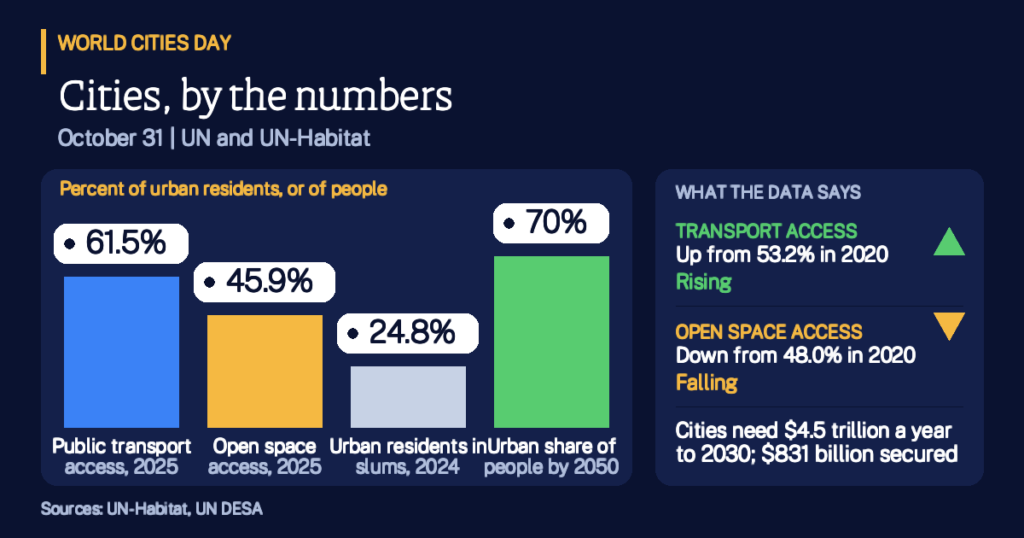
Until 2009, more people lived in rural than in urban areas. That balance has now reversed. Today around 55 percent of the world’s population lives in towns and cities, and the United Nations projects the level of urbanization to reach nearly 70 percent by 2050. The change is not only about numbers. It reshapes how food, water, jobs, energy and housing must be delivered, and it does so within a few decades.
Example 1: a country on the move. Imagine a country of 10 million people that is 55 percent urban, or 5.5 million city dwellers. If it reaches 70 percent urban with the same population, 7 million live in cities. That is 1.5 million more people needing homes, pipes, schools and bus routes. The numbers are round and illustrative, but the planning task is real.
The housing question
Housing sits at the center of city life, and it is where the strain is clearest. UN reporting for 2026 says that about 1.16 billion people, almost one in four urban residents (24.8 percent), lived in slums or informal settlements in 2024, more than 130 million more than in 2015. UN-Habitat adds that at least 3 billion people live in inadequate housing. Nearly half of households spend more than 30 percent of their income on rent, and the house-price-to-income ratio rose from 9.3 in 2010 to 11.2 in 2023.
- 1.16 billionpeople in slums or informal settlements, 2024
- 24.8%of urban residents live in them
- 3 billionpeople in inadequate housing, at least
- 11.2house-price-to-income ratio, 2023, up from 9.3 in 2010
Example 2: the rent squeeze. A household earning $1,000 a month that spends 30 percent on housing has $300 going to rent and $700 left for food, transport, school and health. If rent rises to $400, the leftover falls to $600, a drop of about 14 percent. These figures are round and illustrative, yet they show why a small rise in housing costs is felt across a whole budget.
Moving, breathing, gathering
A city also has to move people, keep its air breathable and give residents places to meet. The picture is mixed. Convenient access to public transport rose from 53.2 percent of urban residents in 2020 to 61.5 percent in 2025, though about 4 in 10 still lack it. Access to open public space, however, slipped from about 48.0 percent to 45.9 percent over the same years.
Green space tells a similar story. UN-Habitat reports that urban green space per person fell from about 57 square meters in 1990 to about 28 in 2025. Air quality has stalled as well: the 2023 global average of fine particles (PM2.5) was about 26 micrograms per cubic meter, roughly five times the WHO guideline value, and progress has largely plateaued since 2020.
Cities on the climate front line
Dense places concentrate both people and risk. UN-Habitat’s World Cities Report 2024 finds that more than 2 billion people in cities could face temperatures at least 0.5 degrees Celsius higher by 2040, and that 36 percent of the urban population could see annual mean temperatures of 29 degrees or more. About 1 billion people live in areas prone to severe river flooding as of 2025, half of them in cities. Across 2015 to 2024, disasters affected about 123 million people a year. Cities are also where much of the answer lies: compact design, shade and trees, flood-ready drainage and clean transit all work best at city scale.
The money gap
Ideas need funding. UN-Habitat estimates that cities require between $4.5 trillion and $5.4 trillion a year through 2030. In 2021 and 2022 they secured about $831 billion a year, and only about $10 billion, just over 1 percent, went to climate adaptation.
Example 3: a city’s shortfall. Suppose a city of 1 million people needs $100 million a year for transit, housing and drainage but can raise only $18 million. It covers less than a fifth of the need, so it must choose. Roughly the same proportion applies to the world’s cities as a whole, which is why the day’s calls for cooperation and new finance matter. The numbers are round and illustrative.
How the day is marked
Each global observance follows a theme. In 2025, Bogotá hosted the observance under the theme of people-centred smart cities, which puts residents, not technology, at the center of urban design. On October 31, 2026, Fuzhou, China, hosted the observance under the theme Regenerating the City: Adequate Housing for All, and held the award ceremony for the fourth cycle of the Global Award for Sustainable Development in Cities, known as the Shanghai Award. Ordinary residents can take part by joining a local planning meeting, mapping a neighborhood’s missing services, or simply asking how their own city decides where homes, parks and buses go.
- 2016Global observance hosted by Quito, Ecuador
- 2017Global observance hosted by Guangzhou, China
- 2025People-centred smart cities, hosted by Bogotá, Colombia
- 2026Regenerating the City: Adequate Housing for All, hosted by Fuzhou, China
Key Takeaways
- The world is now urban. Around 55 percent of people live in cities, heading toward nearly 70 percent by 2050.
- Housing is the pressure point. About 1.16 billion people lived in slums or informal settlements in 2024.
- Progress is uneven. Transport access improved to 61.5 percent while open-space access slipped to 45.9 percent.
- Climate risk is concentrated. Heat and flooding hit dense places hardest, and half of those in flood-prone areas live in cities.
- Money is the bottleneck. Cities need at least $4.5 trillion a year to 2030 and secured about $831 billion.
- People should come first. The 2025 and 2026 themes both point to design that serves residents, starting with a decent home.
How solid is this? Slum and housing counts are modeled estimates and are revised between reports, so earlier UN publications cite slightly different totals such as 1.12 billion. The urban share of 55 percent is stated by the United Nations without a year, and the 2050 value is a projection. The three worked examples use round, made-up numbers to show an idea. See also the International Days hub and the International Days Calendar.
More in Society
- United Nations, World Cities Day
- UN-Habitat, Urban October: World Cities Day
- UN-Habitat, press release: Bogotá to host World Cities Day 2025
- UN DESA, 2026 HLPF Factsheet on SDG 11
- UN-Habitat, SDG 11 Global Report 2026: key facts and messages
- UN-Habitat, World Cities Report 2024: key messages
- UN Statistics Division, SDG Report 2025, Goal 11