Croatia is a country in Central Europe and the Mediterranean, curved along the eastern coast of the Adriatic Sea and bordered by Slovenia, Hungary, Serbia, Bosnia and Herzegovina, and Montenegro. Its capital and largest city is Zagreb, and its population was estimated at about 3.87 million in 2024. Croatia has belonged to the European Union since 2013 and, since January 1, 2023, has used the euro and taken part in the Schengen Area, even as its recent history is still marked by the war fought over its independence in the 1990s.
Where Croatia Is Located
Croatia sits at the junction of Central Europe, the Balkan Peninsula, and the Mediterranean. Its territory forms a rough crescent, wrapping from the flat Pannonian plain in the northeast, down through hilly central regions, to a long, narrow strip of Adriatic coastline in the south and west. This shape is a legacy of medieval and early modern political borders rather than a natural divide, and it means Croatia has land neighbors on three sides while its western edge opens directly onto the sea, facing Italy across the water.
Geography and Natural Features
Croatia covers 56,594 square kilometers, according to the European Union’s official country profile. The north and east are dominated by the lowland Pannonian Basin, given over largely to agriculture, while the interior rises into the Dinaric Alps, a limestone mountain system that runs parallel to the coast. That limestone geology produces extensive karst terrain, including the tufa barriers and cascading lakes of Plitvice Lakes National Park, a UNESCO World Heritage Site since 1979 prized for the ongoing natural process by which mosses, algae, and bacteria help deposit calcium carbonate into the dams that separate its sixteen lakes.
The Adriatic coastline is one of Croatia’s defining physical features, fringed by more than a thousand islands, islets, and reefs. This coast and its offshore islands support the tourism and maritime activity that make up a significant part of the national economy, a point the World Bank identifies as central to Croatia’s services-driven growth.
A Brief History of Croatia
Croatian political identity dates to the early medieval period, when a Croatian kingdom emerged along the Adriatic and in the Pannonian interior. From the early twelfth century, Croatia entered a long personal union with Hungary, and large parts of its territory later came under Habsburg or Venetian control at different points before the modern era. Croatian lands became part of the Kingdom of Serbs, Croats and Slovenes after the First World War, a state renamed Yugoslavia in 1929. Following the Second World War, Croatia became one of six constituent republics of the Socialist Federal Republic of Yugoslavia under Josip Broz Tito.
The Breakup of Yugoslavia and the War of Independence, 1991 to 1995
As Yugoslavia’s federal structure unraveled in 1990 and 1991, Croatia held a referendum on May 19, 1991, in which a large majority of voters backed sovereignty. On June 25, 1991, the Croatian parliament, the Sabor, passed a constitutional decision on sovereignty and independence, though implementation was deferred for three months under an internationally brokered agreement, and full separation from Yugoslavia took legal effect on October 8, 1991, according to the Croatian Parliament’s own account.
This is contested and painful history, and its details are still debated by historians, courts, and the communities involved, so they are presented here as documented by international bodies rather than as a settled verdict. According to the International Criminal Tribunal for the former Yugoslavia, ethnic Serb communities in Croatia rejected the new state’s authority and, backed by the Yugoslav People’s Army and Serbia, declared control over roughly a third of Croatian territory. The fighting that followed included the shelling of Dubrovnik and the siege and destruction of Vukovar in late 1991. A UN-monitored ceasefire held through much of 1992 to 1994, but combat resumed in 1995 when Croatian forces launched offensives that retook most of the contested territory; the tribunal notes that tens of thousands of Serbs fled during this advance, and that Croats and other non-Serbs had earlier been expelled from Serb-held areas in a violent campaign. Croatia regained full administrative control of its last contested region, Eastern Slavonia, in January 1998 after a period of UN transitional administration.
Government and Economy
Croatia is a parliamentary republic. A directly elected president serves as head of state with a largely ceremonial and foreign-policy role, while executive authority rests with a prime minister who leads the government and answers to the unicameral Sabor. Croatia joined the European Union on July 1, 2013, and became the bloc’s twentieth member state to adopt the euro on January 1, 2023, the same date it joined the Schengen Area and dropped internal border checks with fellow member states, according to Croatia’s Ministry of Foreign and European Affairs.
Economically, the World Bank reports that Croatia’s GDP per capita rose from about 8,190 dollars in 2003 to 23,967 dollars in 2024, with average annual growth of 2.2 percent over that period and growth averaging 4.8 percent in the three years to 2024, outperforming both EU and eurozone averages. Services, especially tourism, are the leading sector, alongside manufacturing and agriculture, with substantial EU-funded public investment supporting recent expansion. The World Bank also flags longer-term pressures, including an aging population, continued outmigration, and regional economic disparities within the country.
Culture and People
Croatian, a South Slavic language written in the Latin alphabet, is the sole official language. The population is predominantly Roman Catholic, a legacy of Croatia’s long historical ties to Central European and Mediterranean Catholic culture rather than the Orthodox Christian sphere that shaped much of the rest of the former Yugoslavia. National identity is closely tied to the Adriatic coast and its walled historic towns, to a strong choral and folk music tradition recognized in several UNESCO intangible cultural heritage listings, and to a distinct regional diversity between the Mediterranean-influenced coast and the more Central European interior.
What Croatia Is Known For
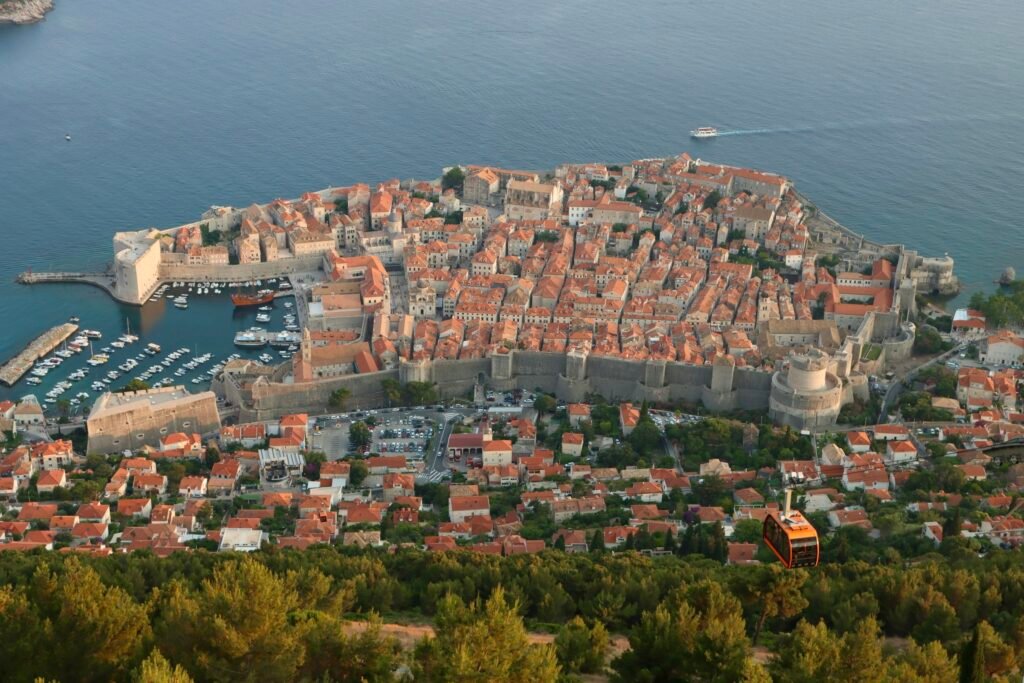
Internationally, Croatia is best known for the fortified medieval port city of Dubrovnik, whose stone walls and Gothic, Renaissance, and Baroque architecture earned it UNESCO World Heritage status in 1979 as, in UNESCO’s words, an outstanding example of a late medieval fortified city. The 1667 earthquake and damage sustained during the 1990s conflict both prompted major restoration campaigns, and the Old City was placed on the List of World Heritage in Danger between 1991 and 1998 before being removed once repairs were complete. Alongside Dubrovnik, Plitvice Lakes National Park is Croatia’s other UNESCO World Heritage Site and its best known natural landmark, along with the country’s broader Adriatic coastline and island chain.
Why Croatia Matters Globally
Croatia matters as a case study in postwar European integration: a country that emerged from a violent breakup of Yugoslavia in the 1990s to become a full member of the European Union, the eurozone, and the Schengen Area within three decades. Its Adriatic coast makes it a significant node in Mediterranean tourism and maritime trade, and its dual UNESCO heritage, cultural in Dubrovnik and natural in Plitvice, gives it an outsized profile in global conservation and heritage policy relative to its population of under four million. Its economic trajectory, tracked closely by the World Bank and EU institutions, is also often cited as a comparative reference point for other small, tourism-dependent economies inside the eurozone.
Key Takeaways
- Location: Croatia lies in Central Europe and the Mediterranean, on the eastern Adriatic coast, bordering Slovenia, Hungary, Serbia, Bosnia and Herzegovina, and Montenegro.
- Population and capital: Its population was estimated at about 3.87 million in 2024, with Zagreb as capital and largest city.
- EU and eurozone member: Croatia joined the European Union in 2013 and adopted the euro and joined the Schengen Area on January 1, 2023.
- Independence: Croatia declared independence from Yugoslavia in June 1991 and completed the legal separation that October, after a war that lasted until 1995.
- UNESCO heritage: The Old City of Dubrovnik and Plitvice Lakes National Park have both been UNESCO World Heritage Sites since 1979.
- Economy: GDP per capita nearly tripled between 2003 and 2024, with tourism and services leading recent growth.
Sources
- World Bank | Croatia Overview | 2025 | https://www.worldbank.org/en/country/croatia/overview | Accessed September 22, 2026
- UNESCO World Heritage Centre | Old City of Dubrovnik | Undated | https://whc.unesco.org/en/list/95/ | Accessed September 22, 2026
- UNESCO World Heritage Centre | Plitvice Lakes National Park | Undated | https://whc.unesco.org/en/list/98/ | Accessed September 22, 2026
- Državni zavod za statistiku (Croatian Bureau of Statistics) | Population Estimate of the Republic of Croatia, 2024 | August 29, 2025 | https://podaci.dzs.hr/2025/en/97254 | Accessed September 22, 2026
- Ministry of Foreign and European Affairs of the Republic of Croatia | Euro and Schengen: Croatia Joins the Euro and Schengen Areas | 2023 | https://mvep.gov.hr/euro-and-schengen-croatia-joins-the-euro-and-schengen-areas/253035 | Accessed September 22, 2026
- European Union | Croatia Country Profile | Undated | https://european-union.europa.eu/principles-countries-history/eu-countries/croatia_en | Accessed September 22, 2026
- International Criminal Tribunal for the former Yugoslavia | The Conflicts | Undated | https://www.icty.org/en/about/what-former-yugoslavia/conflicts | Accessed September 22, 2026
- Hrvatski sabor (Croatian Parliament) | 25 June: Independence Day | Undated | https://www.sabor.hr/en/about-parliament/history/important-dates/25-june-independence-day | Accessed September 22, 2026
Key facts
- Croatia's population was estimated at about 3.87 million in 2024, with Zagreb as capital and largest city.4
- Croatia joined the European Union on July 1, 2013, and adopted the euro and joined the Schengen Area on January 1, 2023.56
- Croatia declared independence from Yugoslavia on June 25, 1991, with full legal separation taking effect on October 8, 1991, after a war that lasted until 1995.87
- The Old City of Dubrovnik and Plitvice Lakes National Park have both been UNESCO World Heritage Sites since 1979.23
- Croatia's GDP per capita rose from about 8,190 dollars in 2003 to 23,967 dollars in 2024, according to the World Bank.1
Quick checkWhen did Croatia join the European Union, and when did it adopt the euro?Show answer
Croatia joined the European Union on July 1, 2013. It adopted the euro and joined the Schengen Area on January 1, 2023, becoming the bloc's twentieth eurozone member.
Sources
- World Bank. Croatia Overview. 2025 (accessed 2026-09-22)
- UNESCO World Heritage Centre. Old City of Dubrovnik. Undated (accessed 2026-09-22)
- UNESCO World Heritage Centre. Plitvice Lakes National Park. Undated (accessed 2026-09-22)
- Drzavni zavod za statistiku (Croatian Bureau of Statistics). Population Estimate of the Republic of Croatia, 2024. 2025-08-29 (accessed 2026-09-22)
- Ministry of Foreign and European Affairs of the Republic of Croatia. Euro and Schengen: Croatia Joins the Euro and Schengen Areas. 2023 (accessed 2026-09-22)
- European Union. Croatia Country Profile. Undated (accessed 2026-09-22)
- International Criminal Tribunal for the former Yugoslavia. The Conflicts. Undated (accessed 2026-09-22)
- Hrvatski sabor (Croatian Parliament). 25 June: Independence Day. Undated (accessed 2026-09-22)
Editorially reviewed by Specialty Digest Editorial TeamLast reviewed September 22, 2026Researched and drafted with AI assistanceReport an issue