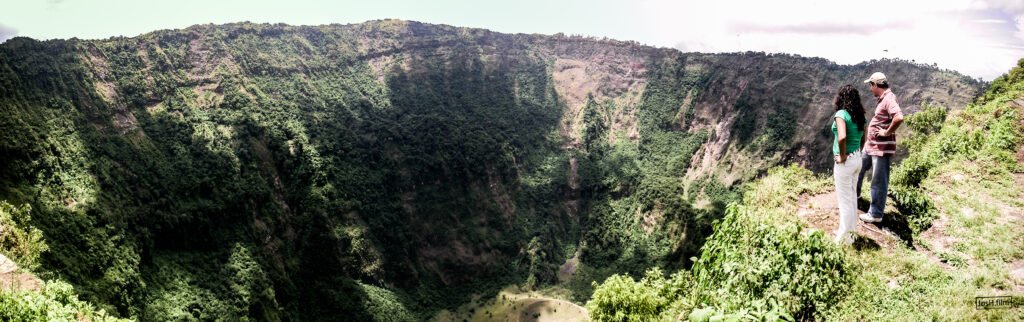
El Salvador is the smallest country in Central America and the only one without a Caribbean coastline, facing the Pacific Ocean along its entire southern border. Despite its size, it is the most densely populated country on the Central American mainland, with a landscape dominated by volcanoes that has earned it the nickname “the Land of Volcanoes.”
Where Is El Salvador Located?
El Salvador sits on the Pacific coast of Central America, bordered by Guatemala to the northwest and Honduras to the north and east. Its entire southern edge runs along the Pacific Ocean, and unlike its Central American neighbors, it has no Atlantic or Caribbean coastline.
Geography of El Salvador
A chain of volcanoes runs through the country as part of the Central American Volcanic Arc, a section of the Pacific Ring of Fire. El Boqueron, a large volcanic crater on the San Salvador Volcano overlooking the capital, is one of the country’s most recognizable natural features and remains active, having last erupted in 1917. Between the coastal lowlands and the northern highlands lies a central plateau where most Salvadorans live, drained by the Lempa River, the country’s longest.
A Brief History of El Salvador
Before Spanish colonization, the region was home to the Pipil, a Nahua-speaking people, along with Lenca and Maya communities. The archaeological site of Joya de Ceren, a farming village buried and preserved by a volcanic eruption around 600 CE, is sometimes called the “Pompeii of the Americas” and is recognized by UNESCO as a World Heritage Site for its exceptionally well-preserved view of everyday Mesoamerican life.
Spain colonized the territory in the sixteenth century, and El Salvador declared independence in 1821, briefly joining the Mexican Empire before becoming part of the Federal Republic of Central America until that union dissolved in 1841. The twentieth century was marked by a brutal civil war from 1979 to 1992 between the government and the Farabundo Marti National Liberation Front, which ended with the Chapultepec Peace Accords. In 2001, El Salvador adopted the United States dollar as legal tender alongside its own currency, a step toward closer economic integration with the United States.
Government and Economy
El Salvador is a presidential republic with a unicameral legislature. According to the World Bank, it has a small, dollarized economy with a population of about six million people that is closely tied to the United States through trade and remittances. The World Bank reports that since 2022 the government has pursued fiscal and macroeconomic reforms, including sovereign debt buybacks and a 40-month Extended Fund Facility agreement with the International Monetary Fund approved in February 2025, alongside a security effort that sharply reduced crime and helped boost investor confidence.
Culture and People
Spanish is the official language, and the population is a mix of mestizo, Indigenous, and European heritage, with Roman Catholic and evangelical Christian traditions both widely practiced. Remittances from Salvadorans living abroad, particularly in the United States, make up a substantial share of the national economy and reflect decades of migration driven by the civil war and, more recently, by economic opportunity.
What Is El Salvador Known For?
El Salvador is known for its dense concentration of volcanoes, its Pacific surf beaches, and its early adoption of the US dollar. Joya de Ceren gives it a distinctive place among Mesoamerican archaeological sites, while El Boqueron, the volcanic crater above San Salvador, is the country’s most visited and photographed natural landmark.
Why El Salvador Matters
As the most densely populated country in mainland Central America, El Salvador illustrates both the pressures and the resilience of a small, volcanically active nation navigating civil conflict, dollarization, and, more recently, an aggressive push to overhaul its economy and security situation, changes the World Bank has flagged as reshaping investor confidence in the country.
Key Takeaways
- El Salvador is the smallest Central American country and the only one with no Caribbean coastline.
- El Boqueron, a volcanic crater on the San Salvador Volcano, overlooks the capital and is the country’s best-known natural landmark.
- Joya de Ceren, a Maya farming village preserved by volcanic ash around 600 CE, is a UNESCO World Heritage Site.
- A 1979 to 1992 civil war ended with the Chapultepec Peace Accords.
- El Salvador adopted the US dollar as legal tender in 2001 and remains closely tied to the US economy through trade and remittances.
Sources
- World Bank, El Salvador Overview
- UNESCO World Heritage Centre, Joya de Ceren Archaeological Site
- Encyclopaedia Britannica, El Salvador
Key facts
Quick checkWhat UNESCO World Heritage Site preserves a Maya farming village buried by a volcanic eruption?Show answer
Joya de Ceren, sometimes called the Pompeii of the Americas.
Sources
- World Bank. El Salvador Overview. 2025-10-06 (accessed 2026-09-23)
- UNESCO World Heritage Centre. Joya de Ceren Archaeological Site. Undated (accessed 2026-09-23)
- Encyclopaedia Britannica. El Salvador. Undated (accessed 2026-09-23)
Editorially reviewed by Specialty Digest Editorial TeamLast reviewed September 23, 2026Researched and drafted with AI assistanceReport an issue