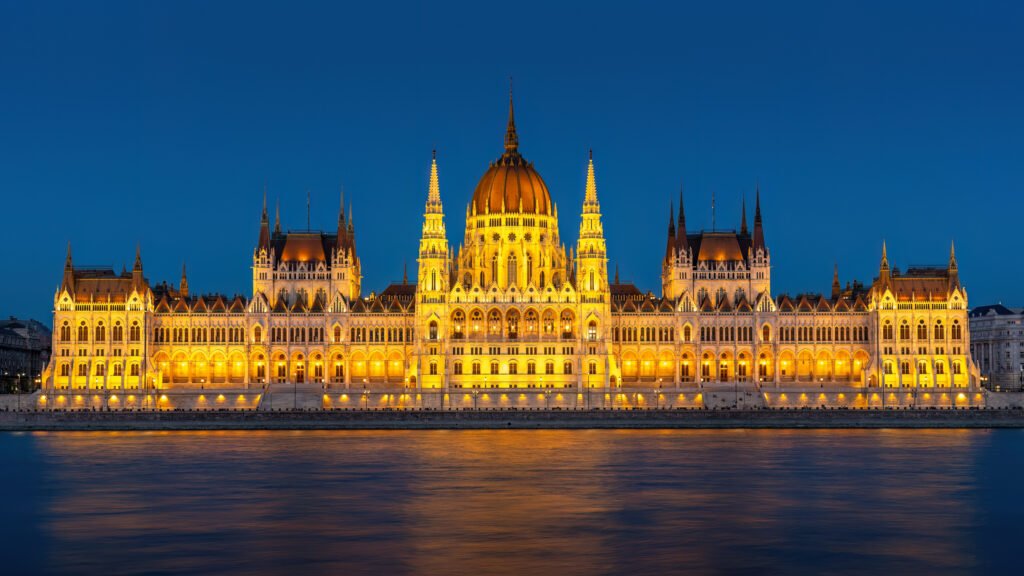
Hungary is a landlocked country in Central Europe, crossed by the Danube River and centered on its capital, Budapest. It shares borders with seven countries, has belonged to both NATO and the European Union since the late 1990s and early 2000s, and speaks a language unrelated to any of its neighbors. With a population of roughly 9.5 million, according to the European Union’s official country profile, Hungary is a mid-sized European state whose influence, from music and science to Cold War history, has consistently outweighed its size.
Where Is Hungary Located?
Hungary lies in the Carpathian Basin of Central Europe, with no direct access to the sea. It is bordered by Austria to the west, Slovakia to the north, Ukraine to the northeast, Romania to the east, and Serbia, Croatia, and Slovenia to the south and southwest, according to the European Union’s official country profile. The country covers approximately 93,012 square kilometers, most of it low-lying plain.
Two rivers define Hungary’s geography. The Danube flows south through the country and directly through Budapest, splitting the capital into the hilly Buda side and the flat Pest side. The Tisza, Hungary’s other major river, crosses the Great Hungarian Plain, known as the Alfold, which occupies much of the country’s eastern and southern territory. West of the Danube lies Transdanubia, a region of low hills, vineyards, and Lake Balaton, described by the European Union’s Earth observation service as the largest lake in Central Europe, with a surface area of about 600 square kilometers.
A Brief History of Hungary
From the Magyar Conquest to the Kingdom of Hungary
The Magyars crossed the Carpathian Mountains into the Danube basin around 895 CE, according to Encyclopaedia Britannica, settling a territory that would become their permanent homeland. Hungary’s statehood formally began on Christmas Day in the year 1000, when Stephen I was crowned its first Christian king. His coronation, Britannica notes, marked Hungary’s entry into the family of European Christian nations, and Stephen used the church as the organizing institution of the new kingdom, founding bishoprics, ordering church construction, and building a standing army. He is remembered as the founder of the Hungarian state and is venerated as the country’s patron saint.
The medieval Kingdom of Hungary grew into one of the larger states of Central Europe, but its independence ended at the Battle of Mohacs in 1526, when Ottoman forces defeated the Hungarian army and killed its king. The following century and a half saw Hungary divided among Ottoman, Habsburg, and semi-independent Transylvanian rule, and by the late seventeenth century the Habsburg monarchy in Vienna had absorbed the entire kingdom.
Trianon, War, and Communism
Hungary’s borders and identity were redrawn twice in the twentieth century. After World War I and the collapse of Austria-Hungary, the Treaty of Trianon, signed on June 4, 1920, stripped Hungary of at least two-thirds of both its prewar territory and its population, according to Britannica, a loss still felt in Hungarian politics and in the large Hungarian-speaking minorities that remain in neighboring countries. Hungary fought World War II as an Axis ally before falling under Soviet occupation, and a communist government took power by the late 1940s.
That government fell into open crisis in October 1956, when a popular uprising against Soviet-backed rule broke out in Budapest. Reform Prime Minister Imre Nagy briefly led a government that withdrew from the Warsaw Pact, but the Soviet Union reversed course and launched a full military invasion on November 4, 1956, crushing the revolt within days, according to the National Security Archive at George Washington University. The 1956 Hungarian Revolution became one of the defining episodes of the Cold War, illustrating the limits of Western intervention behind the Iron Curtain. Communist rule continued under Janos Kadar until the political reforms of the late 1980s, and Hungary transitioned to multiparty democracy in 1989 as Soviet influence collapsed across the region.
Government and Economy
Hungary is a parliamentary republic. A prime minister leads the government and holds executive power, while a president fulfills largely representative duties, according to the European Union’s country profile. The country is divided into 19 counties plus the capital, Budapest, and 25 cities with county-level status.
Hungary joined NATO on March 12, 1999, alongside Poland and the Czech Republic, and became a member of the European Union on May 1, 2004, later joining the Schengen passport-free travel area in December 2007. Hungary still uses its own currency, the Hungarian forint, and has not adopted the euro, though the European Union describes the country as preparing to do so.
Hungary’s economy was valued at about $246 billion in 2025, according to World Bank data, smaller than that of its western EU peers: its 2023 GDP per capita of roughly €29,400 sits below the EU average of €38,100. Unemployment has stayed relatively low, near 4.5%, while inflation and public debt, at roughly 82% of GDP, remain persistent concerns for policymakers.
People and Culture
The great majority of Hungary’s population identifies as ethnically Hungarian and speaks Hungarian, a Uralic language related not to the Indo-European languages of its neighbors but distantly to Finnish and Estonian and more closely to the Ob-Ugric languages of western Siberia, according to Britannica. That linguistic isolation has reinforced a strong sense of distinct national identity across a thousand years of shifting borders and foreign rule.
Hungary’s cultural output has been disproportionate to its population. Thirteen Nobel Prize laureates were born in Hungary, according to the Hungarian Academy of Sciences, spanning physics, chemistry, medicine, economics, and literature, including biochemist Katalin Kariko, whose research underpinned mRNA vaccine technology and earned her the 2023 Nobel Prize in Physiology or Medicine. Composers Franz Liszt and Bela Bartok, both born in the Kingdom of Hungary, remain central figures in the history of Western classical and folk-derived music.
What Is Hungary Known For?
Internationally, Hungary is best known for Budapest, its capital straddling the Danube, and for the eight sites within its borders inscribed on the UNESCO World Heritage List. These include the banks of the Danube together with the Buda Castle Quarter and Andrassy Avenue in Budapest, the Tokaj Wine Region, the Hortobagy grasslands known as the Puszta, the Caves of Aggtelek Karst, the Benedictine Abbey of Pannonhalma, the Early Christian Necropolis at Pecs, the village of Holloko, and the cultural landscape around Lake Ferto. Hungary is also closely associated with a strong classical music tradition and, more recently, with outsized contributions to physics, chemistry, and biomedical research relative to its size.
Why Hungary Matters Globally
Hungary’s location in the Carpathian Basin has made it a historical crossroads between Western and Eastern Europe, a position that shaped centuries of Ottoman, Habsburg, and Soviet influence and that continues to inform its politics as a member of both NATO and the European Union. Its history offers one of the clearest case studies of Cold War-era resistance to Soviet rule, and its scientific and cultural contributions, concentrated in a country of under 10 million people, have shaped fields from music to medicine well beyond its borders.
Key facts
- Hungary covers about 93,012 square kilometers and had a population of roughly 9.5 million in 20251
- Hungary joined NATO on March 12, 19994
- Hungary became a member of the European Union on May 1, 20041
- Eight sites in Hungary are inscribed on the UNESCO World Heritage List2
- Thirteen Nobel Prize laureates were born in Hungary7
Quick checkWhen was the Kingdom of Hungary founded, and by whom?Show answer
The Hungarian state was founded on Christmas Day, 1000 CE, when Stephen I was crowned its first Christian king.
Sources
- European Union. Hungary - EU country profile. Undated (accessed 2026-09-23)
- UNESCO World Heritage Centre. States Parties: Hungary. Undated (accessed 2026-09-23)
- World Bank. Hungary. 2025 data (accessed 2026-09-23)
- NATO. Hungary and NATO. Undated (accessed 2026-09-23)
- National Security Archive, George Washington University. The Hungarian Revolution, 1956. Undated (accessed 2026-09-23)
- European Union Space Programme (Copernicus). Lake Balaton, Hungary. Undated (accessed 2026-09-23)
- Hungarian Academy of Sciences (MTA). Hungary's Nobel Prize Winners. Undated (accessed 2026-09-23)
- Encyclopaedia Britannica. Hungary. Last updated 2026-09-22 (accessed 2026-09-23)
- Encyclopaedia Britannica. Stephen I, king of Hungary. Undated (accessed 2026-09-23)
- Encyclopaedia Britannica. Treaty of Trianon. Undated (accessed 2026-09-23)
- Encyclopaedia Britannica. Uralic languages. Undated (accessed 2026-09-23)
Editorially reviewed by Specialty Digest Editorial TeamLast reviewed September 23, 2026Researched and drafted with AI assistanceReport an issue