Almost every country that has lifted large numbers of people out of poverty has, at some point, learned to make things at scale. Factories turn crops into food products, ore into metal and ideas into goods that can be sold anywhere. Africa Industrialization Day, observed every year on November 20, asks the world to help the African continent do the same, on its own terms and for its own people. It is less a celebration than a yearly checkup on a long project: building enough industry to create good jobs, keep more value at home and make economies steadier.
A day born in 1989
The idea came from African leaders themselves. According to the United Nations, the Organization of African Unity held its 25th Ordinary Session of the Assembly of Heads of State and Government in Addis Ababa, Ethiopia, in July 1989, and Africa Industrialization Day was announced for November 20 during that session. In December 1989 the UN General Assembly proclaimed November 20 as Africa Industrialization Day in resolution A/RES/44/237. The UN describes the purpose as mobilizing the commitment of the international community to the industrialization of Africa.
The day sits inside a larger framework. The UN says it was set within the Second Industrial Development Decade for Africa, which ran from 1991 to 2000. On July 25, 2016, the General Assembly proclaimed 2016 to 2025 as the Third Industrial Development Decade for Africa, and the UN Industrial Development Organization, known as UNIDO, was tasked with leading its implementation. Since 2018 the day has been marked with weeklong events. The UNIDO Director General has also written of an upcoming Fourth Industrial Development Decade for Africa, 2026 to 2035.
What industrialization really means
Industrialization is not just building smokestacks. It means moving an economy toward making and processing goods, so that more of each product’s value is created close to where it starts. Economists track this with a measure called manufacturing value added, or MVA: the value a factory creates by turning inputs into something worth more than the sum of its parts. A country that ships out raw cocoa earns one price. A country that grinds, blends and packs it into chocolate earns more, and also employs the people who do the work.
Example 1: the cashew gap. Suppose a country exports 100 tons of raw cashew nuts at $1,000 a ton, earning $100,000. If local factories shell, roast and pack the same nuts and sell them at $3,000 a ton, the revenue is $300,000. The extra $200,000 pays wages, equipment suppliers and local services. These numbers are round and illustrative, but this is the logic behind the push for industrialization.
The numbers behind the day
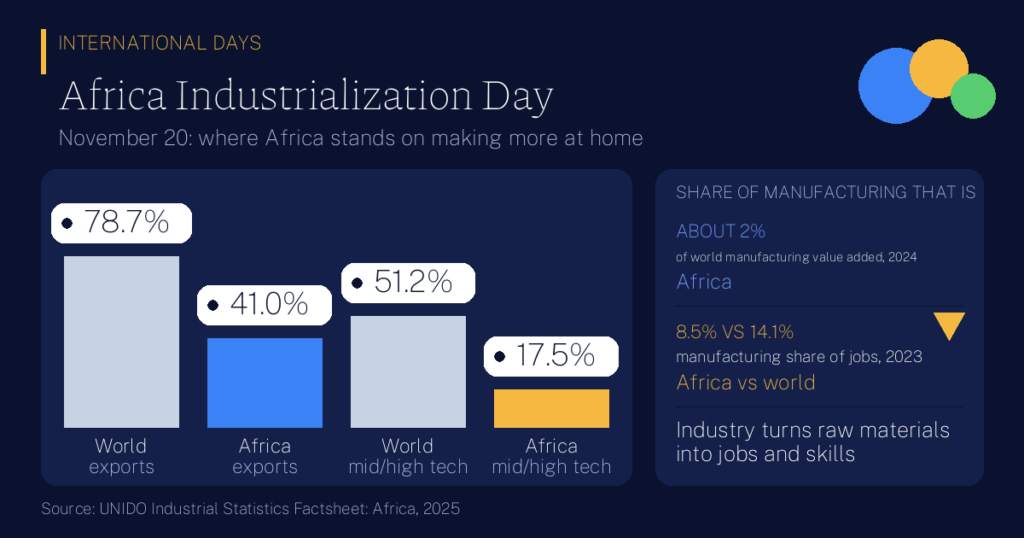
Africa is a continent of many economies at very different stages, so any average hides variety. Still, the picture drawn by UNIDO’s statistics is consistent. Manufacturing accounts for just over 10 percent of GDP across the continent, according to the UNIDO Director General in 2025. In 2024, Africa accounted for about 2 percent of global manufacturing value added, according to UNIDO’s 2025 Africa factsheet. Manufactured goods made up 41.0 percent of the region’s merchandise exports in 2024, compared with 78.7 percent for the world, and Africa’s manufactured exports were around 1.4 percent of global exports.
- 2%of global manufacturing value added, 2024
- 41.0%of African merchandise exports are manufactured goods, 2024
- 8.5%of African employment is in manufacturing, 2023
- 45.6%of the manufacturing workforce are women, 2023
The quality gap
What a continent makes matters as much as how much. UNIDO groups industries by technology level. In 2023, medium and high technology industries, such as machinery, vehicles and chemicals, made up 17.5 percent of Africa’s manufacturing value added, compared with 51.2 percent worldwide. In 2024, such goods were 35.3 percent of Africa’s manufactured exports, against 62.0 percent for the world. Higher technology sectors have grown only 1.8 percent since 2015, according to the factsheet. These sectors tend to pay more and spread skills, so the gap is a central part of the argument for deeper industrialization.
Example 2: the export gap. Imagine an economy that sells $10 billion of goods abroad each year, 40 percent of them manufactured, which is $4 billion. If processing at home lifted that share to 50 percent, manufactured exports would reach $5 billion with no change in total sales. The numbers are made up and rounded, but they show why the mix of exports matters as well as their size.
Jobs, young people and women
Industry is also a question of work. UNIDO’s factsheet reports that manufacturing employment in Africa has grown almost 35 percent since 2015, yet manufacturing still provided 8.5 percent of employment in 2023, against 14.1 percent worldwide. Women made up 45.6 percent of the manufacturing workforce that year. The UNIDO Director General notes that many African countries have a median age under 20 years, which means a very large number of young people will be looking for work in the coming years. Factories, food processing plants and workshops are among the places where steady wages can be found at scale.
Example 3: counting the missing jobs. Picture a country with 10 million workers. At Africa’s 8.5 percent, manufacturing employs 850,000 people. At the world’s 14.1 percent, it would employ 1.41 million. The difference is 560,000 jobs. The figures are round and illustrative, and real countries vary widely, but they show how a few percentage points translate into many livelihoods.
Why it matters beyond Africa
A more industrial Africa is not only Africa’s concern. Supply chains that rely on a few regions are fragile, and new production centers can make the global economy more resilient. Stronger local industry also means more reliable supplies of medicines, food products and building materials close to those who need them. The UN’s own framing links industrialization to financing and investment from both public and private sectors, a point the Secretary-General’s 2026 message makes directly.
How the day is marked
Events happen around the world, and since 2018 they have stretched into a week. Africa Industrialization Week 2025 was held in Kampala, Uganda, from November 17 to 21 with the theme “Transforming Africa’s Economy through Sustainable Industrialization, Regional Integration and Innovation.” It included the fourth edition of the African Women in Processing Forum and the first African Youth Start-ups Forum. An earlier observance, in 2023, focused on the empowerment of African women in processing for an integrated market, according to the African Union.
Key Takeaways
- The day began with African leaders. It was announced in July 1989 and proclaimed by the General Assembly in December 1989.
- Industrialization means keeping more value at home. Processing goods locally turns raw materials into wages and skills.
- The gap is large. Africa produced about 2 percent of world manufacturing value added in 2024.
- Exports tell the story. Manufactured goods were 41.0 percent of African exports in 2024, against 78.7 percent worldwide.
- Technology level matters. Medium and high technology industries were 17.5 percent of African manufacturing in 2023, against 51.2 percent worldwide.
- Jobs are the human stake. Manufacturing employment has grown almost 35 percent since 2015, and a very young population needs more.
- A new decade is coming. A Fourth Industrial Development Decade for Africa, 2026 to 2035, is expected.
How solid is this? Statistics come from UNIDO’s 2025 Africa factsheet, which mixes data years, and from the UNIDO Director General’s 2025 article. The factsheet’s summary box and text show slightly different figures for Africa’s world share, so this article rounds to about 2 percent. The three worked examples use round, made-up numbers. Explore the International Days hub and the International Days Calendar.
More in Society
- United Nations, Africa Industrialization Day, 20 November
- United Nations, Africa Industrialization Day messages, including the Secretary-General’s 2026 message
- UNIDO, Industrial Statistics Factsheet: Africa, 2025
- Africa Renewal, Africa’s industrial future is within reach (UNIDO Director General), 2025
- African Union, Africa Industrialization Day 2023 joint statement