Some of the most consequential decisions in a girl’s life are made when she is still a child, and not by her. Marriage before the age of 18 ends schooling for many, raises the risks of early pregnancy, and narrows the future. UNICEF calls it a fundamental violation of human rights. This day is new. The United Nations General Assembly created it only in September 2026, and November 27 is its first observance. It joins a family of days about children and gender equality, including World Children’s Day and the International Day for the Elimination of Violence against Women.
How a new day was born
On September 4, 2026, during the 114th plenary meeting of its eightieth session, the General Assembly took up a draft resolution titled “International Day for the Elimination of Child, Early and Forced Marriage” (document A/80/L.99). Fatima Maada Bio, First Lady of Sierra Leone, introduced it. The resolution was adopted without a vote, according to UN records, and proclaims November 27 of each year as the day.
The decision did not come from nowhere. All 193 UN member states have already agreed to end child marriage by 2030 under target 5.3 of the Sustainable Development Goals, according to UNFPA. A dedicated day gives that promise a yearly moment of public attention. We have not been able to read the operative text of the resolution, so this article does not describe which bodies are asked to lead the observance. Check the official resolution for those details.
What the three words mean
The title uses three terms that overlap but are not identical. A child marriage is a marriage or informal union in which at least one partner is under 18. An early marriage is often used for the same situation, and also for unions of people who have reached the legal age but are not mature enough to choose freely. A forced marriage is one in which at least one person did not give free and full consent, at any age. A single case can be all three at once.
The data discussed below mostly describe women aged 20 to 24 who were first married or in union before age 18, a measure UNICEF collects through household surveys and censuses. It counts informal unions as well as formal weddings, which is why UNFPA speaks of girls who are “formally married or in an informal union.”
The numbers behind the day
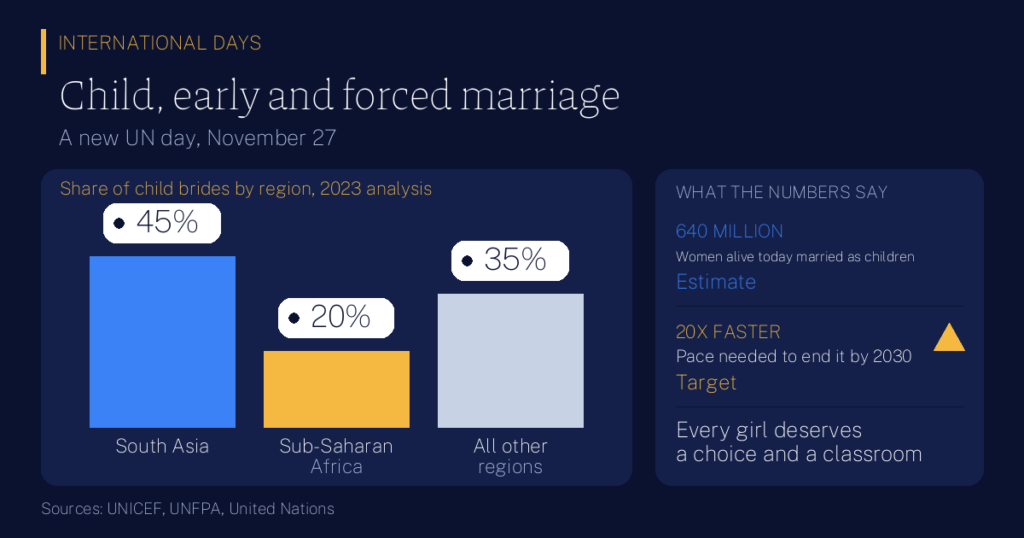
UNICEF’s 2023 analysis, with data up to 2022, estimated that about 640 million girls and women alive today were married in childhood, and that 12 million girls are married each year. UNFPA reports that around one girl in five is married or in union before 18, and that about four percent are married before 15.
The long trend is better than most people assume. UNFPA says that about 25 years ago roughly one in three young women reported being married as a child, and that by 2021 this had dropped to around one in five. It also reports that 68 million child marriages were averted over the last 25 years.
Example 1: a village of a thousand girls. Suppose a district has 1,000 girls in the age group in question. At the global share of 19 percent, about 190 of them would be married before 18. At the share reported around 2000, about 330 would have been. The numbers are round and illustrative, but the gap of roughly 140 girls shows what a quarter century of slow progress means in practice.
Where it happens
Child marriage is a global practice, but it is concentrated. UNICEF’s 2023 analysis found that South Asia accounts for nearly half of all child brides, at 45 percent, and sub-Saharan Africa for 20 percent. The center of gravity has been moving. In 2019 UNICEF noted that close to one in three recent child brides lived in sub-Saharan Africa, against one in seven 25 years earlier, because South Asia’s risk fell from nearly 50 percent a decade earlier to about 30 percent.
Why it matters
Marriage in childhood rarely arrives alone. UNICEF has noted, for example, that in Ethiopia married adolescent girls are three times more likely to be out of school. Early marriage and early pregnancy are linked, and a girl who leaves school loses the years of learning that raise her earnings and her say in family decisions.
Poverty, insecurity, social norms and weak laws all push families toward the decision. UNICEF’s 2019 fast facts note that in the United States the majority of states still allow an exception in law for marriage under 18, which shows that legal gaps are not only a problem of poorer countries. Crises make things worse: UNICEF found that the COVID-19 pandemic cut the number of child marriages averted since 2020 by one quarter.
Example 2: one classroom. Imagine a class of 40 girls in a country at the global average. About 8 of them, one in five, would marry before 18. If even half of those stay in school because a family has support and the law is enforced, 4 more girls finish their studies. The figures are round and illustrative, and real outcomes vary, but they show why small shifts matter.
Is 2030 still possible?
Progress is real, but the pace is far too slow. UNICEF said in 2023 that global reductions would have to be 20 times faster to end child marriage by 2030. At the current pace, it estimated South Asia would need about 55 years and sub-Saharan Africa over 200 years. UNFPA adds that the total number of child marriages is projected to rise by 2030 because of population growth and the effects of COVID-19.
Example 3: the arithmetic of speed. Say a country has 19 percent of its girls married as children and cuts the rate by one percentage point every five years. It would take 95 years to reach zero. Make progress 20 times faster and each point takes three months, so the same task takes under five years. The numbers are illustrative, but they show what the word “twenty times faster” asks of governments.
The cost of acting is modest compared with the stakes. A 2019 study by UNFPA with Johns Hopkins University estimated that ending child marriage in 68 countries, covering about 90 percent of the world’s child marriages, would cost $35 billion by 2030.
What the day asks of us
A new day is an invitation to act, not a celebration. Governments can set and enforce a minimum marriage age of 18 without exceptions, register births and marriages, and keep girls in school. Communities and faith leaders can shift norms. Families can be supported with cash and services, so that marriage is not the only answer to hardship. Anyone who is concerned about a girl at risk can contact local child protection services, a national child helpline, or the nearest UNICEF or UNFPA country office.
Key Takeaways
- The day is new. The General Assembly established it on September 4, 2026, and November 27 is its first observance.
- The scale is large. About 640 million girls and women alive today were married in childhood, and 12 million girls marry each year.
- The trend is encouraging. The share fell from about one in three to about one in five over roughly 25 years.
- It is concentrated. South Asia has 45 percent of child brides and sub-Saharan Africa 20 percent.
- The pace is too slow. UNICEF says progress must be 20 times faster to end the practice by 2030.
- The costs of marriage are lasting. Lost schooling, early pregnancy and fewer choices shape a whole life.
- Action is affordable. A 2019 estimate put the cost of ending it in 68 countries at $35 billion by 2030.
How solid is this? Global totals are modeled estimates from UNICEF and UNFPA and are revised with each update, and UNFPA’s page does not state a year for its headline figures. The UNICEF 2019 and 2023 figures come from different estimates and should not be read as one series. We could not read the full text of the resolution, so the date of November 27 rests on UN press and photo records and the UN observances calendar. The three worked examples use round, made-up numbers. See also the International Days hub and the International Days Calendar.
More in Society
- United Nations, General Assembly press release GA/12779, September 4, 2026
- United Nations Photo, General Assembly adopts resolution on the International Day for the Elimination of Child, Early and Forced Marriage, 2026
- United Nations, International Days and Weeks
- UNICEF, Global polycrisis creating uphill battle to end child marriage, May 2023
- UNICEF, 10 facts illustrating why we must #EndChildMarriage, 2019
- UNFPA, Child marriage (updated February 2025)
- UNICEF Data, Child marriage