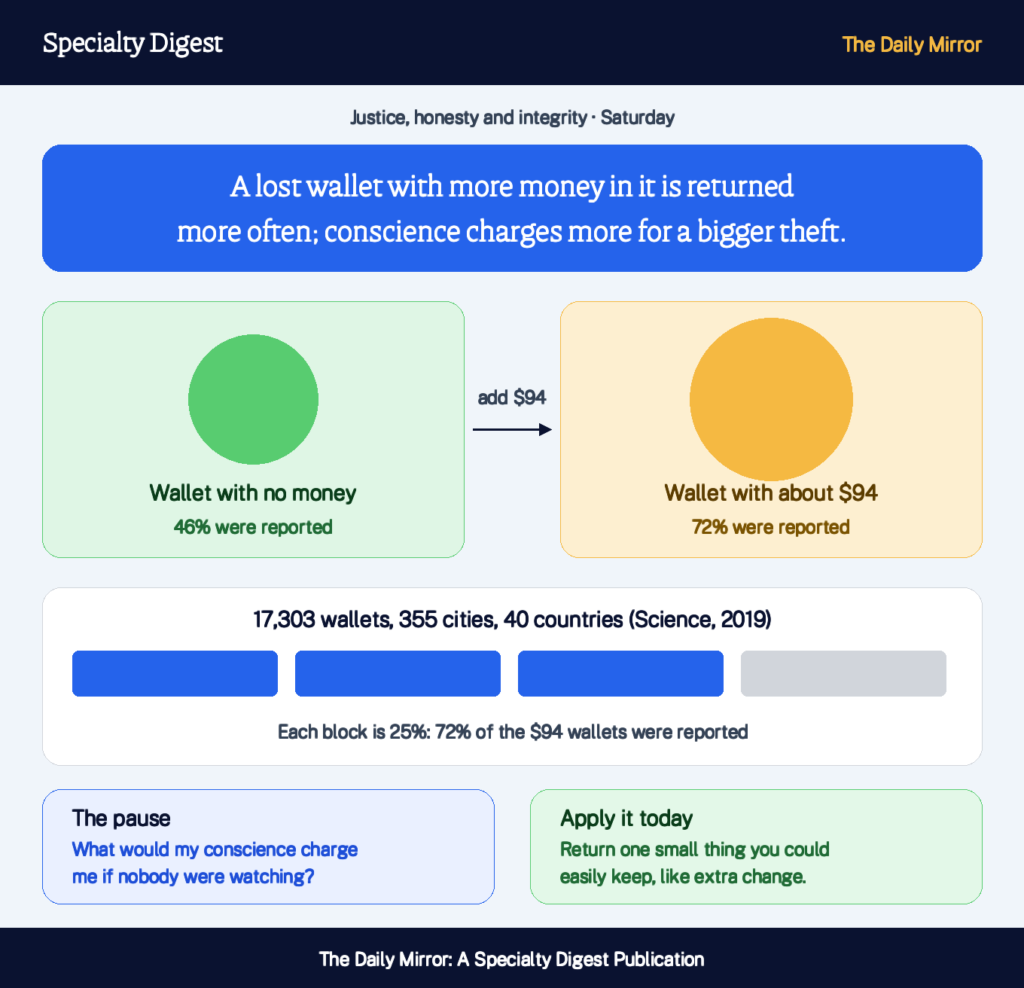
A lost wallet with more money in it is returned more often; conscience charges more for a bigger theft.
The Daily Mirror: A Specialty Digest Publication
Conscience charges more for bigger theft: in a 40-country experiment, lost wallets holding more money were reported more often, not less. Most people would rather stay honest than see themselves as thieves.
The mirror
A wallet lies on a bus seat and the whole row goes quiet. Every passenger can see it, and each is quietly working out what keeping it would cost: the cash, and the voice that follows you home. We assume that voice loses when the sum is big. In practice it often raises its price.
The fact behind it
In a 2019 study in Science, researchers from the Universities of Michigan, Zurich and Utah handed in 17,303 apparently lost wallets at banks, hotels, post offices, museums and police stations in 355 cities across 40 countries. In 38 of the 40 countries, wallets with money were reported more often than empty ones. Where a larger sum was tested (the United States, the United Kingdom and Poland), the share reported rose from 46 per cent with no money to 61 per cent with about US$13 and 72 per cent with about US$94.
Honesty was far from universal: average return rates ranged from 14 to 76 per cent between countries, and the wallets were handed to staff at institutions, not found on a street. The authors explain the pattern by finders not wanting to see themselves as thieves, plus concern for the owner. Read more on why integrity matters on International Anti-Corruption Day, on acting on the inner voice and on how trust is built on a team.
The pause
What would my conscience charge me today if nobody were watching?
Apply it today
Return one small thing you could easily keep: extra change, a borrowed pen, an item a shop forgot to charge for.
The Daily Mirror: A Specialty Digest Publication.
More in Society
- Cohn, A., Maréchal, M. A., Tannenbaum, D. and Zünd, C. L. Civic honesty around the globe. Science, 365(6448), 70-73, 2019.
- University of Zurich. The Richer the Pickings, the more Honest the People. UZH News, media release, 20 June 2019.