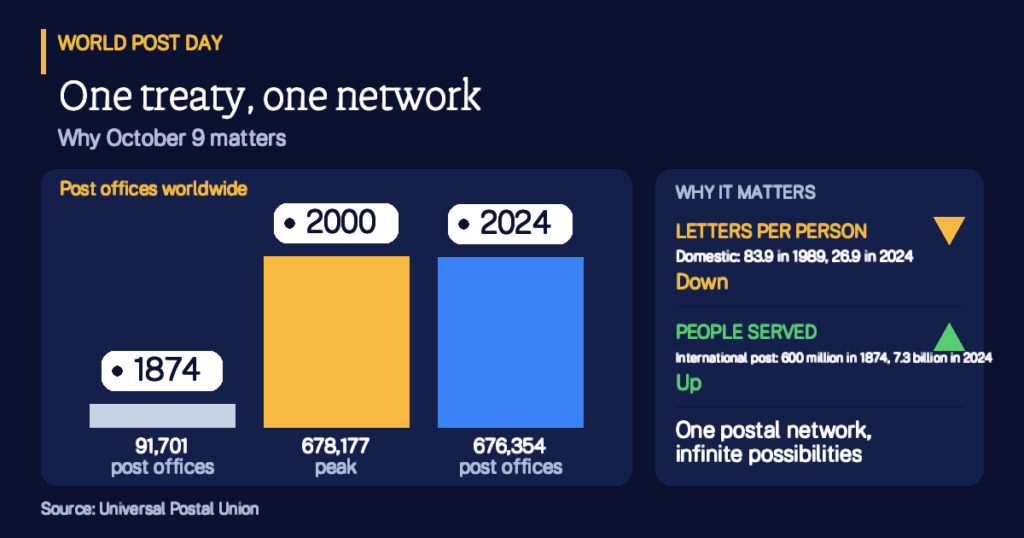
A letter is easy to take for granted. You write an address, drop the envelope in a box, and a stranger on the other side of the world finds the right door. That small miracle rests on a treaty. World Post Day, observed every year on October 9, marks the day in 1874 when nations agreed to treat their separate mail systems as one. It honors the carriers, clerks and sorters who keep that promise, and it asks a fair question for the digital age: what is a postal network still for? The numbers suggest the answer is more than most people expect. For a related story about moving money across borders, see International Day of Family Remittances.
One treaty, one territory
Before 1874, sending a letter abroad meant a patchwork of agreements between pairs of countries, each with its own rates, routes and rules. On October 9, 1874, 22 countries gathered in Berne, Switzerland, and signed the Treaty of Berne, creating the General Postal Union. The UPU describes the founders’ vision as a single postal territory serving people everywhere. In 1878 the name changed to the Universal Postal Union. In 1948 it became a specialized agency of the United Nations, and it is still based in Berne. Today it unites the postal networks of 192 member countries.
The day itself came later. The UPU says the 1969 Universal Postal Congress in Tokyo declared October 9 World Post Day to mark the anniversary of the Union’s creation. In 2024, the 150th anniversary year, the theme was “150 years of enabling communication and empowering peoples across nations.” The 2026 theme is “One postal network, infinite possibilities,” with the UPU’s annual celebrations held on October 9, 2026.
What “universal” really means
The word is a promise, not a slogan. A universal postal network aims to reach every address, including remote, rural and underserved areas, at a price people can afford. Few institutions are present in as many communities. According to the UPU’s State of the Postal Sector 2024 report, international postal services served 7.3 billion people in 2024, up from 600 million in 1874, a twelvefold increase. Nearly 4.5 million people worked in postal services worldwide in 2024.
Example 1: the village parcel. Imagine a weaver in a mountain village who sells scarves to a buyer in a distant city. No private courier serves the village, but the post does, and the parcel travels for a few dollars. The numbers are round and illustrative. The point is that the weaver’s market is no longer limited to the nearest town, because a universal network carries the parcel to an address the weaver has never seen.
The numbers behind the network
The physical network is huge and, surprisingly, steady. The UPU counts 91,701 post offices in 1874, a peak of 678,177 in 2000, and 676,354 in 2024. Yet populations have grown. In 1880 there was one post office for every 5,971 inhabitants. By 2022 that figure was 10,581.
What moves through those offices has changed. Domestic letters per person peaked at 83.9 items in 1989 and fell to 26.9 in 2024. International letters dropped from 7.7 billion items in 1989 to 1.0 billion in 2024. Parcels tell a different story. Domestic parcels reached 40.2 billion in 2024, and the UPU links that growth to e-commerce. International parcels were 291.6 million in 2024, below the 2019 peak of 796.4 million. Only about 0.7 percent of parcels and 0.5 percent of letters cross a border, which means the post is overwhelmingly a local and national service.
Why it matters: the economics of a connected world
A network that touches nearly every community is also an economic asset. The UPU’s 2024 report cites research (Anson et al., 2023) estimating that, without postal services, a country’s GDP would decline by a median of 7 percent. That is a modeled estimate, not a measured loss, but it signals how deeply delivery is woven into trade and daily life. The same report finds wide gaps in postal development. On the UPU’s development index, the global median score is 43.0 and the African median is 21.0, while Switzerland and Germany each score 108.6.
More than mail: the post as a bank
In many places the post office is also where people save. The first postal savings account was opened in the United Kingdom in 1861, according to the World Bank. By 2013 the World Bank noted that over a billion people used the postal sector for savings and deposit accounts. Its Gallup survey of more than 65,000 adults in 60 economies with postal banking, conducted in 2011, found that 12 percent of adults had a post office account. About 3 percent had a post office account only, which was 6 percent of all account holders. In Brazil, more than 10 million bank accounts were opened between 2002 and 2011 after the post set up its Banco Postal service.
- 1 billion+people used postal savings and deposits, World Bank, 2013
- 12%of adults held a post office account, 60 economies, 2011
- 6%of account holders had only a post office account, 2011
- 10 million+accounts opened in Brazil’s postal bank, 2002 to 2011
Example 2: the patient saver. Picture a farm worker who lives hours from the nearest bank branch but a short walk from the post office. She deposits $10 a month. After a year she holds $120 that is safe from theft and easy to reach. These numbers are round and illustrative. For households without a nearby bank, a counter with a stamp and a ledger can be the first step into formal finance.
Who may be left behind
A global average hides local gaps. As the number of inhabitants per post office has grown, access depends on where a person lives. The African median development score of 21.0 is half the global median of 43.0, which hints at how uneven postal services still are. International parcels, the traffic most tied to global trade, are also still below their 2019 peak.
Example 3: counting the distance. Suppose a country of 100 million people has 20,000 post offices, or one for every 5,000 residents. A neighboring country of the same size with 10,000 offices has one for every 10,000, close to the 2022 world figure of 10,581. The numbers are round and illustrative, but they show how the same service can feel near in one place and far in another.
How the day is marked, and what comes next
Each year the UPU holds celebrations at its headquarters and runs a social media campaign, and postal operators around the world join in. The themes show how the Union frames its mission.
- 2024150 years of enabling communication and empowering peoples across nations
- 2026One postal network, infinite possibilities
The data point to a clear task. A network built for letters must keep earning its place by carrying parcels, offering financial services and reaching places others skip. Its 150-year record suggests that shared rules, not any single technology, are what make that possible.
Key Takeaways
- One treaty made one network. On October 9, 1874, 22 countries signed the Treaty of Berne, and 192 countries are UPU members today.
- The day dates to 1969. The Universal Postal Congress in Tokyo declared October 9 World Post Day.
- Reach is the point. International postal services served 7.3 billion people in 2024, up from 600 million in 1874.
- The offices endure. There were 676,354 post offices in 2024, close to the 2000 peak of 678,177.
- Letters fell, parcels rose. Domestic letters per person dropped from 83.9 to 26.9 while domestic parcels reached 40.2 billion.
- The post is also a bank. Postal savings reached over a billion people by the World Bank’s 2013 count.
- Access is uneven. The African median development score is 21.0 against a global 43.0, so the promise of universal service is still being built.
How solid is this? Postal statistics come from the UPU’s State of the Postal Sector 2024, which gives slightly different post office totals in its text and in one table, so this article uses the text figures. The 7 percent GDP effect is a modeled estimate. The postal banking figures date from 2011 and 2013 and are older than the rest. The three worked examples use round, made-up numbers to show an idea. See also the International Days hub and the International Days Calendar.
More in Society