Every day, billions of people decide what to believe. A message arrives, a video autoplays, a headline appears, and within seconds we judge whether it is true, who sent it and what to do next. Most of us were never taught how to make those decisions well. Global Media and Information Literacy Week, held each year from October 24 to 31, exists to change that. It treats the ability to find, judge and create information as a basic life skill, as important in the modern world as reading and arithmetic. It also pairs naturally with the International Day for Universal Access to Information, because access means little if people cannot tell reliable information from noise.
How a UNESCO tradition became a UN week
UNESCO has promoted media and information literacy, often shortened to MIL, for many years, and it supports countries with curricula, policy guidelines and an assessment framework. The week became an official United Nations observance in 2021, when the General Assembly decided to commemorate it, in resolution A/RES/75/267. The UN describes the week as a major occasion for stakeholders to review and celebrate progress toward “Media and Information Literacy for All.”
The resolution gives a clear reason. It stresses the need for factual, timely, targeted, clear, accessible, multilingual and science-based information. It also recognizes that the digital divide and data inequalities between countries, and within them, can be addressed in part by improving people’s competencies. In other words, building skills is treated as part of closing the gap, not as an extra.
What the term actually means
Media and information literacy sounds technical, but the idea is simple. The UN describes it as the ability to access, search, critically assess, use and contribute content wisely, both online and offline. Notice that the list runs in two directions. The first part is about receiving information well. The last part is about making it, because today almost everyone is also a publisher, whether through a post, a photo or a forwarded message.
Example 1: the shared screenshot. Imagine a family group chat receives a screenshot claiming a local clinic will close next week. A literate reader pauses on step three. Who posted it? Is there a date, a named official, a link to the clinic’s own page? A two-minute check turns a rumor into a decision to call the clinic. The scenario is made up, but the habit of pausing to ask where a claim came from is the heart of the subject.
Why the skills gap is wider than the access gap
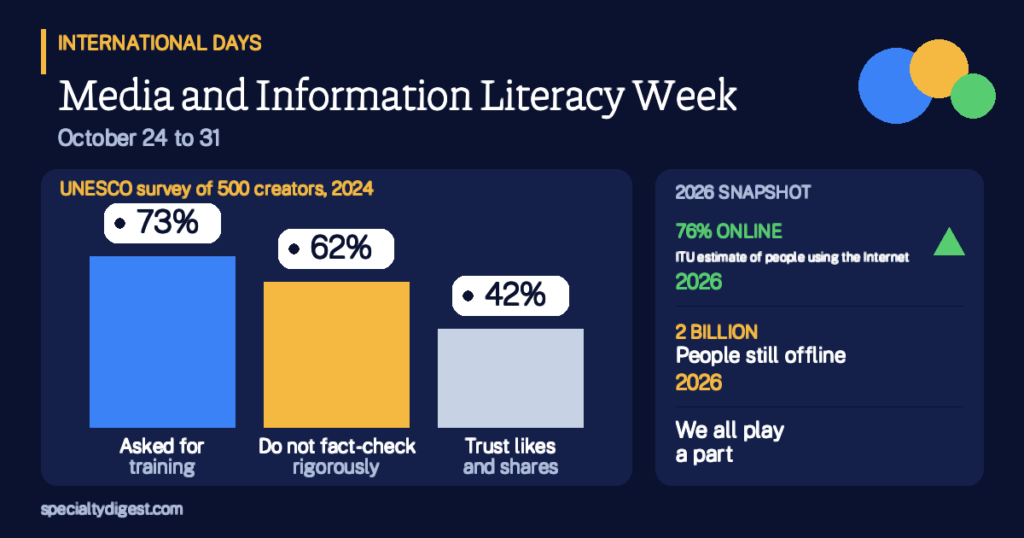
Literacy only helps if people are connected, and many still are not. The International Telecommunication Union (ITU) estimates that 6.3 billion people, or 76 percent of the world’s population, use the Internet in 2026, up from a revised 6.1 billion, or 74 percent, in 2025. About 2 billion people remain offline. Use is far from even: 82 percent of urban residents are online, compared with 63 percent in rural areas, and 93 percent of people in high-income countries use the Internet, against 32 percent in low-income countries.
These gaps matter for literacy in two ways. People offline may lack timely, accessible information in their own language. People online, meanwhile, face a flood of content with little guidance on how to sort it. The week speaks to both, which is why the resolution links skills to the digital divide.
Creators, the new gatekeepers
One of the most revealing recent studies looked at the people who now shape public attention. In 2024, UNESCO published the “Behind the screens” survey, described as the first global analysis of digital content creators’ motivations, practices and challenges, carried out with a research team at Bowling Green State University. It surveyed 500 influencers in 45 countries. It found that 62 percent do not carry out rigorous and systematic fact-checking before sharing information, yet 73 percent asked for training.
The survey is a reminder that literacy is not only about the audience. A creator with a large following who skips a check can spread an error far wider than a single reader could. It also found that about a third of respondents, 32.3 percent, reported being targeted by hate speech, and only 20.4 percent reported it to the platform. UNESCO and the Knight Center for Journalism in the Americas have built a four-week global course in response, and UNESCO reported that more than 9,000 people from 160 countries enrolled.
Example 2: the creator’s checklist. Suppose a creator with 10,000 followers shares a health claim without checking it, and 1 in 10 followers passes it on to 5 friends each. That is 1,000 people forwarding it to 5,000 more, from one unchecked post. The numbers are round and illustrative, but they show why a habit that takes two minutes can matter at scale.
How the week is marked in 2026
The 2026 theme is “We All Play a Part: Media and Information Literacy for the People.” It brings together educators, journalists, young people, policymakers, digital creators, parents and civil society. UNESCO describes a decentralized, participatory approach, with regional and thematic events organized by its offices and partners around the world. Flagship gatherings include sessions on digital content creators in Nairobi, formal education in New Delhi, policymakers in Bishkek, and MIL Cities in Dubrovnik and Al Rayyan. The UNESCO Youth Hackathon, which drew more than 1,200 teams from 138 countries in 2025, also continues, with winning teams invited to present in Thessaloniki, Greece, from November 26 to 28, 2026.
You do not need a conference to take part. Anyone can use the week to practice a few habits: read past the headline, check who published a claim, look for a second independent source, and think before forwarding. Teachers can run a class on spotting misleading images, and families can talk about how each person decides what to trust.
Example 3: a classroom week. Picture a class of 30 students that checks 3 viral claims each, one per day over 3 days, with each student reporting where they found a second source. That produces 90 small investigations in a single week and gives every student practice at the habit. The figures are made up for illustration, but this is the kind of everyday activity the week encourages.
Key Takeaways
- The week runs October 24 to 31. The UN General Assembly decided in 2021 to commemorate it, in resolution A/RES/75/267.
- Literacy has five parts. Access, search, assess, use and contribute, online and offline.
- Access is not evenly shared. ITU estimates 76 percent of people are online in 2026, with about 2 billion offline.
- Place and income matter. Internet use is 82 percent in cities and 63 percent in rural areas, and 93 percent in high-income countries against 32 percent in low-income ones.
- Creators need support too. In UNESCO’s 2024 survey of 500 influencers, 62 percent did not fact-check rigorously and 73 percent wanted training.
- The 2026 theme is shared effort. “We All Play a Part” asks educators, families, creators and officials to each do their share.
- Start with a pause. Ask who made a message, why, and on what evidence before you share it.
How solid is this? Internet use figures are ITU estimates for 2026 and are revised each year. The creator survey covers 500 influencers and describes them, not the general public. The three worked examples use round, made-up numbers to show an idea. See also the International Days hub and the International Days Calendar.
More in Education
- United Nations, Global Media and Information Literacy Week
- UNESCO, Global Media and Information Literacy Week
- UNESCO, Global Media and Information Literacy Week 2026
- UNESCO, Digital content creators survey press release (2024)
- UN News, Digital content creators and fact-checking (2024)
- ITU, Facts and Figures 2026 press release