Most crimes leave a scene. Cybercrime leaves a trail of logs, wallets and servers that may sit in three different countries at once. A thief in one place can empty an account in another, using computers in a third, and no single police force can follow the whole path alone. International Anti-Cybercrime Day, marked on December 24, exists because of that gap. It asks the world to understand cybercrime, to protect itself, and to back the first global treaty built to close the gap. It sits naturally beside the International Day for the Prevention of and Fight against All Forms of Transnational Organized Crime, since much online crime is organized and crosses borders.
Why December 24
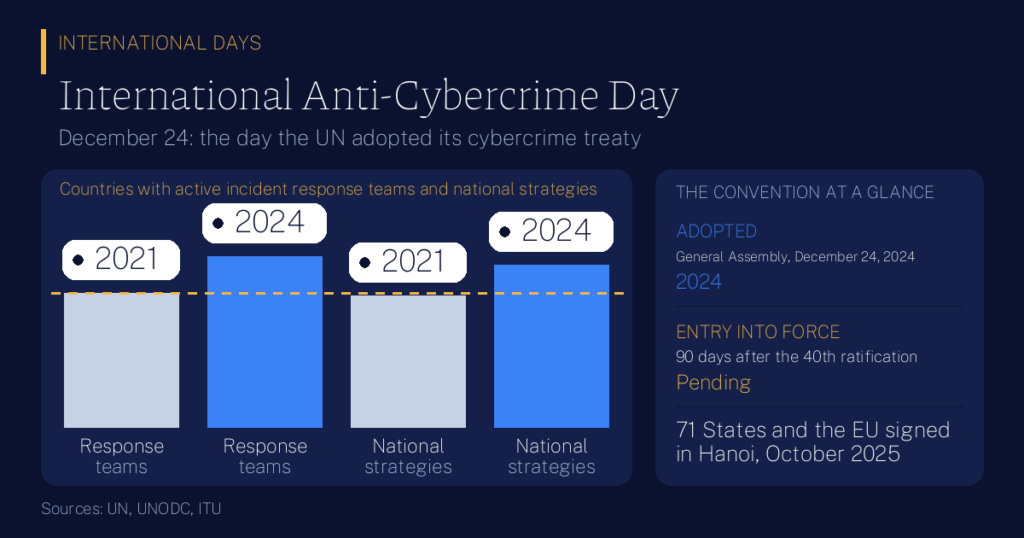
The date is a birthday. On December 24, 2024, in New York, the UN General Assembly adopted a new convention to prevent and combat cybercrime, ending a five-year negotiation. It adopted the resolution without a vote. UNODC, the UN agency for drugs and crime, describes what followed on its list of international days: to raise awareness of cybercrime and of the role of the Convention in preventing and combating it, the General Assembly designated December 24 as International Anti-Cybercrime Day in 2024, in resolution 79/243.
UNODC’s Ghada Waly called the adoption a major victory for multilateralism and the first international anti-crime treaty in 20 years. The treaty then opened for signature in Hanoi, Viet Nam, at a ceremony on October 25 and 26, 2025, hosted by Viet Nam with UNODC.
What counts as cybercrime
Experts split the field in two. Cyber-dependent crimes cannot exist without computers, such as breaking into a network or spreading ransomware. Cyber-enabled crimes are old offenses that technology has made faster and wider, such as fraud, extortion and the exploitation of children. UN News describes the new treaty as covering a range of both kinds. In practice the two blur: a phishing email (cyber-enabled fraud) often delivers software that locks a hospital’s files (cyber-dependent attack).
Example 1: the small shop. Imagine a family bakery whose owner clicks a link in a fake delivery notice. Criminals copy the login to the shop’s bank account and move $8,000 within hours, through accounts in several countries. The numbers are round and illustrative. The owner has no way to chase money across borders, and the local police cannot demand records from a foreign bank without a path for cooperation. Making that path faster is a central aim of the treaty.
What the treaty does
According to UN News, the Convention criminalizes a range of cyber-dependent and cyber-enabled offenses, makes it easier to share electronic evidence across borders, and sets up a 24/7 cooperation network among States. It is also described as the first international treaty to recognize the non-consensual sharing of intimate images as an offense. The General Assembly said it aims to strengthen international cooperation and to provide technical assistance and capacity-building, particularly for developing countries.
Two practical facts follow. First, a treaty binds only States that join. It enters into force on the ninetieth day after the fortieth instrument of ratification, acceptance, approval or accession is deposited (article 65). Second, signing is a promise of intent, not the finish line. Secretary-General António Guterres said at Hanoi that the world must now turn signatures into action, and that no country, whatever its level of development, should be left defenseless against cybercrime.
The numbers: how ready is the world
The best global yardstick of preparedness is the International Telecommunication Union’s Global Cybersecurity Index. Its 2024 edition, released on September 12, 2024, sorted countries into five tiers across five pillars: legal, technical, organizational, capacity development and cooperation. Only 46 countries reached the top tier, called Role-Modelling, while 105 sat in the middle tiers of Establishing and Evolving.
There is real progress under the surface. Compared with the 2021 index, more countries now have an active computer incident response team, a national strategy and trained professionals. ITU also reports that Africa advanced the most since 2021.
Where the gaps are
Rules are spreading faster than results. The same ITU release reports that 177 countries have at least one data protection, privacy or breach notification regulation in force or in progress, and 92 percent of countries (166) report taking part in an international treaty or comparable cooperation mechanism. Yet children show the gap between law and action: 164 countries have legal measures for child online protection, while only 94 report matching strategies and initiatives.
- 177countries with a data protection or privacy rule in force or in progress, 2024
- 164countries with legal measures for child online protection, 2024
- 94countries that also report strategies and initiatives for it, 2024
- 152countries running cyber awareness initiatives for the public, 2024
Example 2: the cross-border request. Suppose a hospital in a small country is locked out of its records by ransomware, and the server used sits abroad. Without a shared channel, the request for logs might take weeks of letters between ministries. With a 24/7 contact point on each side, the same request could be started in a day. The timings are round and illustrative, but they show why the treaty creates a standing network and not only a list of crimes.
Who is left behind
Cybercrime does not spare the poor, but the poor are often the least equipped to respond. A country without a trained response team, a forensic laboratory or up-to-date laws cannot answer a foreign request for help, and criminals know it. This is why the Convention stresses technical assistance and capacity-building for developing countries. The people who bear the cost are ordinary: workers whose pay is stolen, older adults tricked by a convincing call, and young people whose private images are shared without consent.
Example 3: the trained team. Imagine a country with no incident response team. After a training program it staffs one with ten people. In its first year it handles, say, 200 reports that previously went unanswered. The numbers are made up for illustration, yet they capture the point of capacity-building: each trained team becomes a place where victims, banks and foreign police can send a request.
How to mark the day
You can use December 24 as a personal security checkup. Turn on multi-factor authentication for email and banking. Use a different password for every important account, kept in a password manager. Install updates promptly. Pause before you click or pay: confirm unexpected requests through a channel you already trust. If something goes wrong, report it quickly to your bank and to your national police or computer emergency response team, and keep screenshots. Anyone whose private images have been shared without consent can seek support from trusted local victim services and ask platforms to remove the content.
Key Takeaways
- The day marks a treaty. December 24 is the date the General Assembly adopted the UN Convention against Cybercrime in 2024.
- Crime without borders needs cooperation. The Convention covers cyber-dependent and cyber-enabled offenses and sets up a 24/7 cooperation network.
- Signing is not enough. It enters into force 90 days after the 40th ratification, and 71 States and the EU had signed in Hanoi by October 2025.
- Preparedness is uneven. Only 46 countries reached ITU’s top tier in 2024.
- Progress is real. Countries with active response teams grew from 109 in 2021 to 139 in 2024.
- Children need more than laws. 164 countries have legal measures, but only 94 report matching strategies.
- Everyone has a part. Strong passwords, multi-factor sign-in and a pause before paying stop many attacks.
How solid is this? Treaty facts come from UN pages and may change as States ratify. Signature counts differ by source and date: UN News reported 65 signatures on the first day, while the UN Office of Legal Affairs reports 71 States and the EU at the ceremony, and this article uses the latter. UNODC describes the day as designated in 2024 by resolution 79/243; check the resolution text for how it recurs. ITU figures are self-reported by countries for 2024. The three worked examples use round, made-up numbers. See also the International Days hub and the International Days Calendar.
More in Society
- UN General Assembly. UN General Assembly adopts landmark convention on cybercrime (24 December 2024).
- UN General Assembly. Resolution A/RES/79/243 (31 December 2024).
- UN Office of Legal Affairs. The United Nations Convention against Cybercrime opens for signature in Hanoi (2025).
- UN News. Sixty-five nations sign first UN treaty to fight cybercrime (25 October 2025).
- UNODC. International Days.
- UNODC. United Nations Convention against Cybercrime.
- International Telecommunication Union. Global Cybersecurity Index 2024 (12 September 2024).