Every culture is a long conversation between people and the places they live: what to eat, how to greet a stranger, how to mourn, which stories to tell children. Multiply that by thousands of communities and you get the diversity this day celebrates. The World Day for Cultural Diversity for Dialogue and Development, observed every year on May 21, asks a practical question as well as a poetic one. If differences are a shared asset, how can societies use them to talk, to solve problems and to build prosperity, rather than letting them harden into distrust? The United Nations answers with one word, dialogue. The day pairs naturally with the International Day for Tolerance, which approaches the same hope through everyday behavior.
From a declaration to a day
The story starts at UNESCO, the UN agency for education, science and culture. On November 2, 2001, it adopted the Universal Declaration on Cultural Diversity in Paris. Article 1 calls cultural diversity “the common heritage of humanity.” In December 2002 the UN General Assembly, in resolution 57/249, declared May 21 the World Day for Cultural Diversity for Dialogue and Development.
A declaration states principles. A treaty binds the countries that join it. UNESCO took the second step on October 20, 2005, when it adopted the Convention on the Protection and Promotion of the Diversity of Cultural Expressions. Under its Article 29, the Convention entered into force on March 18, 2007.
What “cultural diversity” really covers
It is not only museums and costume festivals. Cultural diversity includes languages, food, music, crafts, religious practice, ways of settling disputes and ways of raising children. The 2005 Convention speaks of the “diversity of cultural expressions,” meaning the many ways groups and individuals create, share and enjoy cultural goods and services. Diversity exists within societies as well as between them, and every country has some.
The two other words in the day’s name matter too. Dialogue means exchange on equal terms, where each side can speak and be heard. Development means that culture is both a goal in itself and a driver of progress, from jobs to social trust.
Example 1: the clinic and the languages. Imagine a city of 100,000 people where 8,000 residents speak a language the local clinic cannot serve. Roughly 8 in every 100 patients may then struggle to describe symptoms or understand treatment. Hiring interpreters for the largest language groups is a small cost that turns diversity into a service strength. The numbers are round and illustrative.
The numbers: languages at risk
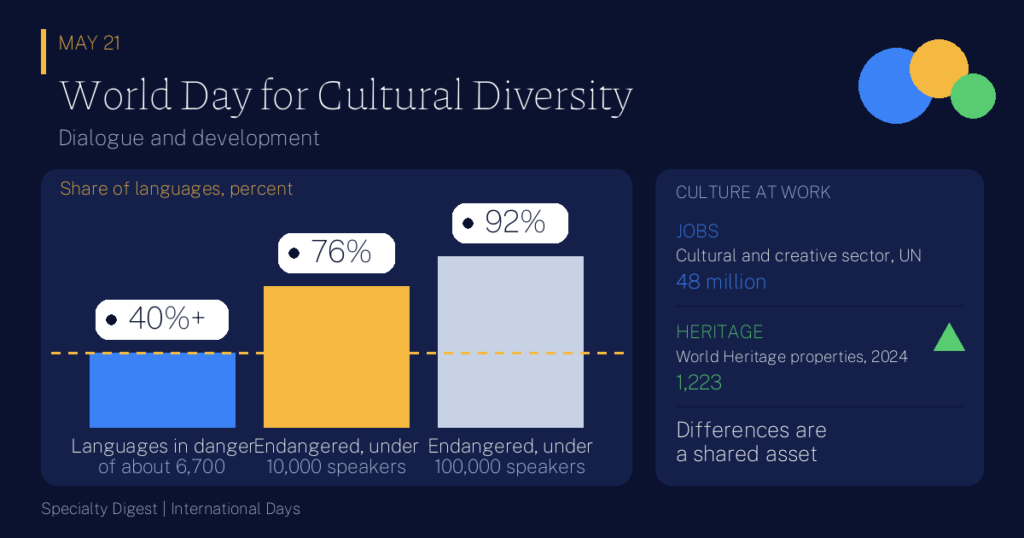
Language is where diversity is most fragile. UNESCO reports that no less than 40 percent of some 6,700 languages spoken today are in danger of disappearing, based on its 2016 Atlas of Languages in Danger. Since 1950, 244 languages have become extinct. UNESCO also notes that its sources give the total as roughly 6,500 to 6,700, so treat the total as approximate.
Among the 2,304 endangered languages for which speaker data exist, 2,124 (92 percent) have fewer than 100,000 speakers, and 1,749 (76 percent) have fewer than 10,000. The Atlas counts 18 languages with a single speaker and 27 with two. A language that lives in a handful of elders can vanish within a generation.
Example 2: a language with 900 speakers. Suppose a language has 900 speakers, but every fluent speaker is over 60 and no child is learning it. In about 30 years the community could lose its everyday speakers entirely, along with place names, songs and farming knowledge that exist only in that tongue. Even a modest program that pays elders to teach children can change the arithmetic. These numbers are round and illustrative.
Culture is also work and prosperity
The UN observance page highlights that the cultural and creative sector accounts for more than 48 million jobs worldwide, almost half of them held by women. That is 6.2 percent of all employment and 3.1 percent of global GDP, according to the page. Behind those totals are weavers, musicians, translators, game designers, chefs and festival crews.
The International Fund for Cultural Diversity, which supports projects in developing countries, has funded more than 140 cultural and creative projects in over 69 countries since 2010, according to the UN.
Example 3: the weavers’ cooperative. Picture 50 weavers who each sell 10 pieces a month at $30. That is $15,000 a month, or $180,000 a year, flowing into one small community. If a fair-trade label lifts the price by $5 per piece, the group earns another $30,000 a year. The figures are round and illustrative, but they show how protecting a craft can protect a livelihood.
Dialogue and the cost of its absence
The UN observance page also makes a sobering link. It states that three-quarters of the world’s major conflicts have a cultural dimension, and it cites 89 percent of current conflicts as occurring in countries with low intercultural dialogue. These are statements from the UN page, and they describe association, not proof that culture causes conflict. Their point is practical: places where communities have few ways to listen to each other are more exposed when tensions rise.
In 2022 delegations from 150 states took part in MONDIACULT, UNESCO’s world conference on cultural policies, a sign that governments now treat culture as policy and not only as ornament.
Heritage that belongs to everyone
Diversity also lives in places. At its 46th session in New Delhi in 2024, the World Heritage Committee added 26 properties, 20 cultural, 5 natural and 1 mixed. UNESCO then counted 1,223 properties on the World Heritage List across 168 countries. The list has probably grown since, so check UNESCO for the current total.
- 40%+of about 6,700 languages are in danger (UNESCO)
- 244languages extinct since 1950 (UNESCO)
- 48 millionjobs in the cultural and creative sector (UN)
- 1,223World Heritage properties in 168 countries, 2024 (UNESCO)
How the day is marked, and what progress needs
Governments, schools, museums and community groups mark May 21 with exhibitions, language lessons, shared meals and public debates. UNESCO also convenes the states that have joined the 2005 Convention, whose ninth Conference of Parties met on June 6 to 8, 2023. Progress needs more than celebration. It needs policies that fund local artists, schools that teach in the languages children speak at home, fair rules for the digital platforms that now carry much of the world’s culture, and respect for the communities that own their traditions.
You can take part in small ways: learn ten words of a neighbor’s language, eat at a family restaurant you have never tried, or ask an older relative to record a story. Dialogue starts with curiosity.
Key Takeaways
- The day has clear roots. UNESCO’s 2001 Declaration came first, and UN resolution 57/249 set May 21 in December 2002.
- Diversity is wider than festivals. It covers languages, food, craft, belief and the many ways people create and share culture.
- Languages are the most fragile part. UNESCO reports at least 40 percent of some 6,700 languages are in danger.
- Culture is also an economy. The UN cites more than 48 million jobs and 3.1 percent of global GDP.
- Dialogue is practical. The UN links low intercultural dialogue to conflict risk, an association and not a proven cause.
- Everyone can act. Learning a word, listening to a story or backing a local craft keeps diversity alive.
How solid is this? Language figures come from UNESCO’s 2016 Atlas of Languages in Danger, which gives the total as roughly 6,500 to 6,700, and the World Heritage count is from August 2024. Jobs, GDP and conflict figures are quoted from the UN observance page, which does not give a year for them. The three worked examples use round, made-up numbers. See also the International Days hub and the International Days Calendar.
More in Society
- United Nations, World Day for Cultural Diversity for Dialogue and Development
- UNESCO, World Day for Cultural Diversity for Dialogue and Development
- UNESCO, Universal Declaration on Cultural Diversity (2001)
- UNESCO, Convention on the Protection and Promotion of the Diversity of Cultural Expressions (2005)
- UNESCO, Towards a World Atlas of Languages
- UNESCO, World Heritage: 26 new sites inscribed (2024)