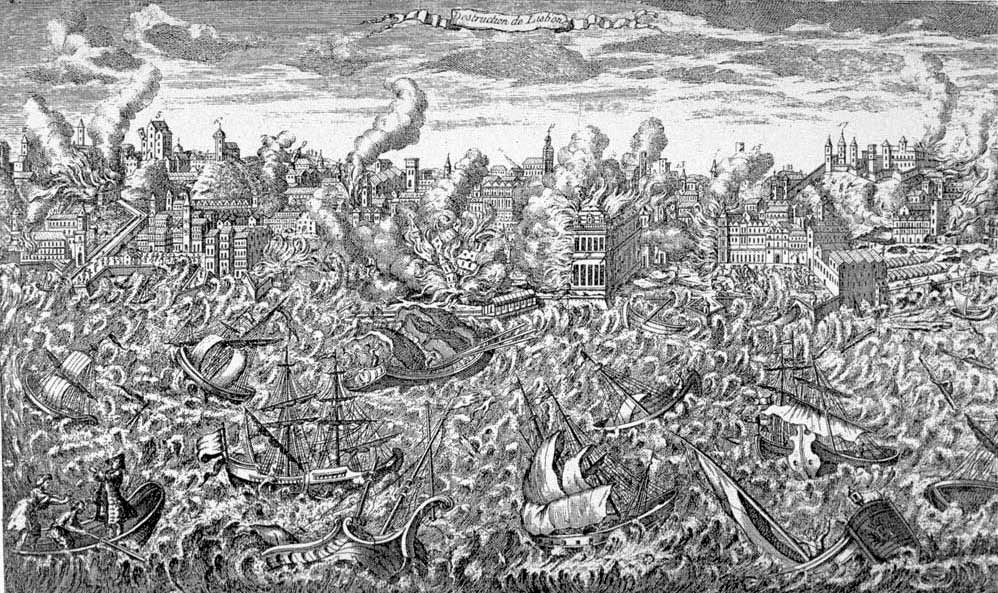
The 1755 Lisbon earthquake was a great earthquake that struck off the coast of Portugal on the morning of 1 November 1755, followed by fires and a tsunami that devastated the capital, Lisbon. Estimates of the dead range from about 10,000 to well over 30,000, and the disaster reshaped European thought, science and city planning.
Background to the 1755 Lisbon earthquake
In 1755 Lisbon had about 250,000 residents. It was the fourth largest city in Europe and the capital of a Portuguese empire that spread around the world, according to a teaching site from California State University, Long Beach. Portugal had felt earthquakes before, but the last major one had occurred roughly 200 years earlier.
The shock came on 1 November, All Saints’ Day, when worshippers were filling the city’s churches and cathedrals, as NOAA’s Science On a Sphere catalog describes. The source of the earthquake lay under the Atlantic. The Long Beach material places the epicenter about 200 kilometers west-southwest of Cape St. Vincent, along the Gorringe Ridge, where the African and Eurasian plates converge, a setting explained under plate tectonics. NOAA’s tsunami model assumes a magnitude 8.5 earthquake on the Horseshoe Fault and cites a 2011 study showing that this fault fits the tsunami observations better than several other proposed sources. The exact fault is therefore still a research question.
Course of events
The earthquake began at about 9:30 in the morning and consisted of three distinct jolts that together lasted nearly ten minutes. Magnitude estimates run from 8.5 to about 9.0 on modern scales such as the moment magnitude scale, and the Long Beach site notes that waves seen as far away as Finland suggest a magnitude approaching 9.0. Before the shaking, people had reported muddy water in parts of Portugal and Spain and falling water levels in wells and springs.
NOAA writes that in seconds the quake left the city in ruins and within minutes the ruins were burning. The Long Beach timeline says the fires raged for five days and that looters set fire to ransacked houses. Many survivors fled to the wharves of the port, but no safety waited there. About an hour after the earthquake, the first tsunami wave surged up the Tagus estuary and reached a maximum runup of 12 meters, killing about 1,000 more people. At least two more waves followed, and the Long Beach timeline describes the city as virtually annihilated by earthquake, fire and tsunami within about an hour.
The sea caused damage far beyond Lisbon. At Lagos, in southern Portugal, the wave may have reached about 30 meters. It also damaged the ports of Cadiz in Spain and Safi and Agadir in Morocco, caused minor harm at Brest in France, flooded the Scilly Isles and Cornwall in England, and flooded low-lying parts of Cork in Ireland. Observers recorded about 4 meters at Madeira and about 1 meter in Barbados, Martinique, Guadeloupe and Antigua, and the waves were observed as far away as Newfoundland.
The shaking itself was felt across a wide area. The Long Beach site reports heavy loss of life in Fez and Meknes in Morocco, moderate damage in Algiers and southwest Spain, and shaking in France, Switzerland and northern Italy.
Aftermath
Sources disagree about how many people died. NOAA says the earthquake probably killed about 30,000 people, though some estimates double that figure. The Long Beach site gives a range of 10,000 to 40,000 and says the true figure was probably closer to 15,000. The wide spread shows how uncertain the counts remain.
The material damage is better documented. About one third of Lisbon was destroyed. Of the city’s forty parish churches, thirty-five collapsed, often onto people who were attending Mass. Only about 3,000 of roughly 20,000 houses remained habitable. The Royal Opera House, finished only a month earlier, was ruined, and 70,000 books in the king’s library were lost.
The royal family had been outside the city at Belem and escaped. The frightened king handed authority to his minister Pombal, who acted quickly and harshly. Looters were hanged, victims’ bodies were gathered and buried at sea with the permission of the Lisbon patriarch, and prices for rents, food and building materials were frozen at pre-earthquake levels. Pombal kept near-absolute power until the king died in 1777.
Military engineers led by Manuel de Maia, Carlos Mardel and Eugenio dos Santos drew up plans for a new city. Their economical Pombaline architecture, grid of streets and large waterfront square still make Lisbon a classic example of eighteenth-century town planning, according to the Long Beach site. About a week after the disaster, city officials formed committees to organize aid and assess the damage, and within a month building codes were being reviewed and changed.
Significance and legacy
The disaster caused deep shock in Europe. The Long Beach site notes that depictions of the ruins were copied and circulated throughout southern, western and central Europe, and it calls the earthquake a watershed event. It links the attention to a new desire to record and understand the quake in natural terms, not only as a matter of religion, although many survivors at the time still wondered whether the disaster was a punishment.
The earthquake is also a case study for modern hazard science. NOAA’s Pacific Tsunami Warning Center has re-created the 1755 tsunami with the same forecast model it uses for real events. The simulation shows that the tsunami’s energy did not spread evenly across the Atlantic but formed a directional beam, so some coasts were hit far harder than others.
The Lisbon earthquake therefore matters for two reasons. It reshaped one of Europe’s great cities, and it showed how a single undersea earthquake can damage coasts thousands of kilometers apart. A modern comparison is the 2004 Indian Ocean earthquake and tsunami, which struck many countries at once.
More in Earth Sciences
Key facts
- The earthquake struck at about 9:30 in the morning on 1 November 1755, with three jolts and nearly ten minutes of shaking.2
- Death toll estimates range from about 10,000 to 40,000, with NOAA giving about 30,000 and noting some estimates are double.1
- The first tsunami wave reached Lisbon about an hour later with a runup of up to 12 meters.1
- About one third of Lisbon was destroyed, and 35 of its 40 parish churches collapsed.2
- The tsunami was observed from Ireland and England to Madeira, the Caribbean and Newfoundland.1
- Pombal led the recovery, and the rebuilt downtown with its street grid remains a classic of eighteenth-century town planning.2
Related concepts
Quick checkHow many people died in the 1755 Lisbon earthquake?Show answer
Estimates range from about 10,000 to 40,000, and NOAA gives about 30,000 with some estimates twice as high, because no accurate count was made at the time.
Sources
- NOAA Science On a Sphere, Tsunami Historical Series: Lisbon - 1755, https://sos.noaa.gov/catalog/datasets/tsunami-historical-series-lisbon-1755/
- California State University, Long Beach, 1755 Lisbon Earthquake: Description of the Events, https://home.csulb.edu/~rodrigue/geog458558/lisbon/m02description.html
- California State University, Long Beach, 1755 Lisbon Earthquake: Response to the Disaster, https://home.csulb.edu/~rodrigue/geog458558/lisbon/m09responses.html
Editorially reviewed by Specialty Digest Editorial TeamLast reviewed November 4, 2026Researched and drafted with AI assistanceReport an issue