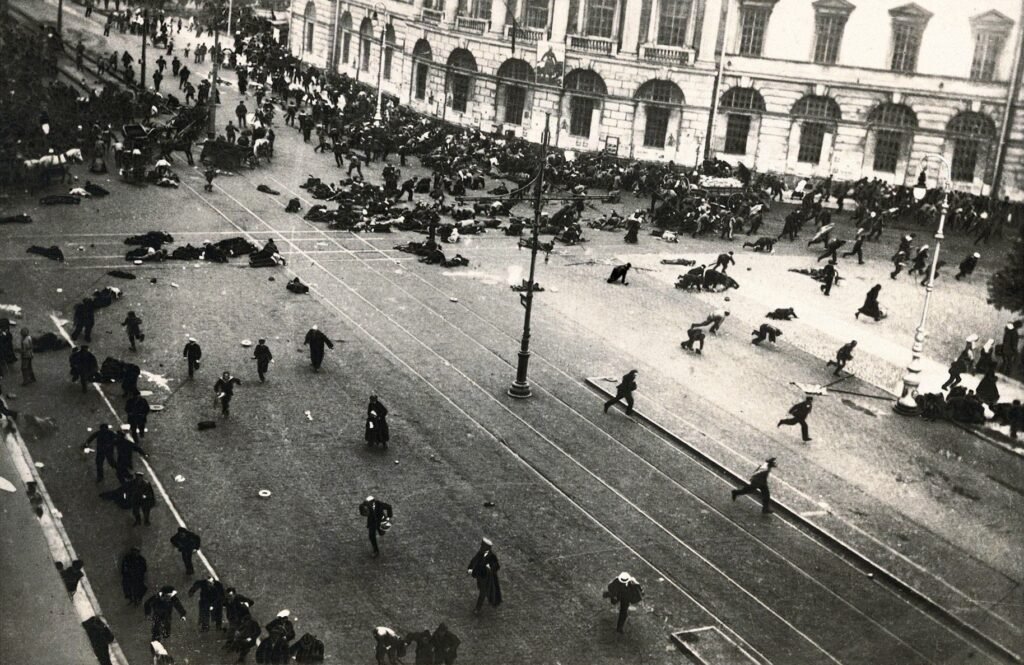
The Russian Revolution was the series of upheavals in 1917 that ended the rule of the tsars in Russia and brought the Bolsheviks, led by Vladimir Lenin, to power. It began with strikes and riots in Petrograd in March 1917, led to the abdication of Tsar Nicholas II, and reached its turning point on 7 November 1917, when the Bolsheviks seized the government. A civil war followed, and the Union of Soviet Socialist Republics (USSR) was declared in 1922.
Background of the Russian Revolution
Before 1900, Imperial Russia was largely a land of illiterate peasants controlled by a wealthy nobility. A revolution in 1905 forced Nicholas II, who reigned from 1894 and was the last of the Romanov emperors, to promise reform. That upheaval also created many new converts to revolutionary socialism, and the tsar’s promises did not settle the underlying anger.
World War I then placed an enormous strain on the country. Between 14 and 15 million men were mobilized for the army, and food and fuel shortages followed in the cities. In the early months of 1917, more than 1,300 strikes took place, involving more than 600,000 workers.
Course of the Russian Revolution
The revolution began in the capital, then called Petrograd and now Saint Petersburg. On 8 March 1917 by the modern Gregorian calendar, a riot over bread and coal shortages broke out and lasted three days. Russia then used the older Julian calendar, which ran 13 days behind, so Russians dated these events to late February and the movement is often called the February Revolution.
The unrest spread, and Nicholas II abdicated in March 1917. A Provisional Government took over. It enjoyed the support of many middle-class and upper-class Russians and of the Russian Orthodox Church, but it governed ineffectively. By June, regions on the edges of the former empire were also pressing for self-determination along ethnic and national lines. In mid-July, the Bolsheviks made an early and unsuccessful attempt to seize power.
The decisive moment came on 7 November 1917, which was 25 October in the old Russian calendar and is why the event is called the October Revolution. The Bolsheviks, a radical socialist party led by Lenin, installed their own government by force and replaced the Provisional Government. Leon Trotsky was another leading Bolshevik, and he later organized the Red Army.
The new government moved quickly. It separated church and state in February 1918, and from 1918 the Bolsheviks called themselves the Communist Party. On 3 March 1918 the government signed the Treaty of Brest-Litovsk with Germany, withdrawing Russia from the war. Under its terms, Soviet Russia gave up Ukraine, eastern Poland, Finland, the Baltic provinces and Belorussia to Germany, while the Caucasus went to Turkey. Russia’s former allies were furious at what they saw as Lenin’s capitulation.
Russian Civil War and aftermath
Opposition to the Bolsheviks hardened into the Russian Civil War, a conflict that historians date differently. Some begin it with the violent repression of opponents between November 1917 and May 1918, while others start with the Czechoslovak Legion uprising in May 1918. That corps was traveling to the Western Front after Brest-Litovsk when it turned against the Bolshevik regime and won large areas along the Volga River. The end is also debated. Candidates include 1920, when foreign intervention in the west ended, 1921, when the Kronstadt rebellion was crushed, and October 1922, when Japanese forces withdrew from Siberia.
Policies imposed from the summer of 1918, including conscription and the requisitioning of grain, were deeply unpopular. The Bolshevik Red Army, commanded by Trotsky, nonetheless grew from about 500,000 soldiers in 1918 to about 3 million in 1919 and 5 million by June 1920, all tightly controlled by party commissars and the secret police known as the Cheka. In 1918, anti-Bolshevik Cossacks advanced through Ukraine, and a battle was fought for control of Tsaritsyn, later called Stalingrad and now Volgograd.
The Whites, as the anti-Bolshevik forces were called, were led by commanders such as General Lavr Kornilov, General Anton Denikin and Admiral Aleksandr Kolchak. In 1919, anti-Communist forces included troops from the Allies, Germany, Poland and Scandinavia, but none of these attacks seriously threatened the Russian heartland. Poland and Soviet Russia fought a separate war that ended with an armistice in October 1920, under which Poland received parts of Ukraine and Belorussia. The last White territory, in the Far East, was lost in 1922.
The human cost was immense. One scholarly summary reports about 800,000 soldiers dead and at least 5 million civilians killed in the civil war, and some historians, counting famine and epidemics of cholera, typhus and influenza, put total deaths as high as 14 million. These figures are estimates, and the true toll cannot be known with precision. Nicholas II and his family were also killed in 1918.
To revive a failing economy, Lenin compromised on ideology and adopted a new economic approach. The Soviet state formally took shape in 1922, when the USSR was declared. Stalin later discredited Trotsky, who had remained head of the Red Army, and rose to dominate the party.
Significance and legacy of the Russian Revolution
The revolution replaced a monarchy with the Soviet state, and its consequences reached far beyond Russia. The civil war left lasting suspicion between the Soviet government and Western powers. That distrust shaped relations before World War II, when the USSR signed the Nazi-Soviet Pact with Germany, and it dominated world politics afterward through the Cold War between the USSR and the United States.
Most accounts agree on one point: the Russian Revolution was not a single event. It unfolded over many months in 1917, merged into a civil war that lasted several years, and produced a state whose influence was felt around the world. Even the dates people use for it differ, since the same events fall in February or March and in October or November depending on the calendar.
Key facts
- Strikes and riots over bread and coal shortages began in Petrograd on 8 March 1917 (Gregorian calendar).1
- Tsar Nicholas II abdicated in March 1917 and a Provisional Government took over.12
- The Bolsheviks seized power on 7 November 1917, which was 25 October in the old Russian calendar.2
- Russia and Germany signed the Treaty of Brest-Litovsk on 3 March 1918.23
- The Russian Civil War killed an estimated 800,000 soldiers and at least 5 million civilians, and the USSR was declared in 1922.2
Related concepts
Quick checkWhy is the Bolshevik takeover called the October Revolution if it happened on 7 November?Show answer
Russia used the Julian calendar in 1917, which ran 13 days behind the Gregorian calendar, so the takeover fell on 25 October by the date Russians used.
Sources
- EBSCO Research Starters, Russian Revolution of 1917, https://www.ebsco.com/research-starters/history/russian-revolution-1917
- World History Encyclopedia, Russian Civil War: The Failed Fightback Against Bolshevism, https://www.worldhistory.org/Russian_Civil_War/
- World History Encyclopedia, Treaty of Brest-Litovsk, https://www.worldhistory.org/Treaty_of_Brest-Litovsk/
Editorially reviewed by Specialty Digest Editorial TeamLast reviewed November 4, 2026Researched and drafted with AI assistanceReport an issue