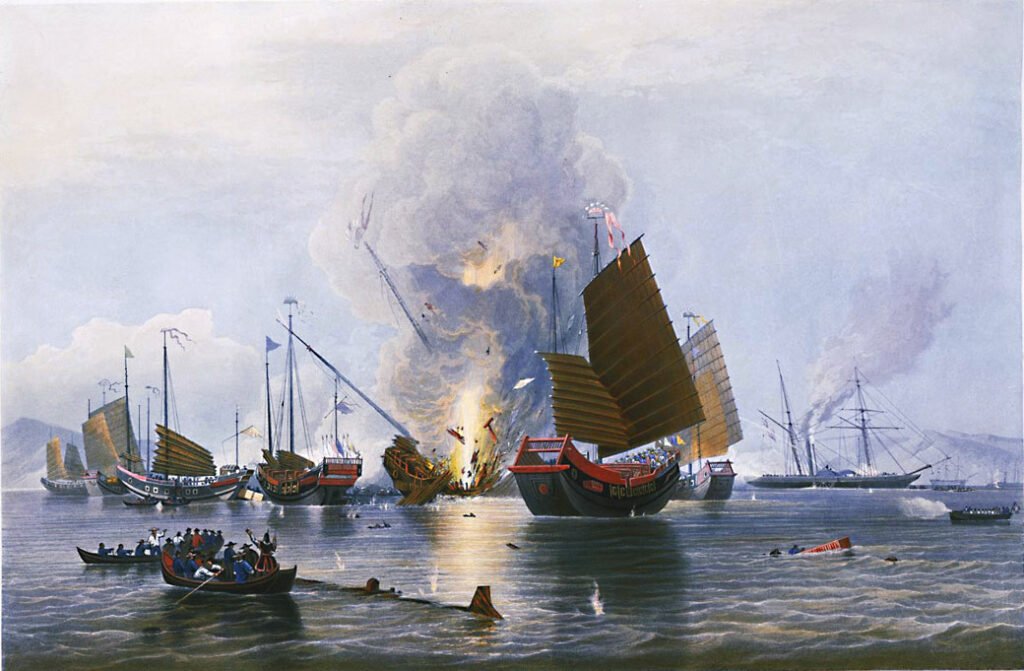
The Opium Wars were two conflicts in the nineteenth century in which Britain used military force against Qing China to open its markets to foreign trade. The first lasted from 1839 to 1842 and ended with the Treaty of Nanjing, signed in August 1842. The second was fought in the late 1850s and ended in 1860.
Background of the Opium Wars
Western traders had long wanted Chinese tea, silk and furniture but found that few Western products interested Chinese buyers. Britain’s demand for tea grew sharply in the eighteenth century, and Asia for Educators at Columbia University notes that the British closed the gap by shipping increasing amounts of opium grown in Bengal, in India, to China. The U.S. Office of the Historian adds that American merchants also turned to opium, and that China began importing more than it exported.
Opium use spread despite repeated bans by the Chinese government. Silver flowed out of the country to pay for the drug, and some historians estimate that about 10 percent of the population used it regularly by the late nineteenth century. In 1838, the emperor sent an official named Lin Zexu to Guangzhou, then called Canton, with orders to end the trade.
Lin had addicts rounded up and treated, and he had domestic dealers punished. He then moved against foreign merchants, confiscating their stores of opium and requiring them to sign pledges never to trade in it again. This third step led to war. British opinion was divided, since some people felt uneasy about the trade, but those who wanted to expand trade with China prevailed.
Course of the First Opium War
The war began in 1839 and was fought mostly at sea and along the coast. In the same year, Lin wrote an open letter of advice to Queen Victoria, which Columbia University includes among its teaching documents on the period. British forces had a large technical advantage, including percussion muskets, heavy artillery and steam-powered paddlewheel gunboats. They could also draw on garrisons and supplies from nearby colonies in Southeast Asia and India.
By the summer of 1842, British ships were preparing to shell the old capital of Nanjing. The emperor accepted British terms rather than face the attack.
The Treaty of Nanjing, signed in August 1842, was the first of what came to be called the unequal treaties. According to excerpts held by Columbia University, it contained these main provisions:
China allowed British subjects to live and trade in Canton, Amoy, Foochow, Ningpo and Shanghai, where British consuls would be stationed. China ceded the island of Hong Kong to Britain permanently. It also abolished the practice of forcing foreign merchants to trade only through licensed Chinese firms called the Cohong, and it agreed to pay a total of 21 million dollars in installments, including 3 million for debts owed to British merchants.
The Office of the Historian reports that the United States, through the negotiator Caleb Cushing, signed a similar agreement, the Treaty of Wangxia, near Macau in 1844. Unlike the British treaty, it stated that Americans involved in the opium trade or in smuggling would be prosecuted under Chinese law. Both treaties opened five ports to foreign trade and let foreigners own land there for the first time.
Course of the Second Opium War
By the 1850s, Western powers were dissatisfied with the terms of their treaties and with the Qing government’s compliance. Sources date the second war slightly differently. The Office of the Historian places British attacks on Guangzhou and Tianjin in 1857 and 1858, while Columbia University dates the second war from 1858 to 1860.
In 1858, France, Russia and the United States signed treaties with China at Tianjin in quick succession, using a most-favored-nation clause to claim the same rights that Britain had won by force. The Treaty of Tianjin and the Convention of Peking in 1860 opened more ports to foreign residence and trade. They also allowed foreigners, especially missionaries, to travel and do business freely across the country.
Aftermath of the Opium Wars
The treaties gave foreigners a privileged position in China. Extraterritoriality meant that foreigners accused of crimes were tried by their own officials and not by Chinese courts. Under the most-favored-nation clause, any concession given to one power could be claimed by all.
The Office of the Historian notes that the Qing government had itself supported these clauses in the first treaties, in order to keep foreigners under a single set of rules. The treaty ports became centers of contact between Chinese and Western culture, and by 1900 there were more than 100 of them, according to Columbia University.
The treaties also changed how China dealt with other countries. For centuries, foreign traders had been expected to bring tribute to the emperor and accept Chinese superiority. The European powers refused to do so and demanded that China follow Western diplomatic practice, including written treaties.
Significance and legacy
The wars marked the start of what one historian called China’s treaty century. Columbia University notes that major aspects of the unequal treaties were not formally ended until 1943.
Scholars weigh the causes of China’s later difficulties in different ways, but the sources used here agree on the wars’ importance for Chinese memory. The Office of the Historian says the treaties built resentment toward Western imperialism, and Columbia University says China’s experience of Western aggression in the 1800s still shapes its foreign policy and its drive for modernization.
The wars also remain a subject of moral debate because they were fought to protect a trade in a harmful drug. Some British people felt uneasy about it at the time. Britain’s formal hold on Hong Kong dates from the 1842 treaty.
Key facts
- The First Opium War lasted from 1839 to 1842 and ended with the Treaty of Nanjing in August 1842.1
- The Chinese official Lin Zexu was sent to Canton in 1838 to end the opium trade.2
- The Treaty of Nanjing ceded Hong Kong to Britain and opened five ports to British trade.3
- China agreed to pay a total of 21 million dollars under the Treaty of Nanjing.3
- Sources date the second war differently, from 1857 or 1858 to 1860.12
Related concepts
Quick checkWhat did the Treaty of Nanjing do?Show answer
Signed in August 1842, it ended the First Opium War, opened five Chinese ports to British residence and trade, ceded Hong Kong to Britain and required China to pay 21 million dollars.
Sources
- U.S. Office of the Historian, Milestones 1830-1860, The Opening to China Part I: the First Opium War, the United States, and the Treaty of Wangxia, https://history.state.gov/milestones/1830-1860/china-1
- Columbia University Asia for Educators, The Opium War and Foreign Encroachment, https://afe.easia.columbia.edu/special/china_1750_opium.htm
- Columbia University Asia for Educators, Excerpts from the Treaty of Nanjing, August 1842, https://afe.easia.columbia.edu/main_pop/ps/ps_china-nanjing.htm
Editorially reviewed by Specialty Digest Editorial TeamLast reviewed November 4, 2026Researched and drafted with AI assistanceReport an issue