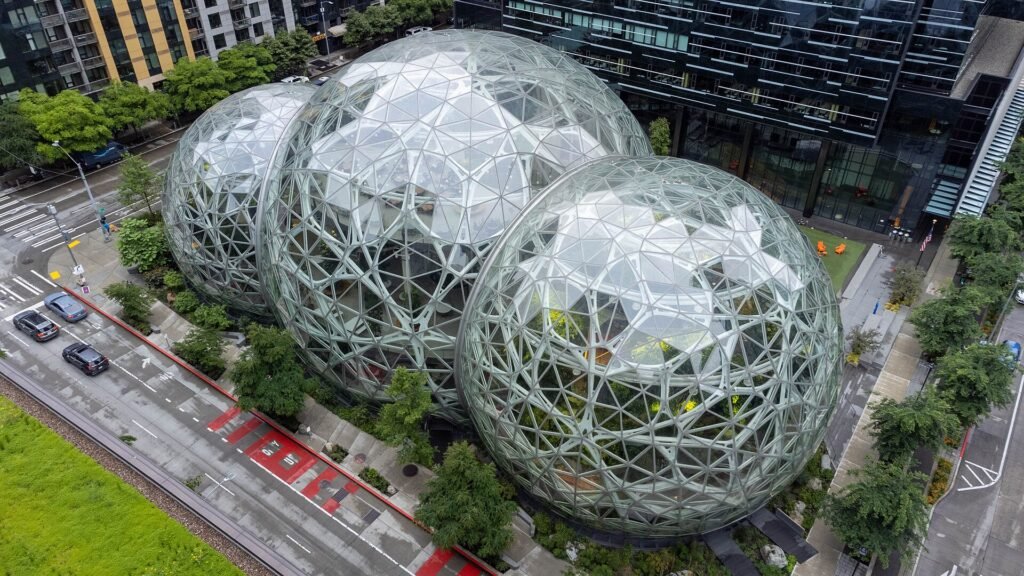
Amazon.com, Inc. is an American company based in Seattle, Washington, that operates online and physical stores, the Amazon Web Services (AWS) cloud platform and a range of media, advertising and device businesses. It reported net sales of $716.9 billion for 2025 in its annual report filed with the U.S. Securities and Exchange Commission (SEC), up from $638.0 billion in 2024.
History of Amazon
Jeff Bezos founded the company on July 5, 1994, as an online bookstore called Cadabra, after moving from New York City to the Seattle area. He renamed it Amazon in November 1994, after the world’s largest river. The website opened to customers in July 1995.
Bezos picked the Seattle area partly for its pool of technical workers and its closeness to a large book distribution warehouse in Oregon. Early customers bought books, and the company shipped them from wholesalers and publishers.
Amazon went public in May 1997 and soon expanded beyond books into music, video, electronics and toys. It began selling in the United Kingdom and Germany in 1998 by buying local online booksellers.
In 2002 the company launched Amazon Web Services, which started by offering tools for web developers. In 2006 it added storage and computing services that businesses could rent by the hour, and in 2006 it also launched Fulfillment by Amazon, which lets outside sellers use its warehouses and delivery network.
Later acquisitions included Whole Foods Market, a grocery chain bought for $13.7 billion in 2017, and the video doorbell maker Ring, bought for about $1 billion in 2018.
Products and services of Amazon
Amazon’s annual report says it serves consumers, sellers, developers, enterprises, content creators, advertisers and employees. Consumers shop in its online and physical stores, where it aims to offer wide selection, low prices and convenience. Sellers can list products in its store and use its fulfillment services, which store, pack and ship goods on their behalf.
AWS is its cloud computing business. It rents servers, storage, databases and other computing services to companies, governments and developers over the internet. Amazon also sells advertising, subscription services and its own devices and media.
The company separates product sales from service sales. In 2025, net product sales were $296.3 billion and net service sales were $420.7 billion. Service sales include seller fees, advertising, AWS and subscriptions, and they now exceed product sales by a wide margin.
Net product sales were $255.9 billion in 2023 and $272.3 billion in 2024, and net service sales were $318.9 billion and $365.6 billion. Services therefore grew faster than products in each year shown.
Corporate structure and operations
Amazon organizes its operations into three segments: North America, International and AWS. Its principal executive offices are at 410 Terry Avenue North in Seattle.
As of December 31, 2025, Amazon employed approximately 1,576,000 full-time and part-time people. It also uses independent contractors and temporary workers to supplement its workforce. The size of this workforce reflects the scale of its warehouses, delivery network and logistics operations.
Operating income, which is profit from running the business before interest and taxes, was $80.0 billion in 2025, compared with $68.6 billion in 2024. AWS alone earned $45.6 billion of that total, while North America earned $29.6 billion and International earned $4.8 billion. In other words, the cloud segment produced more than half of the company’s operating income.
North America operating income rose from $25.0 billion in 2024 to $29.6 billion in 2025, and International operating income rose from $3.8 billion to $4.8 billion.
AWS operating income was $39.8 billion in 2024, so its profit rose by about $5.8 billion in one year. That growth came while the retail segments also increased their earnings.
Net income was $77.7 billion in 2025, $59.2 billion in 2024 and $30.4 billion in 2023. Net sales over the same three years rose from $574.8 billion to $638.0 billion and then to $716.9 billion.
The annual report states the company’s aim of being Earth’s most customer-centric company and lists intense competition for qualified workers as a continuing challenge.
Impact of Amazon
Amazon changed how many people shop by combining a large product range with fast delivery. Its marketplace gives small businesses access to customers around the world, but those businesses also depend on Amazon’s fees and rules. Its network of distribution centers and delivery services has pushed other retailers to speed up their own shipping.
AWS has become one of the main providers of cloud infrastructure. Many websites, apps and government services run on rented computing capacity instead of servers owned by the organizations that use them. This lowers the upfront cost of starting an online business, although it also concentrates a large share of the internet’s infrastructure in a few companies.
The company is also one of the world’s largest private employers. Its hiring decisions, wages and working conditions therefore draw attention from governments, researchers and labor groups.
Criticism and controversies
In September 2025 the U.S. Federal Trade Commission (FTC) announced a settlement with Amazon over its Prime subscription program. The agency had alleged that Amazon enrolled millions of consumers in Prime without their consent and knowingly made it hard to cancel. Under the order, Amazon must pay a $1 billion civil penalty, provide $1.5 billion in refunds to affected consumers and stop the practices at issue.
The order also names two Amazon executives, Senior Vice President Neil Lindsay and Vice President Jamil Ghani, alongside the company.
Amazon’s annual report says the settlement and the resolution of Italian tax disputes related to its stores business contributed to higher special charges in 2025. It recorded $2.5 billion in charges in the third quarter of 2025 for the FTC settlement.
The report also notes that the company faces legal proceedings on antitrust, intellectual property, privacy, consumer protection and other issues, including claims brought by state attorneys general and the FTC. It says the outcomes are inherently unpredictable and that costs could exceed amounts it has reserved.
More in Management
Key facts
- Amazon is headquartered in Seattle, Washington, and reports three segments: North America, International and AWS.1
- Amazon reported net sales of $716.9 billion and net income of $77.7 billion for 2025.1
- AWS earned $45.6 billion of Amazon's $80.0 billion consolidated operating income in 2025.1
- Amazon employed approximately 1,576,000 full-time and part-time people as of December 31, 2025.1
- In September 2025 the FTC announced a settlement requiring Amazon to pay a $1 billion civil penalty and provide $1.5 billion in refunds over Prime enrollment and cancellation practices.2
Related concepts
In the news
Quick checkWhat are the three segments Amazon reports?Show answer
North America, International and Amazon Web Services (AWS).
Sources
- Amazon.com, Inc., Form 10-K for the fiscal year ended December 31, 2025 (SEC EDGAR), https://www.sec.gov/Archives/edgar/data/1018724/000101872426000004/amzn-20251231.htm
- U.S. Federal Trade Commission, FTC Secures Historic $2.5 Billion Settlement Against Amazon, September 25, 2025, https://www.ftc.gov/news-events/news/press-releases/2025/09/ftc-secures-historic-25-billion-settlement-against-amazon
Editorially reviewed by Specialty Digest Editorial TeamLast reviewed November 4, 2026Researched and drafted with AI assistanceReport an issue