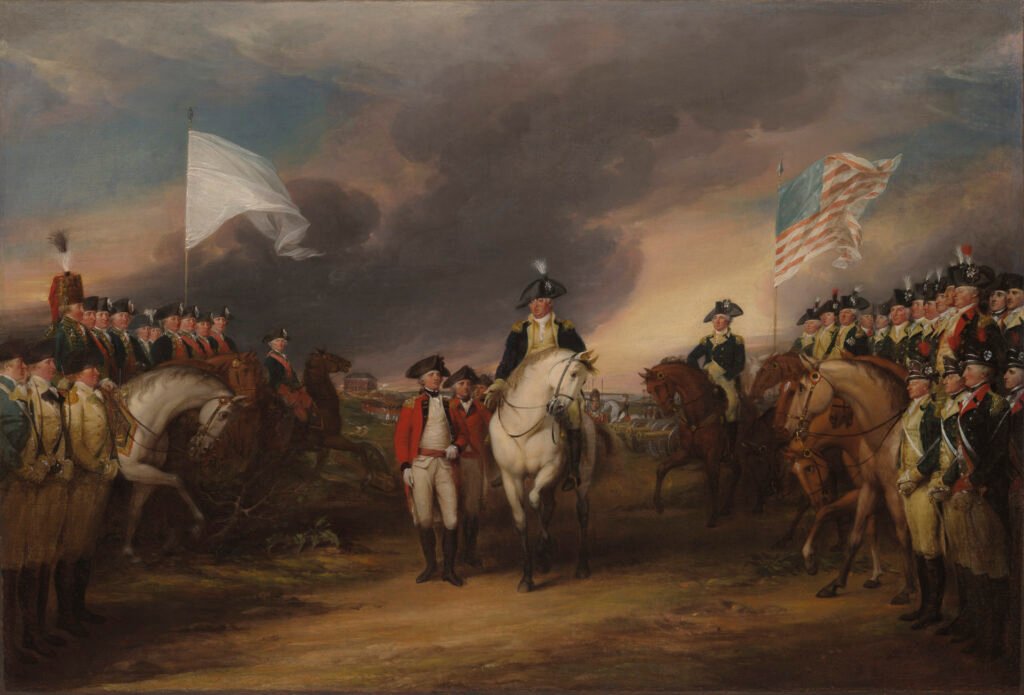
The American Revolution was the political upheaval and war, fought from 1775 to 1783, in which thirteen British colonies in North America broke away from Great Britain and became the United States. It grew out of disputes over taxation and self-government, turned into open war when fighting broke out in Massachusetts on 19 April 1775, and ended when Britain recognized American independence in the Treaty of Paris, signed on 3 September 1783.
Background of the American Revolution
Throughout the 1760s and early 1770s, the colonists clashed with British imperial policy on taxation and frontier lands, according to the U.S. Office of the Historian. Repeated protests failed to change that policy. Britain instead closed the port of Boston and placed Massachusetts under martial law, so colonial governments sent delegates to a Continental Congress to organize a boycott of British goods.
The Seven Years’ War, which ended with the 1763 Treaty of Paris, had cost France its North American territory. That defeat later made French officials eager to profit from Britain’s troubles with its own colonies.
Tension was sharpest in Massachusetts. In the summer of 1774, British warships closed Boston Harbor, and Royal Governor Thomas Gage, who was charged with enforcing the unpopular Massachusetts Government Act, dismissed the elected legislature. In October, patriot leaders formed a Provincial Congress that took control of the colony’s militia and began stockpiling weapons, with a goal of raising an army of 15,000 men, the National Park Service reports.
Course of the American Revolution
The war began on 19 April 1775. General Gage sent about 700 soldiers from Boston to seize military supplies stored at Concord, 18 miles away. Fighting at Lexington and Concord then spread along a 16-mile road and involved some 1,700 British regulars and more than 4,000 colonial militia. The park service counts 273 British casualties and 95 colonial casualties that day.
Congress moved only slowly toward independence, because most delegates still hoped for reconciliation. Parliament banned trade with the colonies in December 1775, and Congress answered in April 1776 by opening American ports. Thomas Paine’s pamphlet Common Sense, published in January 1776, argued openly for separation. On 7 June 1776, Richard Henry Lee moved that Congress declare independence. A committee assigned the drafting to Thomas Jefferson, Benjamin Franklin and John Adams reviewed his text, and Congress adopted the final Declaration of Independence on 4 July 1776.
Independence opened the door to foreign help. News that the British army had surrendered at Saratoga reached the French foreign minister, the Comte de Vergennes, in December 1777, and he then offered an alliance. Franklin, Arthur Lee and Silas Deane signed a Treaty of Alliance and a Treaty of Amity and Commerce with France on 6 February 1778. Spain entered the war against Britain on 21 June 1779. French supplies, troops and naval support then reached the Continental Army, which had endured freezing winters at Valley Forge in 1777 to 1778 and at Morristown in 1779 to 1780.
The decisive campaign came in 1781. Commanded by General George Washington and the Comte de Rochambeau, American and French armies marched south from New York to trap Lord Cornwallis, who had fortified Yorktown, Virginia, to provide a harbor for the British fleet. A French fleet under Admiral de Grasse fought the British navy off the Chesapeake Bay on 5 September and then blockaded the coast. By the end of the month, about 17,600 American and French soldiers faced roughly 8,300 British troops. The allies began digging siege lines on 28 September, stormed two British strongpoints on the night of 14 October, and watched most of Cornwallis’s army march out and lay down its arms on 19 October 1781.
Aftermath of the American Revolution
Yorktown did not end the war at once, but it led to peace talks. American commissioners reached a preliminary agreement with Britain in 1782, and provisional articles were signed in Paris on 30 November 1782. The definitive Treaty of Paris was signed on 3 September 1783 by David Hartley for Britain and by John Adams, Benjamin Franklin and John Jay for the United States, the National Archives records.
The treaty’s two crucial provisions were British recognition of American independence and a set of boundaries that allowed westward expansion. The National Archives also notes that the conflict had become a world war, involving France, Spain and the Netherlands as well as Britain and its former colonies. The Netherlands had acknowledged American independence in 1782, and Spain did so through the 1783 treaty.
At home, the new states formed a loose union under the Articles of Confederation, a process that ran from 1777 to 1781. The wartime alliance with France proved harder to manage. After the French Revolution began, the United States under President George Washington adopted a policy of neutrality in the war between Britain and France, which strained the 1778 treaty until the Convention of 1800 formally ended it.
Significance and legacy of the American Revolution
The Declaration of Independence mattered diplomatically as much as politically. By declaring independence, the colonists could confirm an alliance with France and obtain French assistance, as the Office of the Historian explains. The British government tried to dismiss the Declaration as the work of disgruntled colonists, yet recognition by friendly governments followed, beginning with France in 1778.
The Revolution was not a united effort. Loyalist sentiment remained strong in some areas, and all but the most radical members of Congress were unwilling to declare independence before 1776. Support for separation was built over time, not assumed from the start.
The war also reshaped the wider world of European colonialism, since it showed that a group of colonies could win independence with foreign support. Today, Minute Man National Historical Park in Massachusetts and Yorktown Battlefield in Virginia preserve the places where the fighting began and where it effectively ended, and Britain’s recognition of American sovereignty in 1783 remains the formal end of the war.
More in History
Key facts
- Fighting began on 19 April 1775 at Lexington and Concord, Massachusetts.4
- Congress adopted the Declaration of Independence on 4 July 1776.1
- France signed a Treaty of Alliance with the United States on 6 February 1778.2
- Cornwallis's army surrendered at Yorktown on 19 October 1781.5
- The Treaty of Paris, signed on 3 September 1783, recognized American independence.3
Related concepts
In the news
Quick checkWhen did Britain formally recognize American independence?Show answer
Britain recognized American independence in the Treaty of Paris, signed on 3 September 1783.
Sources
- U.S. Office of the Historian, The Declaration of Independence, 1776, https://history.state.gov/milestones/1776-1783/declaration
- U.S. Office of the Historian, French Alliance, French Assistance, and European Diplomacy during the American Revolution, 1778-1782, https://history.state.gov/milestones/1776-1783/french-alliance
- U.S. National Archives, Treaty of Paris (1783), https://www.archives.gov/milestone-documents/treaty-of-paris
- National Park Service, Minute Man National Historical Park: April 19, 1775, https://www.nps.gov/mima/learn/historyculture/april-19-1775.htm
- National Park Service, Yorktown Battlefield: History of the Siege, https://home.nps.gov/york/learn/historyculture/history-of-the-siege.htm
Editorially reviewed by Specialty Digest Editorial TeamLast reviewed November 4, 2026Researched and drafted with AI assistanceReport an issue