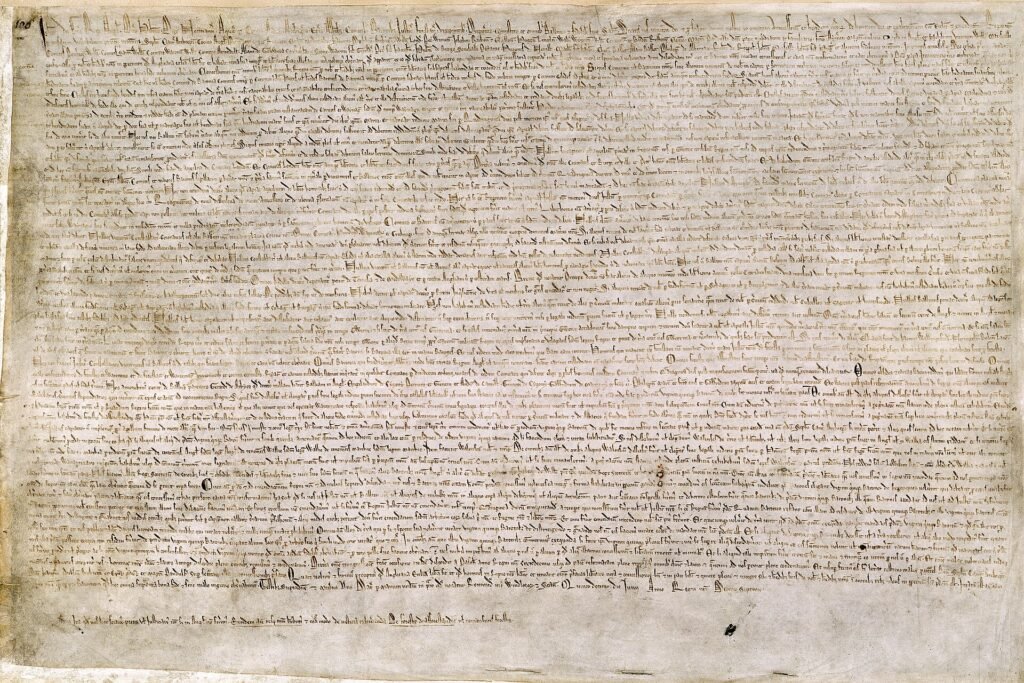
Magna Carta, Latin for “Great Charter,” is a charter of liberties that King John of England sealed in June 1215 to head off a rebellion by his barons. Its original terms protected a privileged class and collapsed within weeks. Later reissues and centuries of reinterpretation turned it into a lasting symbol of the rule of law, the idea that even a ruler must obey the law.
Background to Magna Carta
John ruled a kingdom built on feudalism, a system in which the king granted land to nobles, or barons, in return for loyalty, money and military service. Under John the money side grew heavy. Under Richard I, a payment of 100 pounds was recognized as a reasonable relief, the fee a baron paid to inherit his father’s lands, yet the king could often charge far more. Records kept by the royal treasury show how far John pushed. In 1214, the baron William FitzAlan owed 10,000 marks to inherit his father’s barony. That same year Geoffrey de Mandeville promised 20,000 marks for the right to marry the Countess of Gloucester, and the king seized his lands when he failed to pay.
The 1214 campaign in France, which failed, made matters worse. Many barons refused to join it, and John answered by seizing rebel lands. By 1215 about 40 rebellious barons confronted him, according to the U.S. National Archives. These were practical complaints about taxes, inheritance and royal justice, not a call for universal freedom.
What happened in 1215
On June 15, 1215, John affixed his seal to the charter in a meadow called Runnymede, between Windsor and Staines. He agreed in order to avoid civil war. Kings of this era sealed documents rather than signing them, so “sealed” is the accurate word. The charter is dated June 15, and on June 19 the king announced that peace had been restored.
The text opens by confirming the freedom of Church elections, a right Pope Innocent III had already approved. It then grants a list of liberties to all free men of the kingdom. Two passages became famous. One says that no free man shall be imprisoned or otherwise destroyed except by the lawful judgment of his peers or by the law of the land. The other promises that the king will not sell, deny or delay right or justice.
Because the barons did not trust John, the charter also named 25 barons to hold him to his word. The king’s officials were told to make everyone in their counties swear obedience to those 25 barons.
Aftermath and significance
The peace did not last. On September 13, 1215, John wrote to Innocent III asking for his support. About ten weeks after the sealing, the pope declared the agreement void, and England fell into civil war.
The charter survived anyway. After John’s death, supporters of his young son, Henry III, reissued it in the boy’s name in 1216 and 1217. In June 1217 the government ordered sheriffs to read it aloud in county courts, hoping to win rebels back to the crown. The same year the rules about royal forests were moved into a separate Charter of the Forest. In 1225 Henry III, now old enough to commit personally, issued the version that became the definitive text. A 1297 version, confirmed under Edward I, was entered into the official Statute Rolls of England, making it part of statute law.
Why Magna Carta still matters
The Library of Congress notes that the charter secured only the rights of a privileged class when it was issued. Its lasting power came later. Lawyers, judges and political writers kept returning to it as a statement that power has limits, and that idea shaped constitutional law in many places. It stands as an early landmark in the English legal tradition behind common law.
The clearest line of influence runs to the United States. During the American Revolution, colonists argued that they held the same rights as Englishmen, rights they believed Magna Carta guaranteed. They wrote those ideas into state laws and later into the Constitution and the Bill of Rights. The National Archives calls the Fifth Amendment’s guarantee of due process of law a direct descendant of the charter’s promise of proceedings according to the “law of the land.” The Library of Congress also traces links from the charter to trial by jury and the writ of habeas corpus, a court order that requires officials to justify holding a person.
Where the documents are kept
The National Archives in Washington, D.C., displays a 1297 version, one of four surviving originals of that version, on loan from David M. Rubenstein. The 1215 text published by the UK National Archives comes from a copy that belongs to Salisbury Cathedral, because the National Archives does not hold an original of its own.
FAQs
Who signed Magna Carta?
No one signed it. King John affixed the royal seal at Runnymede on June 15, 1215, in front of rebellious barons and Church leaders.
Did Magna Carta create democracy?
No. The barons wrote it to protect their own rights and property, and the interests of ordinary people barely appear in it. Its democratic reputation grew from how later generations read and used it.
Why did the pope cancel Magna Carta?
John appealed to Innocent III after he stopped tolerating the limits the charter placed on him. The pope declared the agreement void about ten weeks after it was sealed.
Which version of Magna Carta is the definitive one?
The 1225 reissue by Henry III is the version the UK National Archives describes as definitive, and the 1297 version entered the statute rolls.
More in History
Key facts
- King John sealed Magna Carta at Runnymede on June 15, 1215, after about 40 rebellious barons confronted him.1
- The charter was meant to avert civil war, but Pope Innocent III declared it void about ten weeks later.1
- It was reissued in 1216 and 1217, and in definitive form in 1225 by Henry III.2
- A 1297 version was entered in the official Statute Rolls of England.1
- The Fifth Amendment guarantee of due process descends from the charter's promise of proceedings by the law of the land.1
Related concepts
Quick checkDid King John sign Magna Carta?Show answer
No. Kings of his era sealed documents rather than signing them. John affixed his seal at Runnymede on June 15, 1215.
Sources
- U.S. National Archives, Magna Carta, https://www.archives.gov/exhibits/featured-documents/magna-carta
- The National Archives (UK), Magna Carta 1214-1225, https://www.nationalarchives.gov.uk/education/resources/magna-carta/
- Library of Congress, Magna Carta: Muse and Mentor, https://www.loc.gov/exhibits/magna-carta-muse-and-mentor/
Editorially reviewed by Specialty Digest Editorial TeamLast reviewed November 4, 2026Researched and drafted with AI assistanceReport an issue