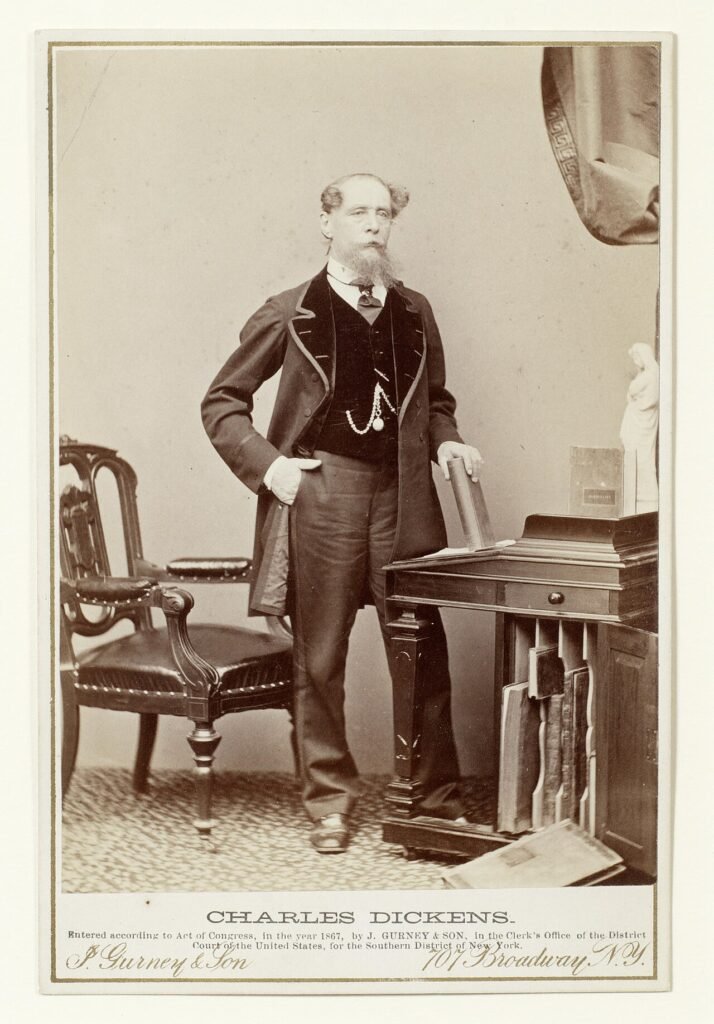
Charles Dickens (1812 to 1870) was an English novelist and the leading storyteller of the Victorian era, famous for characters such as Oliver Twist, Ebenezer Scrooge and Pip. His novels, most of which first appeared in serial installments, combine humor, social criticism and vivid portraits of London and its poor. He died at his home near Rochester on 9 June 1870 and was buried in Westminster Abbey.
Early life of Charles Dickens
Charles Dickens was born on 7 February 1812, the second of eight children of John Dickens and Elizabeth, born Barrow. Westminster Abbey, which holds his grave, records that his father was arrested for debt in 1824. At the age of twelve Charles had to work in a shoe-polish, or blacking, factory until he could return to his education, an experience that marked him for life and echoes in many of his stories. His father was held in the Marshalsea debtors’ prison, and Dickens later used that prison as a setting in Little Dorrit.
Because of this early hardship, he cared deeply about education and about the children of poor families, and these concerns reappear throughout his fiction and his charity work.
He later became a legal clerk and then a reporter in the House of Commons. His first writings appeared under the signature Boz, a pet name for one of his brothers. These early pieces, later collected as Sketches by Boz, gave a close view of ordinary life in London.
Career and major works
The Pickwick Papers, issued in monthly parts from 1836, was his first major success, and Oliver Twist and Nicholas Nickleby soon followed. Readers waited for each new installment, and this form of publication shaped his plots and his habit of ending chapters on a suspenseful note. In 1836 he married Catherine Hogarth, and the couple had ten children before they separated in 1858.
His novella A Christmas Carol appeared in December 1843, and it has been adapted for stage and screen ever since. In the following years he wrote David Copperfield, which drew on his own childhood, and then Bleak House, Hard Times and Little Dorrit. Hard Times, published in 1854, is set in an invented industrial town and addresses working conditions during the Industrial Revolution.
In the 1850s he also edited the magazines Household Words and later All the Year Round, which carried fiction and journalism by several authors. His later novels include A Tale of Two Cities, set during the French Revolution, Great Expectations, and Our Mutual Friend. In 1856 he bought Gad’s Hill Place in Kent, a house he had admired as a boy.
He also gave popular public readings from his works, touring Britain and America. On 9 June 1865 he survived the Staplehurst rail crash in Kent, on a trip home from France, an event that shook him. He was working on The Mystery of Edwin Drood, which he left unfinished, when he died exactly five years later.
Ideas and contributions
Dickens used fiction to expose social problems such as child labor, debtors’ prisons, poor housing and cruel institutions. His journalism campaigned on specific issues such as sanitation and the workhouse, and his fiction probably did even more to change public opinion about class inequality. He wrote scenes that made readers feel the experience of the poor, and his stories often showed kindness and family warmth as moral forces.
His technique was also influential. He created memorable names and comic speech, such as Mr. Micawber and Uriah Heep, and he built large casts of connected characters across a city. As a novelist he helped expand the readership for fiction by serving middle-class and working-class audiences through cheap monthly and weekly parts. Many of his characters entered everyday language, and the word Dickensian now describes both grim social conditions and festive cheer.
Death of Dickens
Dickens died on 9 June 1870 at Gad’s Hill Place. It was assumed he would be buried at Rochester Cathedral, but an Order in Council did not permit further burials in the churchyard there. Public opinion, led by The Times newspaper, demanded that he be buried at Westminster Abbey.
His funeral on 14 June was strictly private, as he had instructed, with only twelve mourners. The grave in Poets’ Corner is marked by a small stone with a simple inscription, at his own wish. Thousands of people came to pay their respects and throw flowers into the open grave before it was closed on 16 June.
Legacy of Charles Dickens
Dickens remains among the most widely read English-language authors. A Tale of Two Cities, Great Expectations and A Christmas Carol are the most popular Dickens titles in the Project Gutenberg library of free public-domain books. Each year on the anniversary of his birth a wreath is laid at his grave in Westminster Abbey, and a bicentenary service was held there on 7 February 2012.
His London home at 48 Doughty Street is now the Charles Dickens Museum, and his birthplace in Portsmouth is also open to visitors. The Dickens Fellowship, a worldwide association, supports the study of his life and works.
Controversies and criticism
Dickens’s private life drew sharp public attention. After he separated from Catherine in 1858, he conducted a long relationship with the young actress Ellen Ternan, which he kept largely hidden. Biographers still debate how he treated his wife and how fully he concealed the relationship.
His writing has also been criticized. The character Fagin in Oliver Twist is repeatedly described in the original text as a Jew, drawing on an antisemitic stereotype of the time. Dickens later softened the descriptions in revised editions and created a sympathetic Jewish character, Riah, in Our Mutual Friend.
Key facts
- Charles Dickens was born on 7 February 1812 and was the second of eight children.1
- His father was arrested for debt in 1824, and Charles worked in a blacking factory as a boy.1
- He married Catherine Hogarth in 1836, and they had ten children before separating in 1858.1
- The Pickwick Papers was his first major success, followed by Oliver Twist and Nicholas Nickleby.1
- He died on 9 June 1870 at Gad's Hill Place and was buried in Poets' Corner, Westminster Abbey, on 14 June.1
Related concepts
Quick checkWhere is Charles Dickens buried?Show answer
In Poets' Corner at Westminster Abbey in London. He died on 9 June 1870 and was buried privately on 14 June, with a simple stone inscription as he had requested.
Sources
- Westminster Abbey, Charles Dickens, commemoration page, https://www.westminster-abbey.org/abbey-commemorations/commemorations/charles-dickens/
- Project Gutenberg, Books by Dickens, Charles (author listing), https://www.gutenberg.org/ebooks/author/37
Editorially reviewed by Specialty Digest Editorial TeamLast reviewed November 4, 2026Researched and drafted with AI assistanceReport an issue