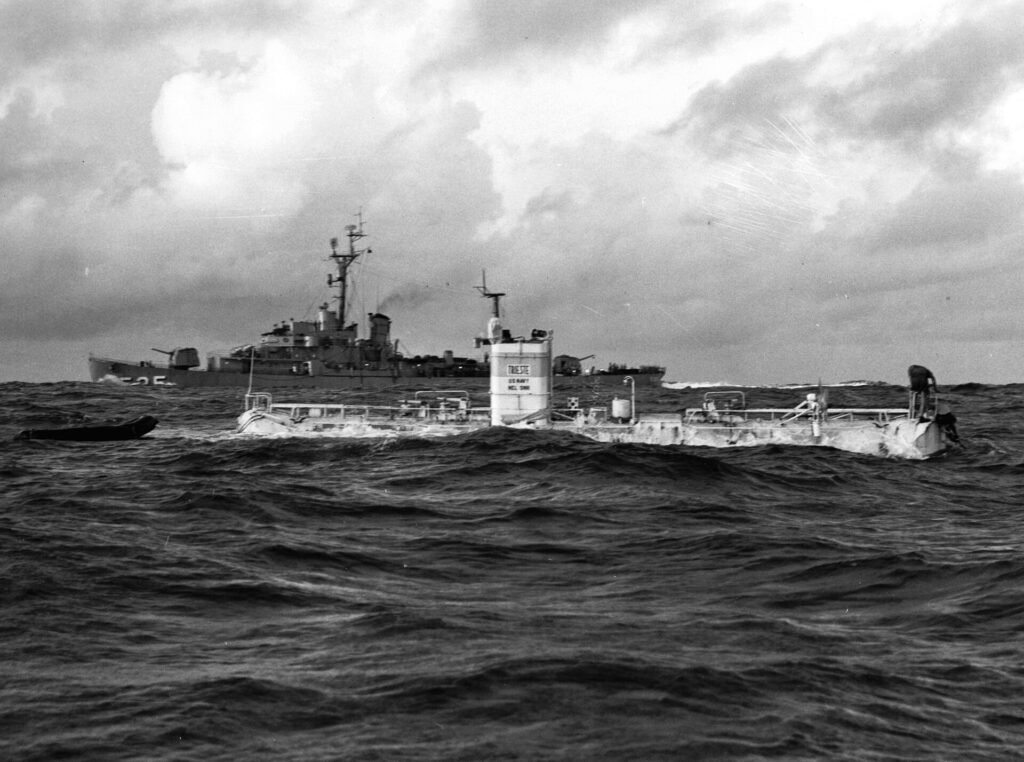
The Mariana Trench is the deepest known part of the ocean, an arc-shaped trough in the western Pacific Ocean. HMS Challenger first sounded the trench in 1875, and in 1960 the bathyscaphe Trieste carried two men to the bottom of its deepest spot, Challenger Deep.
Background
The trench stretches about 2,500 kilometers in an arc edged by islands such as Guam and Saipan. It formed where the old, cold Pacific plate sinks beneath the younger Philippine plate, a process called subduction that is explained further in the entry on plate tectonics. Challenger Deep is a valley at its southern end.
The scale is hard to picture. NASA’s Earth Observatory notes that the depths dwarf the tallest mountains and that the water pressure exceeds 1,000 atmospheres. EARTH magazine adds that if Mount Everest, at 8,848 meters, were set into Challenger Deep, about 2,000 meters of water would cover its peak.
For most of history nobody could measure such depths. After the Second World War, NOAA records, electronic echo sounding became the common way to chart the seafloor, and it made much more detailed mapping possible.
The discovery
The Mariana Trench was first sounded by HMS Challenger in 1875, according to NOAA’s ocean exploration timeline. The trench was sounded again in 1951 by HMS Challenger II. These early soundings established that the Pacific held a deep trough near the Mariana Islands, long before anyone could go there.
The first human visit came in 1960. The Trieste was a bathyscaphe designed by the Swiss physicist Auguste Piccard. It had a cylindrical body full of float tanks holding gasoline, which is nearly incompressible, and a heavy crew sphere slung beneath. It first launched in 1953 as a deep-diving vessel for the French Navy, and the U.S. Navy acquired it for Project Nekton.
A Navy announcement of the time described Project Nekton as an effort to gather scientific knowledge about conditions such as sunlight penetration and underwater visibility. At 11,000 meters the water pressure is more than 1,000 times the pressure at the surface, and EARTH magazine compares the challenge of reaching the bottom with that of climbing Everest.
The Trieste left San Diego on 5 October 1959 and traveled more than 10,000 kilometers to the trench. On 7 January 1960 it set a record by diving to 7,000 meters. On 23 January 1960 Jacques Piccard, Auguste’s son, and U.S. Navy Lieutenant Don Walsh began the final dive.
How the dive was made
Before the dive, the team had to find the deepest spot. They dropped sticks of TNT and timed the returning echoes, the longest of which took 14 seconds. The Trieste also made test dives, including one that left Guam in November 1959. Before 1960 the deepest dive on record was 5,532 meters, also made by the Trieste.
The craft descended as water slowly filled its open ballast tanks and gasoline was released from the float tanks. According to Walsh’s report, sunlight reached about 240 meters, after which the sea fell to darkness. For the ascent, the crew released iron shot that served as ballast in place of compressed air.
How it was confirmed
The descent took four hours and 48 minutes. About halfway down, the sonar telephone failed, and the two men could only send tone pulses. At about 9,000 meters a window in the entrance tunnel cracked, but the sphere held, and they continued. They reached the bottom at 10,916 meters, according to EARTH magazine. NOAA’s timeline gives the observed depth as 10,915 meters.
They stayed for roughly 20 minutes, in water close to 7 degrees Celsius. Piccard and Walsh reported seeing sea creatures in the beam of the vessel’s light, a flat white fish and small red shrimp. At the time many scientists had been fairly sure that nothing could live at such a depth. Then they dropped iron shot used as ballast and made the three-hour ascent.
Later missions repeated the visit with machines. A Japanese vehicle called Kaiko went into the trench three times between 1995 and 1998. In May 2009 the hybrid vehicle Nereus reached 10,902 meters. In March 2012 the filmmaker James Cameron became the first person in more than 50 years to dive to Challenger Deep in a submersible.
Differing depth figures
Sources give several depths for the bottom of the trench because the figure depends on the instrument and survey used. NOAA lists 10,915 meters for the 1960 dive and 10,938 meters from a Japanese research vessel in 1998. EARTH magazine reports that the officially measured depth is now 10,971 meters.
A 2010 mapping survey led by James Gardner of the University of New Hampshire and Andrew Armstrong of NOAA produced an estimate of 10,994 meters, plus or minus 40 meters, which NASA described as the most precise to date. The survey also found four deep-water bridges crossing the trench and standing as much as 2,500 meters above the trench floor. The resulting map had a resolution of 100 meters per pixel, nearly 20 times finer than earlier maps.
Impact and legacy
The 1960 dive showed that people could reach the deepest ocean floor. Don Walsh’s dive came seven years after Edmund Hillary and Tenzing Norgay climbed Everest, and it opened a long period of work on deep-sea vehicles. Similar craft, such as Alvin, later explored sites like hydrothermal vents. NOAA’s timeline notes that the Alvin submersible was launched in 1964 and that Scripps began developing the Deep Tow system in 1961, a forerunner of later remotely operated vehicles. Any submarine or submersible that works at depth must also cope with the pressure that Piccard and Walsh faced.
The trench remains a focus for research on subduction and on how life survives under extreme pressure. Each new survey has improved the map of this region.
Key facts
- HMS Challenger first sounded the Mariana Trench in 1875.1
- HMS Challenger II sounded the trench again in 1951.1
- Jacques Piccard and Don Walsh reached the bottom in the Trieste on 23 January 1960.2
- The 1960 dive reached about 10,916 meters, according to EARTH magazine, and 10,915 meters, according to NOAA.2
- A 2010 survey estimated the depth of Challenger Deep at 10,994 meters, plus or minus 40 meters.3
- The trench is about 2,500 kilometers long.3
Related concepts
Quick checkWhen was the Mariana Trench discovered?Show answer
HMS Challenger first sounded it in 1875, and two men reached the bottom of Challenger Deep in the bathyscaphe Trieste on 23 January 1960.
Sources
- 1. NOAA Ocean Exploration, History Timeline: The Age of Electronics II (1946-1970), https://oceanexplorer.noaa.gov/history/timeline-the-age-or-electronics-2-1946-1970/
- 2. EARTH Magazine, Benchmarks: January 23, 1960: Humans reach the deepest point on Earth, https://www.earthmagazine.org/article/benchmarks-january-23-1960-humans-reach-deepest-point-earth/
- 3. NASA Earth Observatory, New View of the Deepest Trench, https://science.nasa.gov/earth/earth-observatory/new-view-of-the-deepest-trench-77640/
Editorially reviewed by Specialty Digest Editorial TeamLast reviewed November 5, 2026Researched and drafted with AI assistanceReport an issue