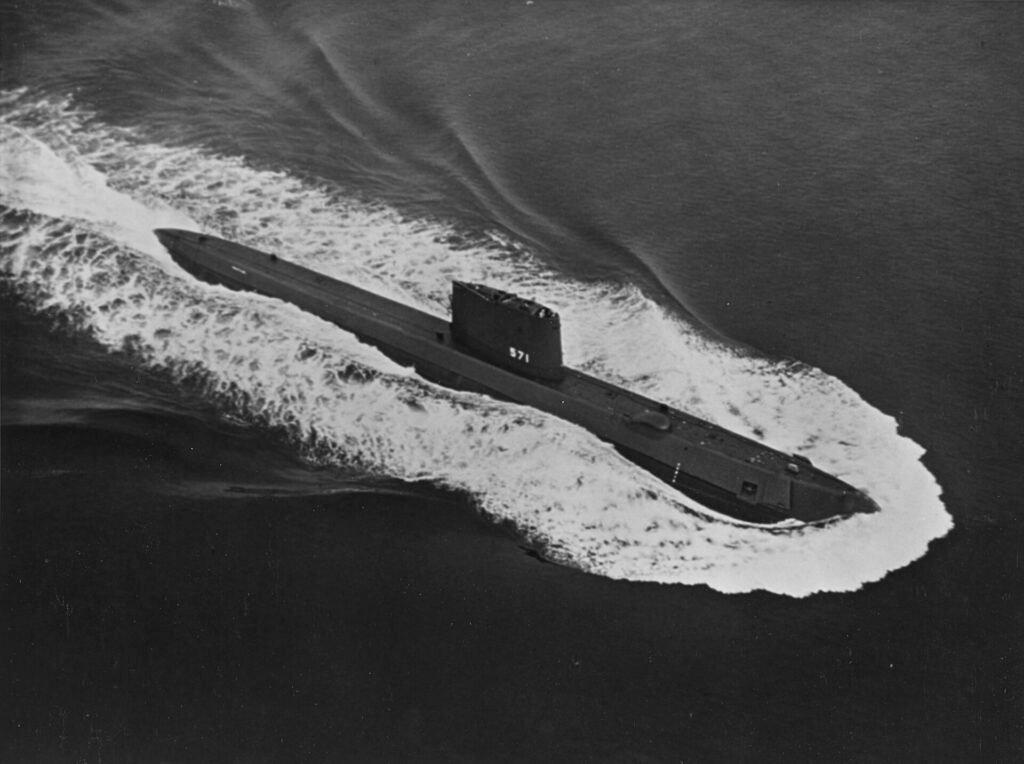
A submarine is a vessel that can travel beneath the surface of the water as well as on top of it, and the term is used most often for naval warships. The idea is old, but practical boats date from the 1600s to the 1900s, when electric motors, diesel engines and finally nuclear reactors gave them the range to operate for long periods. No single inventor created the submarine, and builders in several countries supplied essential parts.
History of the submarine
Proposals for underwater boats began in the late 1500s. The Dutch inventor Cornelis Drebbel likely built and tested the first one in the early 1600s, a leather-covered rowboat with 12 oars that was reinforced with iron. It was tried on the River Thames for the English court between 1620 and 1624, but the Royal Navy lost interest and no more were built.
During the American Revolution, David Bushnell built the Turtle, a one-man craft made of oak that could dive to about 20 feet and stay down for up to half an hour. On September 6, 1776, Sergeant Ezra Lee tried to attach an explosive charge to the British ship HMS Eagle in New York Harbor. The attempt failed, and a U.S. Naval Institute article describes it as the first actual submarine attack attested by definite records.
Robert Fulton experimented with designs in the early 1800s, and his Nautilus of 1801 carried a crew of four with about three hours of air. The Confederate submarine H. L. Hunley became the first to sink a ship in battle on February 17, 1864, when it destroyed the 1,240-ton USS Housatonic off Charleston, South Carolina. The Hunley’s nine-man crew was lost, and the boat was raised from the harbor on August 8, 2000.
Later designs tried other power. Steam drove the Nordenfeldt boats of the 1880s, and the Spanish Navy’s Peral of 1889 ran on electricity. The U.S. Navy acquired its first submarine, the Holland, on April 11, 1900.
Inventor and origins of the submarine
Credit is divided among several people. Drebbel built the first known practical submersible, Bushnell made the first recorded attack, Fulton and the builders of the Spanish Navy’s Peral advanced the design, and the Irish immigrant John P. Holland created the model that fleets followed before World War I. Simon Lake added bow and stern diving planes for depth control in the 1890s.
Some claims are uncertain. A 1936 account says Drebbel demonstrated his boat to King James I, but a later history calls the claim that the king took a test dive apocryphal. The Library of Congress says only that Drebbel likely built the first submarine.
How a submarine works
A submarine dives by taking in seawater as ballast and rises by expelling it. The Turtle had lead ballast low in the hull and a ballast tank, and the operator opened a foot-operated flood valve and used two pumps to empty the tank. The boat also carried lead weights that could be released from inside if it became too heavy to hold its depth.
The Hunley used manual pumps to change its ballast and diving planes on each side of the hull, and it had a snorkel to supply air. Lake’s boats put planes at the bow and stern. The Turtle moved with a crank-driven propeller, steered with a rudder, and used a tube with a floating cork and phosphorus as a depth gauge.
Air is the other limit. Early boats could stay under only briefly, which is why equipment that extracts oxygen from seawater, together with nuclear power, later let submarines remain submerged for weeks or months.
Types of submarines
Boats are grouped by size, power and mission. Early human-powered boats included Drebbel’s rowboat and Fulton’s Nautilus, and one-man or midget craft include the Turtle and the Japanese midget submarines of World War II, which had a range of about 80 miles.
Power changed the design again and again. The Holland used a gasoline engine on the surface and a battery-driven motor below, with a single tube for 18-inch torpedoes. The German U-20 was a diesel-electric boat of about 650 tons on the surface and 837 tons submerged. The nuclear USS Nautilus of 1955 was followed by ballistic missile submarines, which are known as strategic submarines, while attack submarines form a separate class.
Impact of the submarine
Submarines changed naval warfare in World War I. On September 22, 1914, the German U-9 sank three British cruisers with six torpedoes, and on May 7, 1915, the U-20 sank the liner Lusitania. Germany later resumed unrestricted submarine warfare, which helped bring the United States into the war.
In World War II, German U-boats hunted in groups called wolf packs against Allied convoys. The British broke German codes and used radar and direction finders to locate them. The U.S. Navy had 314 submarines in the war, lost 52, and sank more enemy supply ships than all other weapons combined.
The Holland Torpedo Boat Company, which built the boat that became a model for navies, was a forerunner of General Dynamics. Theodore Roosevelt, then Assistant Secretary of the Navy, watched the Holland’s sea trials and recommended that the Navy buy it, and the boat was formally commissioned in 1900. By the start of World War I, Holland-inspired vessels served in large fleets around the world.
Uses of submarines today
Nuclear power removed the need to surface often. USS Nautilus went to sea in 1955 as the first nuclear-powered submarine, and in 1958 it made the first voyage beneath the Arctic ice cap. The power came from a nuclear reactor, which does not need air to run, and equipment that extracts oxygen from seawater allowed crews to stay down for long stretches.
Modern navies operate attack boats and ballistic missile boats. The historic ancestors, from the Turtle to the Hunley, are known today through museums and recovered wrecks such as the Hunley itself.
More in Maritime and Rail Transport
Key facts
- Cornelis Drebbel likely built and tested the first submarine, a rowboat tried on the Thames between 1620 and 1624.23
- David Bushnell's Turtle made the first recorded submarine attack, on HMS Eagle in 1776.2
- The Confederate H. L. Hunley sank USS Housatonic on February 17, 1864.1
- The U.S. Navy acquired its first submarine, the Holland, on April 11, 1900.1
- USS Nautilus, the first nuclear-powered submarine, went to sea in 1955 and sailed beneath the Arctic ice cap in 1958.3
Related concepts
In the news
Quick checkWho invented the submarine?Show answer
No single person did. Cornelis Drebbel built the first known practical boat in the 1620s, David Bushnell made the first recorded attack in 1776, and John P. Holland designed the model that navies adopted around 1900.
Sources
- Library of Congress, Today in History: April 11, https://www.loc.gov/item/today-in-history/april-11
- U.S. Naval Institute Proceedings, The First American Submarine (1936), https://www.usni.org/magazines/proceedings/1936/december/first-american-submarine
- Warfare History Network, Evolution of the Submarine, https://warfarehistorynetwork.com/article/evolution-of-the-submarine/
Editorially reviewed by Specialty Digest Editorial TeamLast reviewed November 4, 2026Researched and drafted with AI assistanceReport an issue