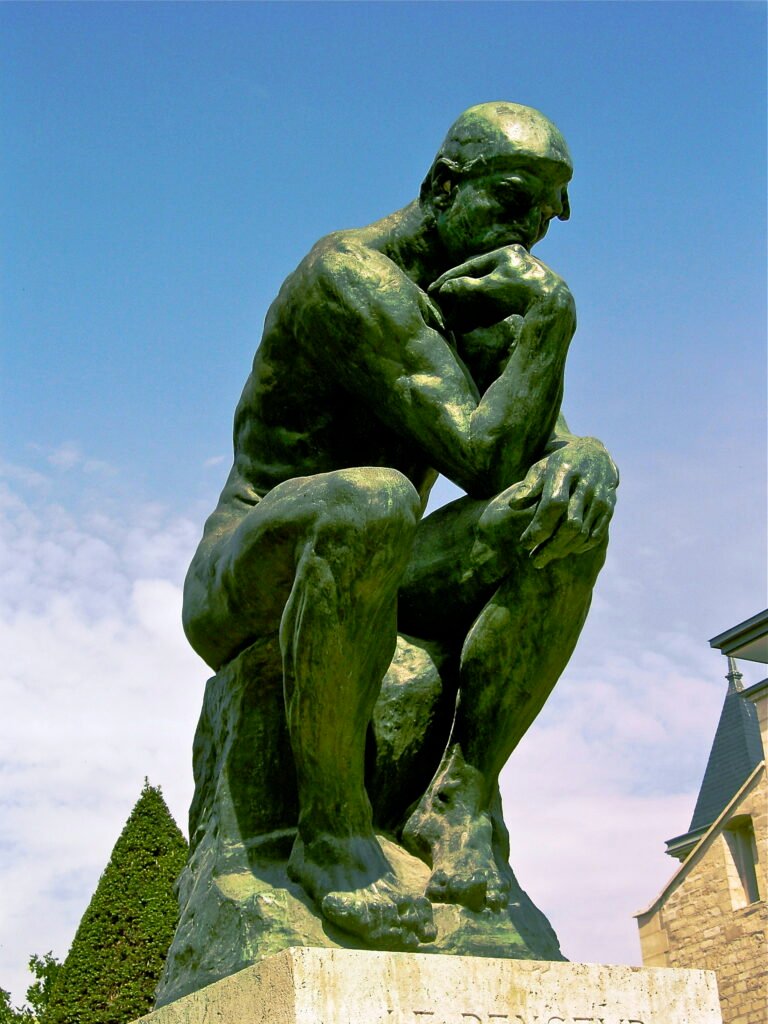
The Thinker is a bronze sculpture by the French artist Auguste Rodin, showing a nude man seated on a rock with his chin resting on his hand. Rodin conceived it in 1880 as a small figure for the top of a monumental doorway, The Gates of Hell, and it later became an independent work that was cast many times at a larger size. It is now one of the most recognized sculptures in the world.
Background and creation of The Thinker
In 1880 the French government commissioned Rodin to make bronze doors for a museum that was to be built but never was. Rodin spent years on the project, which he based on the Inferno, the first part of Dante’s Divine Comedy. The figure was designed to sit on the tympanum, the panel above the doors, looking down at the twisting bodies below.
At first the figure was about 70 centimeters tall and was called The Poet. According to the Musée Rodin, it represented Dante leaning forward to observe the circles of hell while meditating on his work. The museum describes the figure as both a being with a tortured body, almost a damned soul, and a free-thinking man trying to rise above his suffering through poetry.
The pose drew on earlier sculpture. The Musée Rodin points to two sources, Jean-Baptiste Carpeaux’s Ugolino of 1861 and Michelangelo’s seated portrait of Lorenzo de’ Medici, carved between 1526 and 1531.
Description of The Thinker
The figure sits hunched, with the right elbow resting on the left knee and the chin on the back of the right hand. The musculature of the back, shoulders and legs is exaggerated, giving the impression of a body under strain. The Musée Rodin says the powerful body suggests a great capacity for action even though the man is lost in thought.
The cast in the gardens of Rodin’s house at Meudon is made of bronze and measures 189 centimeters high, 98 wide and 140 deep. It dates from 1903 in the museum’s catalog and stands on the tomb of the sculptor and his wife.
Themes and interpretation of The Thinker
The Musée Rodin stresses a tension in the figure. It is at once a tormented body and a mind trying to rise above suffering through poetry. On the doors this tension had a clear literary setting, since the figure was Dante surveying the circles of hell.
Once the figure was exhibited alone, that setting fell away. Viewers could no longer rely on the doors to tell them who he was, and the figure came to be read more generally as a man deep in thought. That change from a specific poet to a universal thinker is an interpretation, but it fits the museum’s account of how the sculpture became independent in 1888.
The borrowed pose adds another layer. By echoing Michelangelo’s seated Lorenzo de’ Medici, Rodin linked his figure to a Renaissance tradition of contemplation, and by echoing Carpeaux’s Ugolino he linked it to the same Dantean theme of suffering.
From The Gates of Hell to a stand-alone work
The Thinker remained in place on The Gates of Hell, but it was shown separately in 1888 and became an independent work. Its popularity led Rodin to produce a colossal version. The Musée Rodin dates the enlargement to 1904, while a history by Joe Schwarcz of McGill University places the first large casting in 1903.
The enlargement was done with a pantograph, an instrument of linked arms that traces an object and scales it up, and Rodin’s assistants used it to make a large clay model that was cast in bronze. Rodin wanted the first large cast shown at the 1904 World’s Fair in St. Louis, but he changed his mind and sent a plaster painted to look like bronze instead. That first bronze is now in Louisville, Kentucky, in front of Grawemeyer Hall at the University of Louisville, and the large plaster belongs to the Metropolitan Museum of Art, which does not display it.
Rodin’s original clay model has not survived, but the Musée Rodin owns a 70-centimeter plaster cast. The first bronze of that small version was cast in 1884 and is in the National Gallery of Victoria in Melbourne. A cast in the museum’s garden in Paris was a gift to the City of Paris and was installed outside the Panthéon in 1906.
Casts, patina and The Gates of Hell
Once a mold exists, any number of bronzes can be made. McGill’s account says there are about 28 large casts around the world. One bought by the German collector Dr. Max Linde stood in his garden in Lubeck, and the Norwegian painter Edvard Munch, already famous for The Scream, painted it there. That cast is now at the Detroit Institute of Arts, and Munch’s painting of it can be seen at the Rodin Museum.
The large casts do not all look alike. Bronze is mostly copper, and copper reacts with oxygen and carbon dioxide in the air to form oxides and carbonates, which produce a patina that ranges from black to green.
Rodin finished a plaster of The Gates of Hell but never saw it cast in bronze. The first bronze was made after his death, and examples are now in Paris, Philadelphia, Stanford and Tokyo.
Reception and legacy of The Thinker
The Musée Rodin calls the figure of a man lost in thought, with a powerful body that suggests a capacity for action, one of the most celebrated sculptures ever known. Because it can be read as a poet, a damned soul or a universal figure of reflection, it has been used to represent human thought in many settings.
The work belongs to the long tradition of sculpture in bronze, and its popularity shows how a single figure can outgrow the larger project it was made for.
More in Visual Arts
Key facts
- The Thinker is a bronze sculpture by Auguste Rodin, conceived in 1880 as the crowning figure of The Gates of Hell.1
- It was first called The Poet and represented Dante, author of the Divine Comedy.1
- It was shown separately in 1888 and enlarged in 1904, according to the Musée Rodin.1
- The Meudon cast is bronze, 189 centimeters high, and stands on the tomb of Rodin and his wife.1
- About 28 large casts exist worldwide.2
Related concepts
Quick checkWho is The Thinker meant to represent?Show answer
It was first called The Poet and represented Dante contemplating the circles of hell in The Gates of Hell. Once shown on its own, it came to stand for thought more generally.
Sources
- Musee Rodin, The Thinker (collection record, Meudon cast), https://www.musee-rodin.fr/en/musee/collections/oeuvres/penseur-meudon
- Joe Schwarcz, Thinking About The Thinker, McGill University Office for Science and Society, https://www.mcgill.ca/oss/article/history/thinking-about-thinker
Editorially reviewed by Specialty Digest Editorial TeamLast reviewed November 5, 2026Researched and drafted with AI assistanceReport an issue