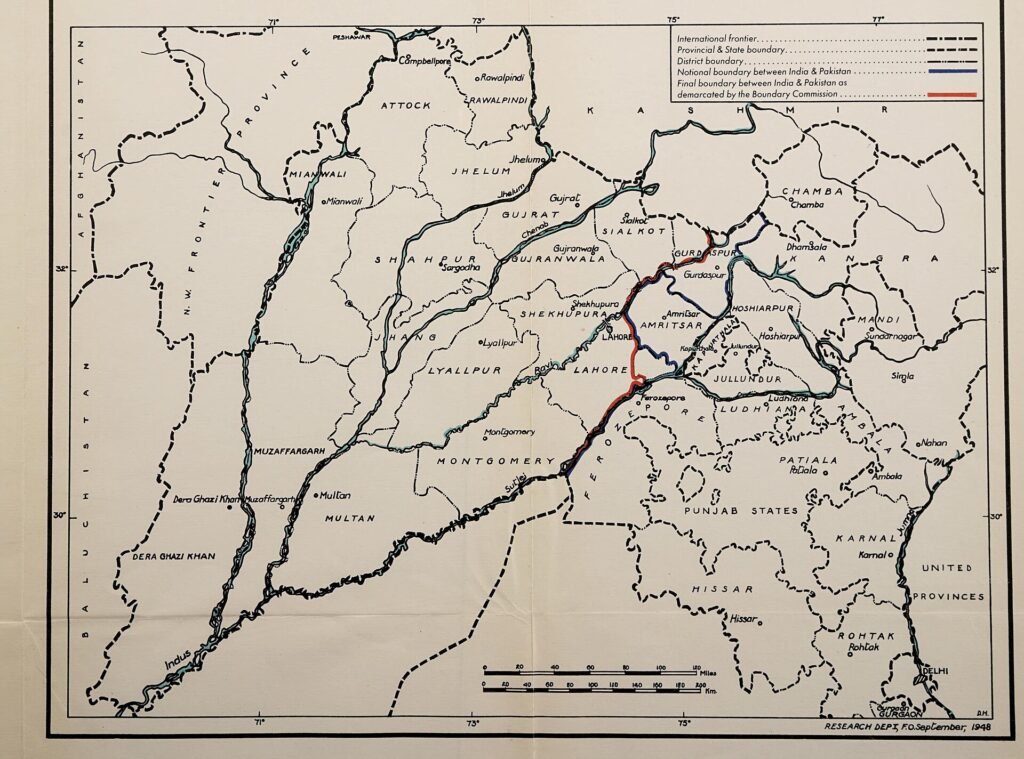
The Partition of India was the division of British India into two independent dominions, India and Pakistan, on 15 August 1947. It ended British rule in South Asia and drew a new border through the provinces of Punjab and Bengal. The division was followed by violence and one of the largest mass migrations in human history.
Background to the Partition of India
By the mid-1940s British rule in India was ending. Britain had been weakened by the Second World War, and the Indian National Congress and the All-India Muslim League could not agree on a shared constitutional future. The Muslim League demanded a separate state for the subcontinent’s Muslims, while Congress sought a single independent country. The Imperial War Museums describe Partition as the point where British colonial rule ended and the country split into two.
Lord Mountbatten was sent to India in February 1947 to oversee Britain’s withdrawal. On 3 June 1947 he announced, together with Jawaharlal Nehru and Muhammad Ali Jinnah, that power would pass to two governments, India and Pakistan, a year earlier than had been planned. The shorter timetable left very little time to settle questions of territory, armies, assets and administration.
Punjab and Bengal were the hardest cases. Both provinces had roughly equal numbers of Muslims and non-Muslims, so any border had to divide communities that had lived side by side for generations. In July 1947 a Boundary Commission was created to recommend how the two provinces would be split. It was chaired by Sir Cyril Radcliffe and had eight other members, four nominated by Congress and four by the Muslim League. According to The National Archives in the United Kingdom, officials had only nine weeks to work out the division.
Course of the Partition
The Indian Independence Act 1947, passed by the British Parliament in July 1947, set the legal framework. It provided that from 15 August 1947 two independent dominions, India and Pakistan, would be set up. The Province of Bengal ceased to exist and was replaced by East Bengal and West Bengal, and the Punjab was likewise divided. Pakistan was to include East Bengal, West Punjab, Sind and British Baluchistan, with other areas able to join after a referendum. The Act did not prevent Indian princely states from acceding to either dominion.
Independence was declared on 14 and 15 August 1947. The borders were announced only on 17 August, two days after independence, so people celebrated without knowing which side of the line their homes would fall on. The line ran through villages, towns and farms, and through the families and religious sites of the people who lived there. The city of Lahore, important to Sikhs as well as to others, fell on the Pakistani side, even though Sikh groups had appealed for recognition of their history before the line was drawn.
Violence broke out in the Punjab and elsewhere as the news spread. The National Archives notes that much of it was organized by militias linked to political parties rather than being random. Contemporary officials struggled to explain it. Lord Ismay observed that it would be hard to find two people who agreed on how the trouble started, and wrote that neither its character nor its extent had been anticipated by anyone in authority. By late August 1947 The Times of London was reporting massacres in East Punjab.
Aftermath of the Partition
Millions of people crossed the new borders in the months around August 1947. The National Archives states that more than 15 million are thought to have migrated, and a 1948 report by an official named Shattock described the evacuation of about four million Muslims from the Punjab and the arrival of a similar number of Hindus and Sikhs from West Pakistan. The 1947 Partition Archive gives a higher figure, saying that up to 25 million people were uprooted through the 1950s. These figures use different dates and definitions, so they are best read as a range.
The number of deaths is uncertain. At the time, General Rees suggested only a few thousand, while The Times argued the toll was likely much higher. More recent estimates are far larger. Britannica says that as many as 2,000,000 people may have been killed in communal violence and notes that scarce documentation leaves a wide range of estimates. The 1947 Partition Archive cites nearly 2 million deaths. No figure can be treated as exact.
The new states faced an immediate refugee crisis. Governments in both countries had to house, feed and resettle millions of people who had left property and livelihoods behind. Disputes over territory also began almost at once, and the Imperial War Museums note that several wars have been fought over the border since 1947 and that tensions continue between the two nuclear-armed neighbors.
Significance and legacy of the Partition
Partition reshaped South Asia. It created the modern states of India and Pakistan, and East Bengal later became part of the independent country of Bangladesh after 1971. It also left a lasting mark on the memory and identity of families on both sides of the border, many of whom still describe themselves in terms of the homes they left.
Much of what is known about everyday experience comes from witnesses. The 1947 Partition Archive says that it has preserved more than 12,000 recorded memories of people who lived through the period, and the Imperial War Museums cite the Partition Voices oral-history project. Historians use such testimony alongside official records, which are incomplete, to understand how the division was lived.
Questions about how Partition happened remain open to debate. Scholars still discuss whether the timetable was too short, how much responsibility lay with British officials, party leaders or local militias, and whether the violence could have been prevented. Because the evidence is contested and the casualties were so great, the event is usually presented with ranges and with the caution that no single account is complete.
More in History
Key facts
- Under the Indian Independence Act 1947, two independent dominions, India and Pakistan, were set up from 15 August 1947.1
- Mountbatten announced the plan with Nehru and Jinnah on 3 June 1947, bringing the transfer of power forward by a year.2
- The Boundary Commission, chaired by Sir Cyril Radcliffe, had about nine weeks to divide Punjab and Bengal; the borders were announced on 17 August 1947.2
- More than 15 million people are thought to have migrated across the new borders; one archive cites up to 25 million uprooted through the 1950s.2
- Estimates of deaths go up to about 2,000,000, with scarce documentation and a wide range of estimates.4
- The Imperial War Museums describe the migration as one of the largest in human history.3
Related concepts
Quick checkWhy was India partitioned in 1947?Show answer
British rule was ending, and Congress and the Muslim League could not agree on a united independent state, so Britain divided the territory into India and Pakistan.
Sources
- UK Parliament, Indian Independence Act 1947 (legislation.gov.uk), https://www.legislation.gov.uk/ukpga/Geo6/10-11/30/enacted
- The National Archives (UK), Partition of British India education resource, https://cdn.nationalarchives.gov.uk/documents/education/partition-of-british-india.pdf
- Imperial War Museums, Partition of India in 1947, https://www.iwm.org.uk/history/partition-of-india-why-india-was-divided-in-1947
- Encyclopaedia Britannica, What were the consequences of the Radcliffe Line creation, https://www.britannica.com/question/What-were-the-consequences-of-the-Radcliffe-Lines-creation
- The 1947 Partition Archive, About Us, https://www.1947partitionarchive.org/about
Editorially reviewed by Specialty Digest Editorial TeamLast reviewed November 4, 2026Researched and drafted with AI assistanceReport an issue