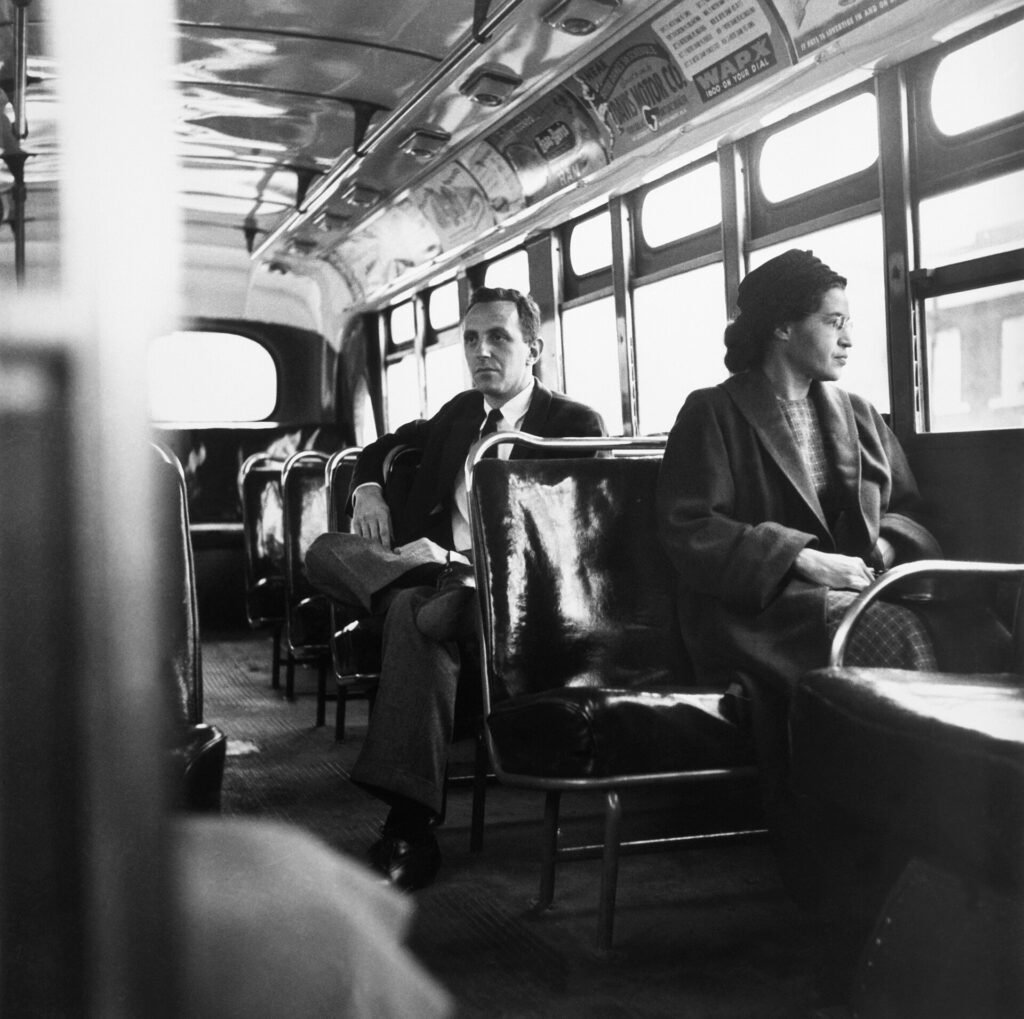
The Montgomery bus boycott was a mass protest by Black residents of Montgomery, Alabama, in the United States against segregated city buses. It lasted for 13 months, from December 1955 to December 1956, and ended after the U.S. Supreme Court affirmed that segregated seating on public buses was unconstitutional. The campaign made Martin Luther King Jr. a national figure and became a model for nonviolent protest in the civil rights movement.
Background of the Montgomery bus boycott
Montgomery, like most southern cities in the 1950s, was thoroughly segregated. After the Supreme Court’s 1954 decision in Brown v. Board of Education, which outlawed segregation in schools, civil rights workers saw an opportunity for change. In Montgomery, activists focused on the city buses.
Black riders made up about three-quarters of the passengers, yet they had to sit in the back. They also had to pay at the front, step off the bus, and re-enter through the rear door. Sometimes the driver pulled away before they could board again. If a white passenger could not find a seat, a Black passenger was ordered to stand.
The roots of the boycott went back years. The Women’s Political Council, a group of Black professionals founded in 1946, met Mayor W. A. Gayle in March 1954 and asked for modest changes. They wanted no one made to stand over empty seats, no Black passengers made to pay at the front and enter at the rear, and buses to stop at every corner in Black neighborhoods, as they did in white ones. The meeting produced no change. In May 1954, council president Jo Ann Robinson wrote to the mayor that a city-wide boycott was under discussion.
Challenges to the system followed. In March 1955, a 15-year-old named Claudette Colvin was arrested for refusing to give up her seat. Seven months later, 18-year-old Mary Louise Smith was arrested on similar grounds. Neither case mobilized the community as the arrest of Rosa Parks did.
Course of the boycott
On the evening of 1 December 1955, Rosa Parks, a 43-year-old seamstress and civil rights worker, refused to give up her seat to a white passenger and was arrested. The Women’s Political Council called for a one-day boycott on 5 December, and Robinson prepared and distributed leaflets. Local leaders, including the former NAACP branch president E. D. Nixon, met at Dexter Avenue Baptist Church on 2 December and agreed to publicize it.
On 5 December, about 90 percent of Montgomery’s Black citizens stayed off the buses. That afternoon, leaders formed the Montgomery Improvement Association and elected King, who was new to the city, as its president. At a mass meeting that evening at Holt Street Baptist Church, the association voted to continue the boycott.
On 8 December, the association issued its demands: courteous treatment by drivers, first-come first-served seating with Black passengers filling from the rear and white passengers from the front, and Black drivers on mostly Black routes. These were not met, so the boycott went on through 1956.
Protesters walked, rode bicycles or used an organized carpool system of about 300 cars, which followed the advice of T. J. Jemison, who had run a carpool during a 1953 bus boycott in Baton Rouge. The city began to penalize Black taxi drivers who helped the boycotters. In early 1956, the homes of King and Nixon were bombed. City officials obtained injunctions against the boycott in February 1956 and indicted more than 80 leaders under a 1921 law against conspiracies that interfered with lawful business. King was convicted and ordered to pay 500 dollars or serve 386 days in jail.
Women played crucial roles. Robinson, Johnnie Carr and Irene West sustained the association’s committees and volunteer networks, and the activist Mary Fair Burks credited the unnamed cooks and maids who walked long distances for a year. Advisers such as the pacifists Bayard Rustin and Glenn Smiley visited in early 1956 and discussed the ideas of Mahatma Gandhi with King, who developed his own approach to nonviolence. National coverage of the boycott and of King’s trial brought support from outside Montgomery, and Rustin, Ella Baker and Stanley Levison founded the group In Friendship to raise money in the North for southern civil rights efforts.
Court decision and end of the boycott
The boycott was also fought in court. On 5 June 1956, a federal district court ruled in Browder v. Gayle that bus segregation was unconstitutional. In November 1956, the Supreme Court affirmed that ruling and struck down laws requiring segregated seating on public buses.
The association continued the boycott until the order reached Montgomery. On 20 December 1956, King called for it to end. The next morning he boarded an integrated bus with Ralph Abernathy, E. D. Nixon and Glenn Smiley.
Significance and legacy
The boycott showed that ordinary people acting together could challenge segregation, and it gave the movement an early success. The Stanford King Institute states that it demonstrated the power of nonviolent mass protest and served as an example for campaigns across the South. Similar boycotts took place in Birmingham and Mobile in Alabama and in Tallahassee, Florida.
A few weeks after the boycott ended, southern Black religious leaders who had supported it formed the Southern Christian Leadership Conference, which elected King as its first president. Parks became a symbol of courage and dignity.
Although much of the publicity centered on Black ministers, women were crucial to the boycott. Much of the planning came from the Women’s Political Council and local organizers, and the daily sacrifice fell on thousands who walked. In his 1958 memoir Stride Toward Freedom, King said the real meaning of the boycott was the power of growing self-respect, and he recalled that it was more honorable to walk in dignity than to ride in humiliation.
More in History
Key facts
- Rosa Parks was arrested on 1 December 1955 for refusing to give up her bus seat to a white passenger.2
- About 90 percent of Montgomery's Black citizens stayed off the buses on 5 December 1955.1
- The Montgomery Improvement Association was formed on 5 December 1955 and elected Martin Luther King Jr. as its president.1
- On 5 June 1956 a federal court ruled in Browder v. Gayle that bus segregation was unconstitutional, and the Supreme Court affirmed the ruling in November 1956.1
- King called for the end of the boycott on 20 December 1956, after 13 months.1
Related concepts
Quick checkHow long did the Montgomery bus boycott last?Show answer
It lasted 13 months. It began with a one-day boycott on 5 December 1955 and ended when King called for it to stop on 20 December 1956, after the Supreme Court affirmed that bus segregation was unconstitutional.
Sources
- Martin Luther King, Jr. Research and Education Institute, Stanford University, Montgomery Bus Boycott, https://kinginstitute.stanford.edu/montgomery-bus-boycott
- Government, Politics, and Protest: Essential Primary Sources via Encyclopedia.com, Montgomery Bus Boycott, https://www.encyclopedia.com/history/encyclopedias-almanacs-transcripts-and-maps/montgomery-bus-boycott
Editorially reviewed by Specialty Digest Editorial TeamLast reviewed November 4, 2026Researched and drafted with AI assistanceReport an issue