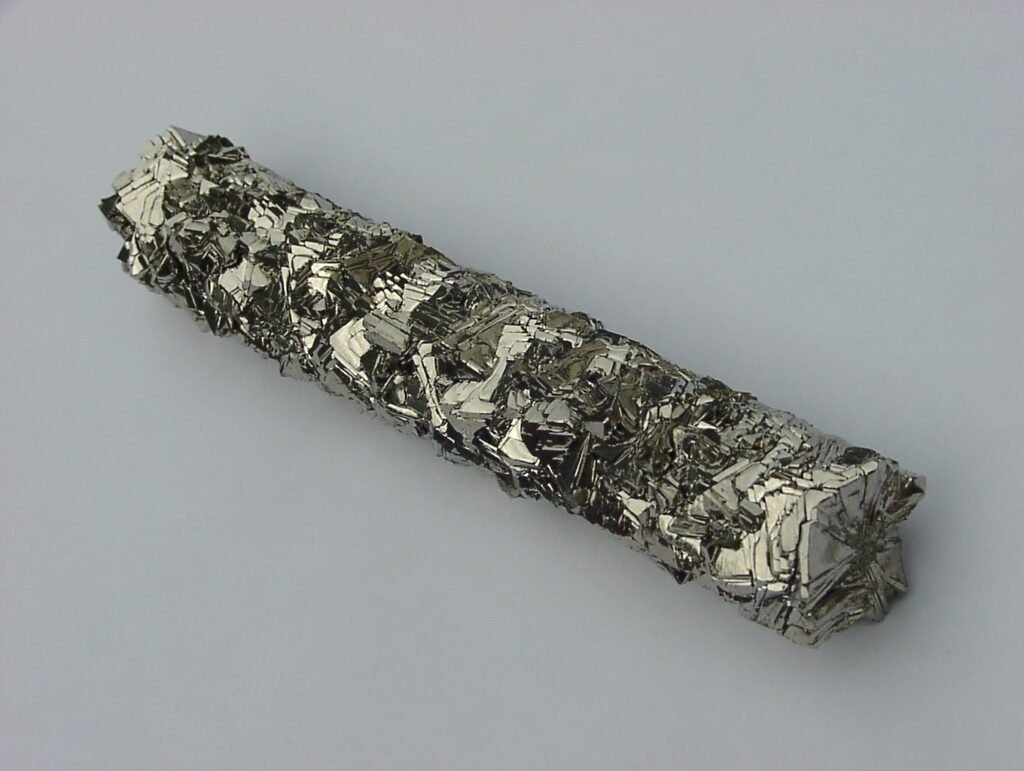
Titanium is the chemical element with atomic number 22 and the symbol Ti. It is a hard, shiny, silvery transition metal in group 4 of the periodic table that is as strong as steel but much less dense. Titanium resists corrosion extremely well, which is why it appears in aircraft, ships and medical implants.
History of titanium
The first titanium mineral was found in 1791 in Cornwall, England, by the Reverend William Gregor. He examined a black sand called menachanite and worked out that it contained the oxide of iron and the oxide of an unknown metal. He reported the finding to the Royal Geological Society of Cornwall.
In 1795 the German chemist Martin Heinrich Klaproth studied a red ore from Hungary, which was a form of rutile, or titanium dioxide. He realized that it contained a previously unknown element and named it titanium after the Titans, the sons of the Earth goddess in Greek mythology. When Klaproth heard of Gregor’s work, he examined the Cornish sand and confirmed that it also contained titanium. For this reason, the Royal Society of Chemistry credits Gregor with the discovery in 1791.
Pure titanium metal was difficult to make because the element combines very readily with oxygen and nitrogen at high temperatures. M. A. Hunter, who worked for General Electric in the United States, produced it in 1910 by heating titanium tetrachloride with sodium. A magnesium-based process developed later by William Kroll made large-scale production possible.
Properties of titanium
Titanium has a standard atomic weight of about 47.867 and an electron configuration of [Ar] 3d2 4s2. It usually has an oxidation state of +4 in compounds, though +3 and +2 also occur. PubChem lists an electronegativity of 1.54 and a first ionization energy of 6.828 electronvolts.
The metal melts at about 1,670 degrees Celsius and boils at about 3,287 degrees Celsius. Its density is about 4.5 grams per cubic centimeter, roughly 60 percent of that of steel. A given weight of titanium alloy can therefore carry loads comparable to steel while taking up more space but weighing much less.
Titanium resists corrosion because a thin oxide film forms on its surface and protects the metal beneath, even in seawater. It is also non-magnetic and withstands extremes of temperature well. These properties together explain why it is chosen for demanding environments.
Occurrence and production of titanium
The Royal Society of Chemistry describes titanium as the ninth most abundant element on Earth. It is found almost everywhere in igneous rocks and in the sediments formed from them, but rarely in rich concentrations. The main ore minerals are ilmenite, rutile and titanite, also called sphene, and it is present in many iron ores.
Titanium metal is produced commercially by the Kroll process. Titanium dioxide ore is first converted into titanium tetrachloride by heating it with carbon and chlorine, and the tetrachloride is then reduced with magnesium in an inert atmosphere. The result is a porous solid called titanium sponge, which is melted and cast into ingots. The inert gas used in the process is usually argon, as the hot metal would otherwise react with air.
The process is slow, uses a lot of energy and produces metal in batches, so titanium costs much more than steel or aluminum. Most mined titanium never becomes metal. Instead, ilmenite is processed by either the sulfate process or the chloride process to make titanium dioxide.
Uses of titanium
Titanium is used as an alloying agent with many metals, including aluminum, molybdenum and iron. An alloy is a metallic mixture designed to have better properties than its separate parts. Titanium alloys are used mainly in aircraft, spacecraft and missiles because of their low density and their ability to withstand extreme temperatures. They are also found in golf clubs, laptops, bicycles and crutches.
Because titanium resists seawater so well, it is used in desalination plants, in the condenser pipes of power stations, and to protect the hulls of ships, submarines and other structures exposed to the sea. Titanium also bonds well with bone and is accepted by the body. It is therefore used in surgical applications such as hip and other joint replacements and dental implants.
The largest use of titanium is in the form of titanium dioxide, which is a bright white pigment with excellent covering power. It is used in house paint, artists’ paint, plastics, enamels and paper. Titanium dioxide also reflects infrared radiation, so it is used in solar observatories where heat causes poor visibility. It is used in sunscreens, because it prevents ultraviolet light from reaching the skin.
Nanoparticles of titanium dioxide appear invisible when applied to skin, which has made them popular in cosmetic products. Titanium dioxide is also used as a photocatalyst, a material that uses light to drive chemical reactions, in self-cleaning glass and surfaces.
Isotopes of titanium
Titanium has five stable isotopes: titanium-46, titanium-47, titanium-48, titanium-49 and titanium-50. Titanium-48 is the most abundant, at about 73.7 percent. Titanium-46, titanium-47, titanium-49 and titanium-50 make up the rest, each between about 5 and 8 percent. An isotope is a version of an element with a particular number of neutrons.
The radioactive isotope titanium-44 has a half-life of about 60 years. It is produced in supernova explosions, and astronomers have detected its radiation from the remnant of a star that exploded long ago, which helps to test models of how stars die. The half-life is the time needed for half of a radioactive sample to decay.
Health and environmental effects of titanium
Titanium has no known biological role. The Royal Society of Chemistry describes the metal as non-toxic, and the body tolerates it well, which is why it is used for implants. However, fine titanium dioxide dust is a suspected carcinogen when inhaled, and workplace exposure limits for it exist in many countries.
Regulators in various regions have reviewed the use of titanium dioxide as a food additive and in cosmetics, and their conclusions have not always been the same. This entry is general background rather than health advice.
Mining ilmenite and rutile from beach sands and hard rock can disturb coastal and mountain ecosystems, and producing titanium dioxide pigment creates waste streams that must be managed. Recycling titanium scrap from machining operations is common in the aerospace industry and reduces demand for new metal.
Key facts
- Array
Related concepts
In the news
Quick checkWhy is titanium used in implants and aircraft?Show answer
Titanium is as strong as steel but much less dense, resists corrosion and bonds well with bone.
Sources
- Array
Editorially reviewed by Specialty Digest Editorial TeamLast reviewed November 4, 2026Researched and drafted with AI assistanceReport an issue