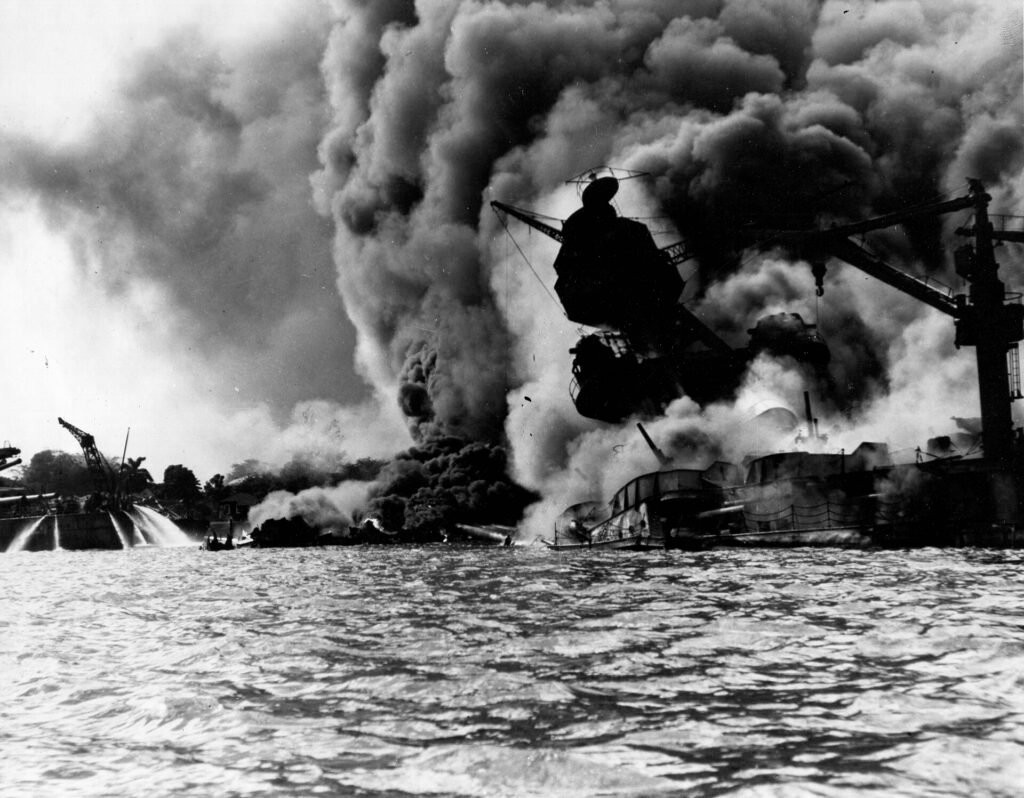
The attack on Pearl Harbor was a surprise Japanese air and naval strike on the United States Pacific Fleet at Oahu, Hawaii, on Sunday, 7 December 1941. More than 2,400 Americans were killed, and the United States entered World War II the following day. The raid sank or damaged many ships and aircraft, but the fleet’s aircraft carriers were not in port and escaped.
Background to the attack on Pearl Harbor
Relations between Japan and the United States worsened through the 1930s as Japan widened its war in China and looked toward Southeast Asia. In September 1940 Japan signed the Tripartite Pact with Germany and Italy. After Japan moved into Southeast Asia under an arrangement with Vichy France, the Roosevelt administration stopped shipments of scrap steel, oil and high-octane gasoline and froze Japanese financial assets in the United States.
The National Park Service says Japan had only about a six-month supply of strategic fuel. Japanese leaders concluded that they had to seize resources in Southeast Asia, which meant war with the United States, Britain and the Netherlands. They regarded the U.S. Pacific Fleet, stationed at Pearl Harbor, as the main obstacle.
Admiral Isoroku Yamamoto, commander of the Japanese Combined Fleet, proposed striking the fleet while it lay at anchor. Commander Minoru Genda drew up the operational plan, and an Imperial Conference approved it on 6 September 1941. Pearl Harbor is shallow, with an average depth of about 45 feet, so Japanese crews fitted their aerial torpedoes with wooden fins and trained in simulated conditions to make them work there.
A task force of 32 vessels, built around six aircraft carriers and commanded by Vice Admiral Chuichi Nagumo, left northern Japan on 26 November 1941. On 2 December it received the coded message ‘Climb Mt. Nitaka,’ the signal that the decision for war was final.
Course of the attack on Pearl Harbor
At 6:00 a.m. on 7 December the Japanese fleet was about 230 miles north of Oahu. The carriers launched a first wave of 183 aircraft, followed by a second wave of 167, which left about 350 planes in the air. More than half of the Pacific Fleet, roughly 150 vessels and service craft, was in the harbor that morning, including all but one of the fleet’s battleships.
Two warnings came before the first bombs fell. At 6:30 a.m. the destroyer USS Ward sank a submarine near the harbor entrance, but the report took about an hour to reach the fleet commander, Admiral Husband Kimmel. At 7:02 a.m. two Army operators at the Opana radar station on Oahu’s north shore picked up a large formation of aircraft. The officer they alerted believed it was a flight of American B-17 bombers, and no action was taken.
The first wave attacked at 7:55 a.m. Aircraft struck the battleships moored along Battleship Row and the airfields at Kaneohe, Hickam, Ewa, Bellows and Wheeler. The Japanese air commander, Mitsuo Fuchida, found that the carriers were absent, so the torpedo planes concentrated on the battleships.
Within 15 minutes the fleet’s main battle line was crippled. The Park Service lists the battleships California, Oklahoma, West Virginia, Nevada and Arizona as sunk, along with the old battleship Utah, which was then used for target training. Maryland, Tennessee and Pennsylvania were damaged. USS Arizona exploded after a bomb hit, and almost half of all the casualties occurred in that single explosion.
The first wave ended about 8:45 a.m., and a second wave of dive and high-altitude bombers arrived at 8:50 a.m. By about 10 a.m., 21 vessels had been sunk or damaged. Japanese losses were small: 29 aircraft and 55 airmen were lost, and all five midget submarines were destroyed, with 10 crewmen killed and one man captured the next day.
Fuchida wanted a third strike against the shipyard, the oil-storage facilities and the ships that remained. Nagumo, worried about fuel and about American carriers that might be searching for him, turned the task force back at about 1:00 p.m. The Park Service study calls this a major blunder that reduced the long-term effect of the attack.
Aftermath of the attack on Pearl Harbor
The Park Service reports that more than 2,400 Americans were killed and 1,104 wounded, while the National Archives gives 2,403 killed. About 75 percent of the aircraft on the airfields around Pearl Harbor were damaged or destroyed. The three Army airfields at Hickam, Wheeler and Bellows lost 217 men and 77 aircraft.
Civilians were also killed. The Pearl Harbor National Memorial records 49 civilian deaths and 35 injuries on Oahu. Many of the five-inch anti-aircraft shells fired at the attackers failed to explode in the air and detonated when they landed in civilian areas, and fires spread in neighborhoods because many fire departments were already working at military sites.
On 8 December 1941 President Franklin Roosevelt told Congress that the previous day was ‘a date which will live in infamy’ and asked for a declaration of war. Congress approved it within hours. Germany and Italy declared war on the United States a few days later, and Congress responded in kind.
Japan struck other targets at the same time. The National Archives notes attacks in the Philippines, Guam and Hong Kong and on other American and British outposts. Because of the International Date Line, the American-held Baker and Howland Islands were attacked on 8 December local time.
Significance and legacy of the attack on Pearl Harbor
The attack brought the United States into the global war and ended the political debate over whether to join it. Four months later, on 18 April 1942, Lieutenant Colonel Jimmy Doolittle led 16 B-25 bombers on a raid over Tokyo, a retaliation that showed American aircraft could still reach the Japanese home islands. The war in the Pacific continued until Japan surrendered in August 1945, after atomic bombs were dropped on Hiroshima and Nagasaki, and the surrender documents were signed aboard USS Missouri in Tokyo Bay on 2 September 1945.
Historians still examine why the warnings were not acted on. The sources describe bureaucratic delay in passing on the Ward report and a misidentified radar contact, rather than a single failure. The raid also left the Japanese plan incomplete, because the carriers survived and the shipyard and fuel stores were spared.
The site is now preserved as the Pearl Harbor National Memorial, which publishes lists of the military and civilian people who died. The sunken Arizona remains a central place of remembrance. Roosevelt’s phrase ‘a date which will live in infamy’ became the best-known description of the day.
More in History
Key facts
- Japanese carrier aircraft attacked Pearl Harbor, Hawaii, on Sunday, 7 December 1941, in two waves of 183 and 167 planes.1
- More than 2,400 Americans were killed and 1,104 wounded; the National Archives gives 2,403 killed.2
- Twenty-one ships were sunk or damaged, and about 75 percent of aircraft on nearby airfields were damaged or destroyed.1
- The Pearl Harbor National Memorial records 49 civilians killed and 35 wounded on Oahu.3
- Japan lost 29 aircraft, 55 airmen and all five midget submarines in the attack.1
- Congress declared war on Japan within hours of the 8 December 1941 address by President Roosevelt.2
Related concepts
Quick checkWhy did Japan attack Pearl Harbor?Show answer
Japanese leaders believed they had to seize resources in Southeast Asia after a US embargo, and they wanted to cripple the US Pacific Fleet, which they saw as the main obstacle to that plan.
Sources
- National Park Service, The Pearl Harbor Attack, https://www.nps.gov/articles/pearlattackww2.htm
- National Archives, Prologue: The Day of Infamy, https://www.archives.gov/publications/prologue/2016/winter/pearl-harbor
- National Park Service, Pearl Harbor National Memorial: Civilian Casualties, https://www.nps.gov/perl/learn/historyculture/civilian-casualties.htm
- National Park Service, Pearl Harbor National Memorial: Military Casualties, https://www.nps.gov/valr/learn/historyculture/military-casualties.htm
Editorially reviewed by Specialty Digest Editorial TeamLast reviewed November 4, 2026Researched and drafted with AI assistanceReport an issue