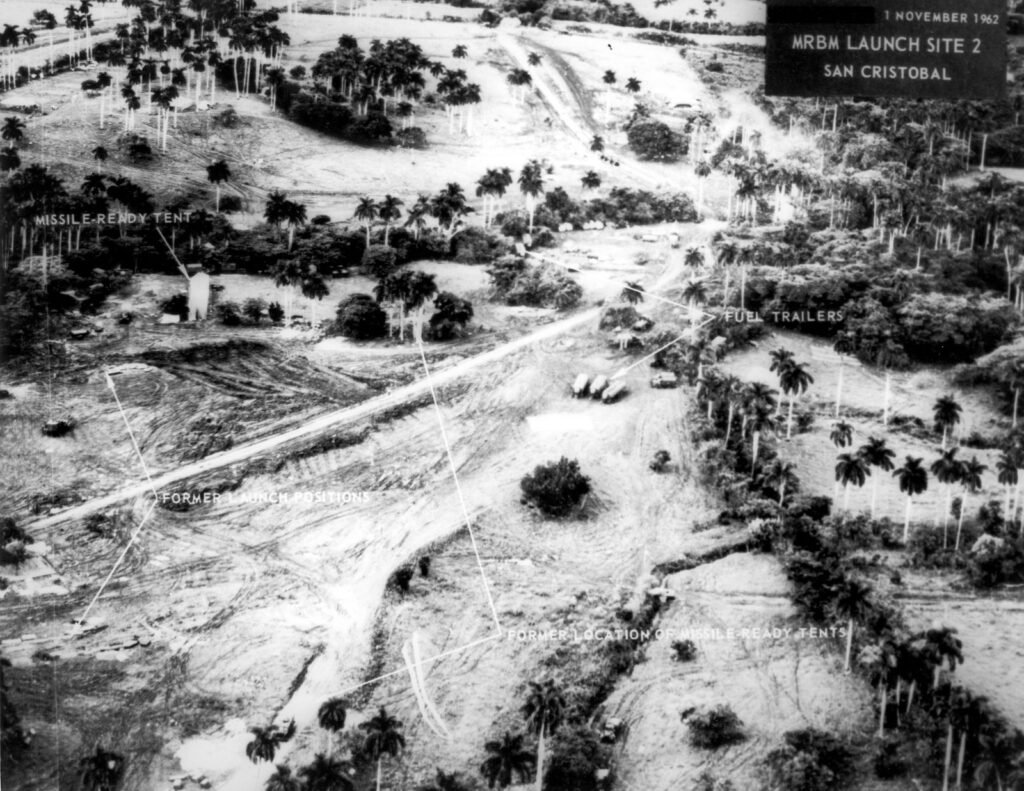
The Cuban Missile Crisis was a confrontation between the United States and the Soviet Union in October 1962 over Soviet nuclear missiles that were being secretly installed in Cuba. It began when a U.S. U-2 reconnaissance aircraft photographed missile sites on 14 October 1962, and it ended on 28 October, when Soviet leader Nikita Khrushchev announced that the missiles would be removed. The U.S. Office of the Historian describes it as the moment when the two superpowers came closest to nuclear conflict.
Background of the Cuban Missile Crisis
The crisis grew out of the Cold War rivalry and out of tension over Cuba itself, which lies only about 90 miles from Florida. After the failed Bay of Pigs invasion of April 1961, in which U.S.-backed forces tried to overthrow Cuban leader Fidel Castro, the Kennedy administration planned a covert program called Operation Mongoose. In July 1962, Khrushchev reached a secret agreement with Castro to place Soviet nuclear missiles in Cuba, partly to deter any future invasion.
Construction of several missile sites began in the late summer. American surveillance had already noticed a general Soviet arms build-up, including surface-to-air missiles, missile-armed torpedo boats and IL-28 bombers, but photographs taken in late August showed no evidence of offensive ballistic missiles. In September, President John F. Kennedy delivered public and private warnings against introducing offensive weapons into Cuba. The Soviets kept building.
Course of the Cuban Missile Crisis
Bad weather kept U-2 aircraft from flying over Cuba during the week of 7 October. On Sunday, 14 October, a clear day produced photographs that clearly showed sites for medium-range and intermediate-range ballistic missiles under construction. The images reached the White House the next day. Kennedy immediately decided that the missiles had to go and gathered his closest advisers as the Executive Committee of the National Security Council, known as ExComm.
ExComm weighed many options: doing nothing, going to the United Nations, offering to trade away U.S. missiles in Turkey, sending secret envoys, a blockade, an air strike and an invasion. All of the Joint Chiefs of Staff favored an air strike followed by invasion. Kennedy chose a middle course. On 22 October, he ordered a naval quarantine of Cuba and explained the situation in a television address that evening. The word quarantine was deliberate. Under international law, a blockade implies a state of war, and the term also helped win the support of the Organization of American States.
The military preparations were enormous. The National Archives records that U.S. forces worldwide were placed on alert, more than 100,000 troops were sent to Florida for a possible invasion, 180 naval vessels entered the Caribbean, and B-52 bombers carrying nuclear weapons stayed in the air at all times. Khrushchev called the quarantine an act of aggression on 24 October. Even so, some Soviet ships turned back, and others were stopped and allowed through after inspection showed no offensive weapons aboard. U.S. forces later moved to DEFCON 2, a level meaning that war involving the Strategic Air Command was imminent.
The crisis reached its peak over the weekend of 26 and 27 October. On 26 October, ABC News correspondent John Scali relayed an informal Soviet offer to remove the missiles in exchange for a U.S. pledge not to invade Cuba, and that evening Khrushchev sent a long message along the same lines. The next day, he sent a second message that demanded the removal of U.S. Jupiter missiles from Turkey as well. A U.S. U-2 was shot down over Cuba that same day, and Kennedy’s advisers prepared for an attack within days.
Kennedy chose to answer only the first message. His reply proposed that the Soviets remove the missiles under United Nations supervision in return for a guarantee that the United States would not invade Cuba. Attorney General Robert Kennedy also met secretly with Soviet Ambassador Anatoly Dobrynin and indicated that the Jupiter missiles would be removed from Turkey soon, though this could not be part of any public deal. On the morning of 28 October, Khrushchev announced publicly that the Soviet missiles would be dismantled and removed.
Aftermath of the Cuban Missile Crisis
The crisis did not end at once. The naval quarantine stayed in place until the Soviets also agreed to withdraw their IL-28 bombers, and the United States lifted it on 20 November 1962. The Jupiter missiles left Turkey in April 1963. The secrecy of that part of the settlement is one reason that accounts of who gave up what have been debated ever since.
The standoff had domestic and diplomatic effects. It strengthened Kennedy’s image at home and abroad, and it may have softened the negative world reaction to the Bay of Pigs. It also exposed how hard it was for the two leaders to understand each other’s true intentions while messages crossed between Washington and Moscow. To prevent a repeat, the two governments set up a direct telephone link between the White House and the Kremlin, which became known as the Hotline.
Significance and legacy of the Cuban Missile Crisis
Historians and officials treat the crisis as a unique episode of the Cold War because the superpowers moved so close to using nuclear weapons. The Office of the Historian notes that it was played out mainly at the White House and Kremlin level, with relatively little input from the usual bureaucracies.
Having approached the brink, both sides began to reconsider the nuclear arms race and took the first steps toward a nuclear Test Ban Treaty. The episode remains a central case study for nuclear deterrence, crisis communication and the risk of miscalculation, because it showed both how deterrence could work and how narrow the margin for error could be.
Turkey, which hosted the Jupiter missiles, and Cuba, which hosted the Soviet ones, were both pulled into a dispute between the superpowers. The crisis is therefore also a reminder of how decisions made in Washington and Moscow affect smaller states far from the leaders who make them. The key dates are still taught in sequence: 14 October for the photographs, 22 October for the quarantine, 27 October for the most dangerous day, and 28 October for the agreement.
More in History
Key facts
- A U.S. U-2 aircraft photographed Soviet missile sites in Cuba on 14 October 1962.12
- President Kennedy announced a naval quarantine of Cuba on 22 October 1962.12
- Khrushchev announced on 28 October 1962 that the missiles would be dismantled and removed.1
- The United States lifted its quarantine on 20 November 1962 and removed its Jupiter missiles from Turkey by April 1963.1
- A direct White House to Kremlin telephone link, the Hotline, was created afterward.1
Related concepts
In the news
Quick checkWhy did President Kennedy call his naval measure a quarantine instead of a blockade?Show answer
A blockade implies a state of war under international law, and the word quarantine also helped the United States win the support of the Organization of American States.
Sources
- U.S. Office of the Historian, The Cuban Missile Crisis, October 1962, https://history.state.gov/milestones/1961-1968/cuban-missile-crisis
- U.S. National Archives, Prologue, Forty Years Ago: The Cuban Missile Crisis, https://www.archives.gov/publications/prologue/2002/fall/cuban-missiles.html
Editorially reviewed by Specialty Digest Editorial TeamLast reviewed November 4, 2026Researched and drafted with AI assistanceReport an issue