Who Is Responsible for a Library Library governance describes the structures through which a library is directed, funded, and held accountable, answering the basic question of who ultimately decides what a library does and how it spends its money. The answer varies widely by library type and by country, ranging from elected boards to university
Library Governance Read More »
The organizational and legal structures through which libraries are overseen, funded, and held accountable to the public or institution they serve.
The Library of Congress Classification is an alphanumeric system for organizing library materials by subject, developed by the Library of Congress in the United States in the early twentieth century and widely adopted by academic and research libraries. The system divides knowledge into broad classes represented by single or double letters, such as Q for
Library of Congress Classification Read More »
The Library of Congress Classification is an alphanumeric system for organizing library materials by subject, used primarily by academic and research libraries in the United States and elsewhere.
Designing Space for Changing Library Use Library space planning is the practice of organizing a library building so that its physical layout supports the services patrons actually use, balancing collections, technology, seating, meeting rooms, and staff work areas within a fixed footprint. The task has grown more complex as library use patterns have shifted substantially
Library Space Planning Read More »
The design and organization of library facilities to balance collections, technology, programming, and seating within available space.
Who Keeps a Library Running Library staffing and human resources covers the full range of work needed to recruit, train, schedule, and retain the people who operate a library, from credentialed librarians to part time pages who shelve returned books. Because library service hours often extend into evenings and weekends, scheduling alone presents a constant
Library Staffing and Human Resources Read More »
The practices libraries use to recruit, train, schedule, and support the staff who carry out library operations.
Linked data is a method of structuring and publishing data so that individual pieces of information are connected to related data across the web through standardized identifiers and relationship types, allowing both people and machines to follow connections between datasets. The approach rests on a small set of principles: use web addresses, known as Uniform
Linked Data Read More »
Linked data is a method of structuring and publishing data so that individual pieces of information are connected to related data across the web using standardized identifiers and relationships.
MARC, short for Machine-Readable Cataloging, is a standardized data format for encoding bibliographic records so that different library systems can exchange catalog data consistently, developed by the Library of Congress beginning in the 1960s as one of the earliest applications of computing to library cataloging. A MARC record represents each piece of bibliographic information, such
MARC Format Read More »
MARC, short for Machine-Readable Cataloging, is a standardized data format for encoding bibliographic records so that different library systems can exchange catalog data consistently.
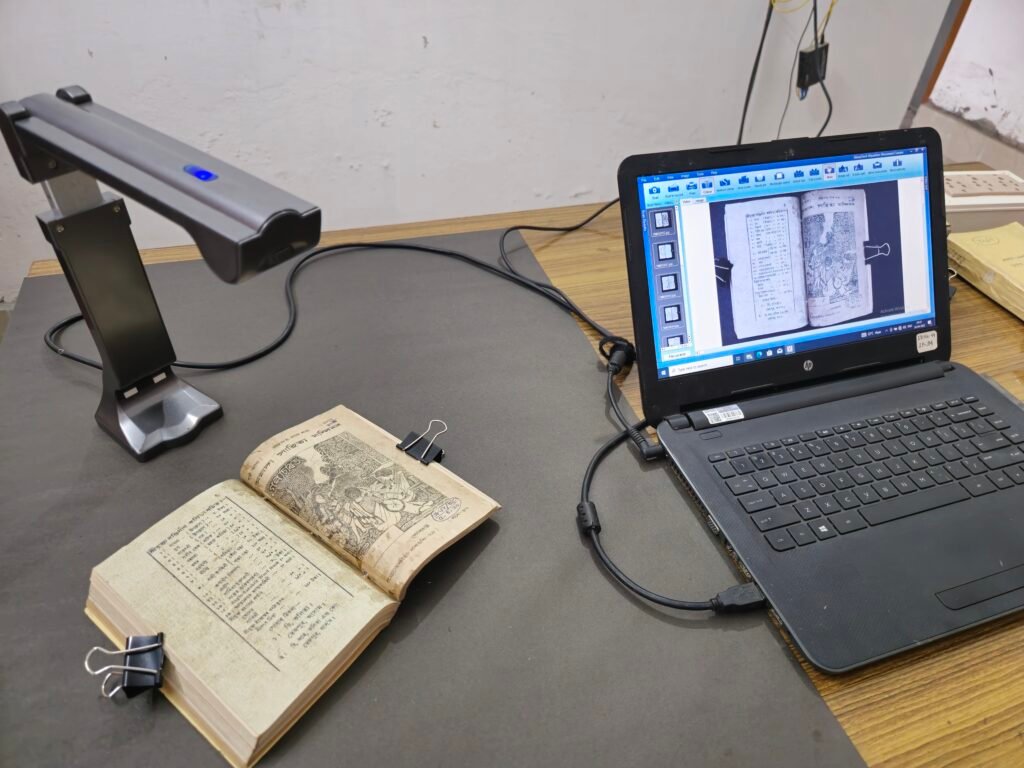
Mass digitization is the large-scale conversion of library, archival, or museum collections into digital form using high-throughput scanning equipment and standardized, streamlined workflows designed to process very large volumes of material efficiently. Where traditional digitization projects often focus on carefully selected collections, with significant individual attention given to each item, such as detailed metadata creation
Mass Digitization Read More »
Mass digitization is the large-scale conversion of library, archival, or museum collections into digital form using high-throughput scanning and standardized, streamlined workflows.
Describing Resources Consistently Metadata standards are agreed upon schemas that specify which descriptive fields to record about an information resource and how to format them, allowing different systems and institutions to describe similar material in comparable ways. Without such standards, a photograph description created by one archive would look nothing like a comparable description from
Metadata Standards Read More »
Structured schemas that describe the attributes of information resources in a consistent, shareable format.
OAI-PMH, short for the Open Archives Initiative Protocol for Metadata Harvesting, is a technical standard that allows digital repositories to expose their metadata records in a consistent, machine-readable format so that other systems can automatically collect, or harvest, those records. Before OAI-PMH, aggregating content across many repositories required custom integration work for each source, since
OAI-PMH Read More »
OAI-PMH, the Open Archives Initiative Protocol for Metadata Harvesting, is a technical standard that lets repositories share metadata records so other systems can collect and aggregate them automatically.
Preserving How Records Were Originally Kept Original order is the archival principle of maintaining records in the sequence and structure established by their creator, rather than imposing an arrangement that an archivist might consider more logical or convenient. This principle rests on the idea that the original sequence itself often carries meaningful information about how
Original Order Read More »
The archival principle of preserving the sequence and internal organization in which records were originally created, used, and maintained.