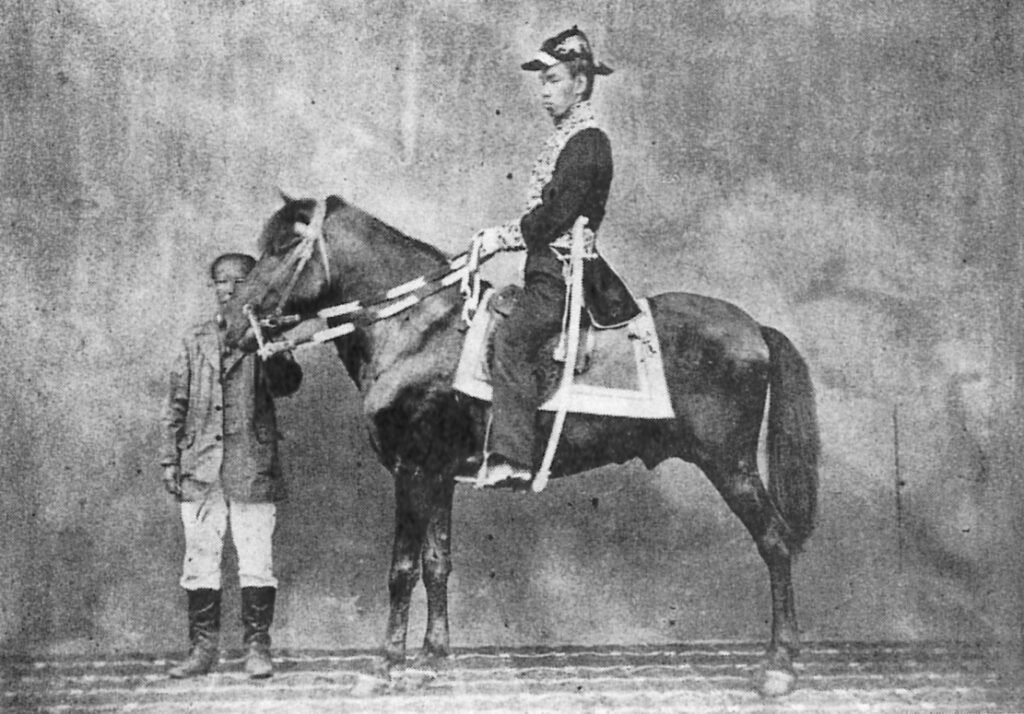
The Meiji Restoration was the political change in Japan in 1868 in which the Tokugawa shogun lost power and the emperor was restored to the head of the state. It led to the end of feudalism and to rapid modernization along Western lines. The emperor took the reign name Meiji, which means enlightened rule.
Background of the Meiji Restoration
For more than two centuries, Japan had been ruled by the Tokugawa shoguns, military leaders who governed in the emperor’s name. The country was largely agricultural and had little technological development. It was divided among hundreds of semi-independent feudal lords, called daimyo.
Foreign pressure upset this order. On 8 July 1853, a U.S. fleet under Commodore Matthew Perry anchored off Uraga, in Edo Bay, and delivered a letter from President Millard Fillmore asking for friendship and trade. Perry returned in March 1854, and the two sides signed a twelve-article Treaty of Peace and Amity. It opened the ports of Shimoda and Hakodate and took effect on 21 February 1855, according to the National Diet Library of Japan, formally ending Japan’s policy of seclusion.
Other Western powers soon obtained treaties of their own. Columbia University’s Asia for Educators explains that these agreements limited Japan’s control over its foreign trade and required that crimes involving foreigners be tried in Western courts. When the Meiji period began, Japan was militarily weak and its leaders were determined to change that situation.
Course of the Meiji Restoration
In 1867, the Tosa domain, advised by Goto Shojiro, urged the shogunate to return political power to the emperor. The National Diet Library notes that the proposal drew on ideas by Sakamoto Ryoma, who called for an assembly, a bureaucracy and a constitution. On 9 November 1867, the shogunate carried out this return of power.
On 3 January 1868, a grand edict proclaimed the restoration of imperial rule. A new governing structure was set up on 11 January 1868, and a bureaucratic reform in June 1868 created the Grand Council of State, which governed until a cabinet system replaced it in December 1885.
Asia for Educators stresses that the emperor did not rule directly. A small group of ambitious young men from the lower ranks of the samurai took control as his advisers. At first their strength was that the emperor accepted their advice and that several powerful domains provided military support, so they moved quickly to build their own military and economic power.
Reforms after the Restoration
The new leaders dismantled the feudal system in stages. In July 1869, the feudal lords were asked to give up their domains. In 1871, the domains were abolished and turned into prefectures of a unified state. The lords and samurai received yearly stipends, later replaced by a one-time payment in government bonds, and the government declared all classes equal.
A national army based on universal conscription was created in 1872, requiring three years of service from samurai and commoners alike. By 1876, the wearing of swords by samurai was banned. A national land tax paid in money instead of rice helped stabilize the government’s budget.
In December 1871, the Iwakura Mission left Japan for a trip of about two years to the United States, Britain, France and other countries. Its purposes were to prepare for treaty revision and to study foreign institutions. A national school system was set up in 1872, and by the end of the Meiji period almost everyone attended free public schools for at least six years.
The government also built railways, shipping lines, telegraph systems, shipyards, mines and factories. Asia for Educators reports that it sold most of these enterprises to private investors in 1880, and that some of the buyers formed large conglomerates called zaibatsu.
Resistance and the Meiji Constitution
The loss of privileges caused resentment among samurai. In 1872, while the top leaders were touring Europe and the United States, conservative groups argued that Japan should answer Korea’s refusal to revise a centuries-old treaty with an invasion, which would restore the importance of patriotic samurai. The leaders returned quickly and insisted that Japan should concentrate on its own modernization instead, and for the next twenty years, domestic reform remained the top priority.
The final blow to conservative samurai came in the Satsuma rebellion of 1877, which was defeated by the new conscript army, which was trained in European infantry techniques and armed with modern Western guns.
A constitution was issued in 1889, and an elected parliament, the Diet, first met after elections in 1890. The constitution was presented as a gift from the emperor, and only the wealthiest one percent of the population could vote at first. In 1925, the vote was extended to all men, but not yet to women.
Japan also rewrote its legal codes on French and German models. In 1894, the Western powers agreed to revise the unequal treaties, acknowledging Japan as an equal in principle.
Significance and legacy
When the Meiji period ended with the emperor’s death in 1912, Japan had a centralized government, a constitution, an industrial economy and a powerful army and navy. It had also won two wars, one against a major European power, Russia. In a little more than a generation, the country had changed its whole society.
The reforms also had costs and limits. The leaders promoted an ideology centered on the emperor and the Shinto religion to unite the nation, and the new state expanded abroad. After a war with China in 1894, Japan gained control over Korea and took Taiwan as a colony, a result tied to the wider age of colonialism.
Historians still study why Japan adopted Western institutions so quickly. Asia for Educators points to the Restoration itself, which put reform in the hands of a small, disciplined group acting in the name of the emperor.
More in History
Key facts
- A grand edict proclaiming the restoration of imperial rule was issued on 3 January 1868.1
- Commodore Perry anchored off Uraga on 8 July 1853, and the treaty ending Japan's seclusion took effect on 21 February 1855.1
- The feudal domains were abolished and turned into prefectures in 1871.2
- A national army based on universal conscription was created in 1872.2
- The Meiji period ended with the emperor's death in 1912, after a constitution in 1889 and a first elected Diet in 1890.2
Related concepts
Quick checkWhat was the Meiji Restoration?Show answer
It was the 1868 change in Japan in which the Tokugawa shogun lost power and the emperor was restored to the head of the state, followed by reforms that ended feudalism and modernized the country.
Sources
- National Diet Library of Japan, Modern Japan in Archives, Initial Steps toward a Constitutional State, https://www.ndl.go.jp/modern/e/cha1/description01.html
- Columbia University Asia for Educators, The Meiji Restoration and Modernization, https://afe.easia.columbia.edu/special/japan_1750_meiji.htm
Editorially reviewed by Specialty Digest Editorial TeamLast reviewed November 4, 2026Researched and drafted with AI assistanceReport an issue