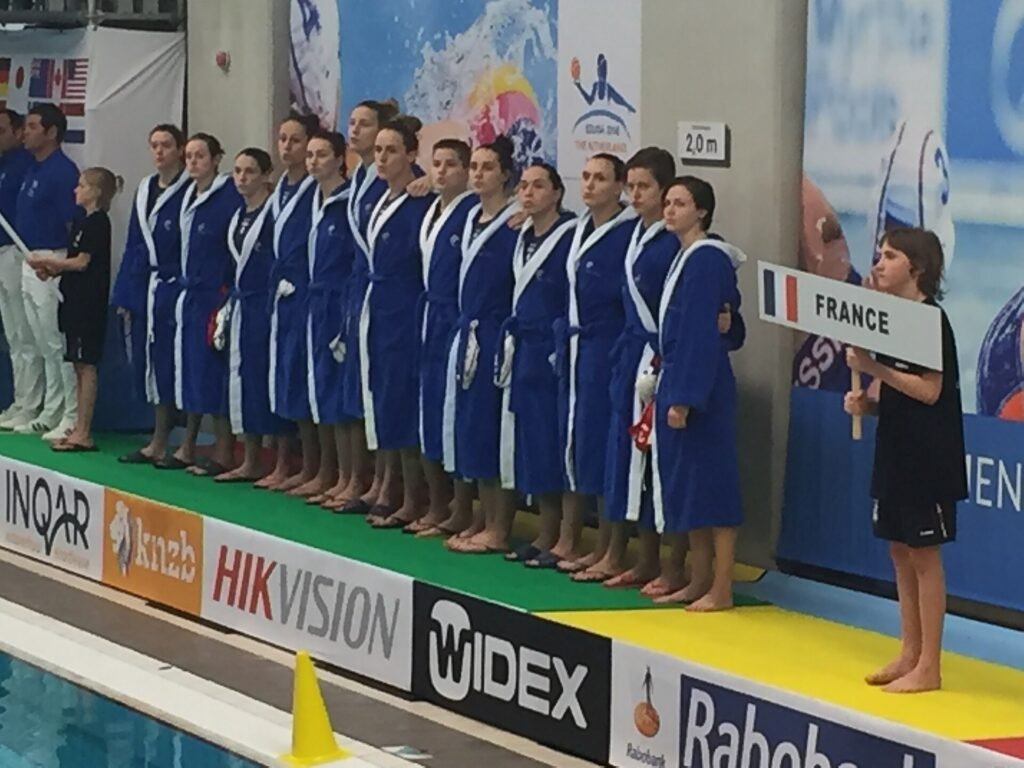
Water polo is a team sport played in a swimming pool in which two teams of seven, six field players and a goalkeeper, try to throw a ball into the opponent’s goal. A match has four quarters of eight minutes of actual play. World Aquatics governs the sport, which has been in the Olympic Games since 1900 for men and 2000 for women.
History of water polo
The earliest form of water polo was played in lakes and rivers and was closely tied to rugby. Players scored by carrying the ball across the opponents’ goal line and placing it on the deck, and the first balls were made from pig’s stomach. By 1869 they had been replaced with Indian rubber balls. The first official match was played at the Crystal Palace Plunge in London.
William Wilson is thought to have developed the game in Scotland in the 1870s. The Arlington Baths Club in Glasgow was founded in 1870. A match was played at Crystal Palace in London on 15 September 1873, and another at Bournemouth on 13 July 1876. By 1880 the Trudgen stroke had made swimming faster, goals were scored by throwing the ball into a cage 10 feet wide and 3 feet deep, and players could handle the ball with one hand only.
In 1911 FINA, now World Aquatics, made the English-Scottish rules compulsory, replacing a more aggressive American style. The United States was the second nation after Britain to take up the sport, with its first championships in Providence in 1890. The game spread to Belgium in 1890, Germany in 1894 and France in 1895.
Men’s water polo appeared at the 1900 Olympic Games, one of the first team sports to do so. Britain dominated the early part of the 20th century, and 12 countries competed at Antwerp in 1920. Women’s water polo became an Olympic sport at Sydney in 2000, a development covered more broadly under gender in sport.
Rules and how water polo is played
A team may start with no more than seven players in the water, one of whom is the goalkeeper. A squad has up to 13 players, 11 field players and two goalkeepers, with five reserves and one reserve goalkeeper. The goalkeeper wears cap number 1, and the substitute goalkeeper wears a red cap numbered 13. A team with fewer than seven players does not have to field a goalkeeper.
A game has four periods of eight minutes of actual play, with a two-minute interval after the first and third periods and three minutes after the second. Each team has two one-minute timeouts per game.
The attacking team must shoot within 30 seconds of gaining possession. The clock is reset to 20 seconds after an exclusion, a corner throw or a rebound to the attackers after a shot.
A player who commits an exclusion foul must leave the water for 20 seconds of actual play, or until an earlier trigger such as a goal or a change of possession. A player with a third personal foul is out for the rest of the game, and a violent action brings an exclusion of four minutes of actual play.
A penalty throw is taken from the five-meter line. The other players must leave the six-meter area and stand at least three meters from the thrower, and the goalkeeper must stay between the posts.
The pool is deep enough that players cannot touch the bottom, which makes the sport a severe test of cardiorespiratory fitness.
Equipment and venues
The World Aquatics regulations set the distance between the goal lines at 20 to 30 meters for men and 20 to 25 meters for women, with a width of 10 to 20 meters. The overall field measures 30.60 by 20.00 meters for men and 25.60 by 20.00 meters for women. The water must be at least 1.80 meters deep, and 2.00 meters at the Olympic Games and World Championships.
The goals are 3.0 meters apart on the inside of the posts, and the underside of the crossbar is 0.9 meters above the water. The ball weighs 400 to 450 grams. For men it measures 0.68 to 0.71 meters around, with a pressure of 7.5 to 8.5 pounds per square inch, and for women 0.65 to 0.67 meters, at 6.5 to 7.5 pounds per square inch.
The ball itself has changed over time, moving from leather to a cotton bladder with rubber fabric and later to nylon, with a yellow color added for visibility. The figures above follow the regulations published in February 2023 and may change in later editions.
Governing bodies and major competitions
World Aquatics, formerly FINA, sets the rules of the sport and organizes the world championships. The men’s World Championship has been held since 1973 and the women’s was added in 1986. The sport is also part of the Olympic Games. Governing bodies of this kind are described under sports governance.
The United States held its first championships in 1890, and early national bodies in Britain, Belgium, Germany and France built the competition structure that the international federation later took over.
Records and notable moments
From 1928 until the 1980s, Hungary was widely regarded as the strongest water polo nation. In the 1956 Olympic semifinal at Melbourne, Hungary beat the Soviet Union 4 to 0.
Women’s water polo had to wait until Sydney in 2000 for its Olympic debut, and the women’s World Championship had begun in 1986. The men’s World Championship had started in 1973.
Global reach of water polo
Water polo spread from Britain to the United States, then to Belgium, Germany and France before 1900. The early spread across Europe and North America explains why 12 countries entered the 1920 Olympic tournament.
Hungary’s long run of strength showed that the sport could be led from continental Europe rather than the British Isles. The need for deep water makes the sport dependent on pool access, which shapes where it is played.
More in Sports Coaching and Performance
Key facts
- A water polo game has four periods of eight minutes of actual play.1
- Each team starts with no more than seven players in the water, including the goalkeeper.1
- Men's water polo appeared at the 1900 Olympics and women's water polo at the Sydney Games in 2000.3
- The men's World Championship began in 1973 and the women's was added in 1986.3
Related concepts
Quick checkHow many players are in the water in water polo?Show answer
Each team has no more than seven players in the water at a time, six field players and one goalkeeper.
Sources
- World Aquatics, Water Polo Regulations (February 2023 edition, hosted by British Swimming), https://www.britishswimming.org/documents/3431/World_Aquatics_Water_Polo_Regulations_February_2023.pdf
- Aquatics GB, History of water polo, https://www.aquaticsgb.com/browse-sport/water-polo/about-water-polo/history-water-polo/
- Wikipedia, Water polo, https://en.wikipedia.org/wiki/Water_polo
Editorially reviewed by Specialty Digest Editorial TeamLast reviewed November 4, 2026Researched and drafted with AI assistanceReport an issue