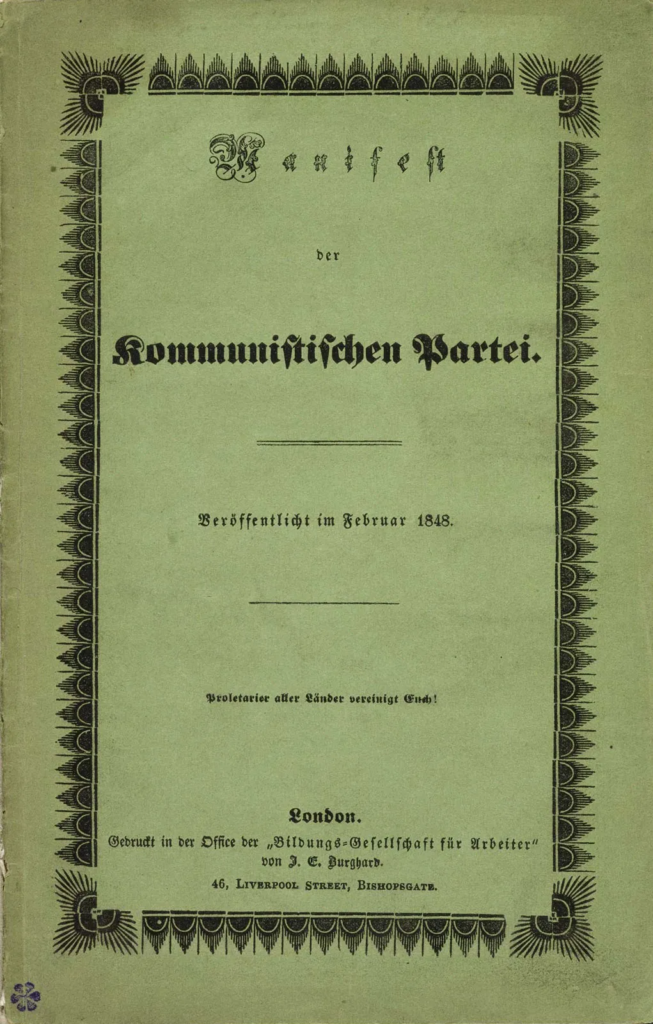
The Communist Manifesto is a political pamphlet by Karl Marx and Friedrich Engels, first published in London in February 1848, that presents history as a story of class struggle and states the aims of the Communist League. Its original German title was Manifest der Kommunistischen Partei, and English editions are often titled Manifesto of the Communist Party. It has become one of the most widely read political documents in the world.
Background and creation of the Manifesto
The 1840s were a period of intense argument among socialist writers. Fourier, Saint-Simon, Blanqui, Proudhon, Owen and many others offered theories of how society might be improved, and Marx was still an obscure young journalist. By studying German philosophy, French socialist thought and British political economy, he came to believe that he had found the basic principles of modern society.
The Communist League was set up in 1847 by scattered groups of German socialist exiles. It was a workingmen’s association that began as exclusively German and later became international. Because of the political conditions on the Continent before 1848, it was unavoidably a secret society.
At a congress of the League held in London in November 1847, Marx and Engels were commissioned to prepare a complete theoretical and practical program for publication. They drafted it in German in January 1848, and the manuscript went to a printer in London a few weeks before the French revolution of 24 February 1848. Copies were coming off the press as revolution broke out in Paris and spread to other European cities, so the pamphlet appeared too late to influence the events of 1848.
Content of the Manifesto
The text has a preamble and four sections. The preamble describes communism as a specter haunting Europe and says it is time for Communists to state their views and aims openly. The first section opens with the claim that the history of all hitherto existing society is the history of class struggles, and it lists opposed pairs such as freeman and slave, lord and serf, and guildmaster and skilled craftsman.
The first section, Bourgeois and Proletarians, applies that idea to the nineteenth century. It portrays modern society as dividing into two opposed classes: the bourgeoisie, who own the means of production, and the proletariat, who live by selling their labor.
The second section, Proletarians and Communists, explains how the Communists relate to the working class as a whole. It says they do not form a separate party opposed to other working-class parties and have no interests apart from those of the proletariat. The authors present the abolition of bourgeois private property as the Communists’ central aim.
The third section, Socialist and Communist Literature, criticizes rival schools of socialism, beginning with what it calls reactionary socialism. The fourth section discusses the position of the Communists toward other opposition parties, including the Chartists in England and the Agrarian Reformers in America. The pamphlet closes with a call for workers of all countries to unite.
Themes and interpretation of the Manifesto
The main theme is that economic arrangements shape politics, law and culture, and that conflict between classes drives historical change. Marx and Engels argued that the bourgeoisie had overturned feudal society and that the proletariat would in turn challenge bourgeois rule.
A second theme is internationalism. The Manifesto addresses workers across national borders, and the League it served had become international in membership.
The third section also sets the Manifesto beside rival schools. By reviewing feudal, petty-bourgeois, conservative and utopian forms of socialism, the authors argue that communism alone ties its aims to the working class and to the course of historical development, and not to the plans of reformers acting on the people’s behalf.
Readers disagree about how to take the text. Some treat it as a program tied to its moment, written for a small organization at a time when revolution seemed close. Others read it as a general theory of history and a forecast of how capitalism would develop. The preface to the authorized English edition itself describes the pamphlet as the platform of the Communist League.
Because the text is a polemic rather than a systematic treatise, its claims are best read alongside the later economic and historical writings of its authors and the many critiques of them.
Reception and legacy of the Manifesto
After the defeat of the 1848 uprisings the Manifesto seemed headed for oblivion. In 1852 the Prussian authorities tried members of the League’s central board in the Cologne Communist trial, which ran from 4 October to 12 November. Seven defendants received fortress sentences of three to six years, and the League was formally dissolved soon after.
Interest returned in the 1860s and 1870s with the founding of the International Workingmen’s Association and the Paris Commune of 1871. The German text had been reprinted several times in Switzerland, England and America since 1850. The first English translation, by Helen Macfarlane, appeared in George Julian Harney’s Red Republican in London in 1850, and another English version ran in Woodhull and Claflin’s Weekly in New York in 1872. Engels later edited an authorized English translation.
When the International Workingmen’s Association was formed, its program had to be broad enough for British trade unions, for followers of Proudhon in France, Belgium, Italy and Spain, and for followers of Lassalle in Germany, so it could not at once adopt the principles of the Manifesto. Engels judged that by the time the International broke up in 1874 the working-class movement had moved much closer to them, and he noted that even the conservative British trade unions were moving toward acceptance of continental socialism.
In the twentieth century, parties and governments that cited its ideas shaped much of world politics, including the Russian Revolution and the Cold War. Historians, economists and political theorists still debate how closely those movements followed the pamphlet and how well its predictions have held. The Manifesto remains a core text for the study of political ideology.
More in Government & Politics
Key facts
- A congress of the Communist League in London in November 1847 commissioned Marx and Engels to prepare its program.1
- The manuscript was drafted in German in January 1848 and sent to a London printer a few weeks before the French revolution of 24 February 1848.1
- The first English translation, by Helen Macfarlane, appeared in the Red Republican in London in 1850.1
- The Cologne Communist trial ran from 4 October to 12 November 1852, and the League was dissolved soon after.1
- The pamphlet appeared too late to influence the revolutions of 1848.2
- Interest revived after the founding of the International Workingmen's Association and the Paris Commune of 1871.2
Related concepts
Quick checkWhich organization commissioned the Communist Manifesto?Show answer
The Communist League, at its congress in London in November 1847.
Sources
- 1. Karl Marx and Friedrich Engels, Manifesto of the Communist Party, authorized English translation edited by Engels, with preface, Project Gutenberg, https://gutenberg.org/cache/epub/31193/pg31193-images.html
- 2. Encyclopedia.com (Gale), Communist Manifesto Published, https://encyclopedia.com/history/encyclopedias-almanacs-transcripts-and-maps/communist-manifesto-published
Editorially reviewed by Specialty Digest Editorial TeamLast reviewed November 5, 2026Researched and drafted with AI assistanceReport an issue