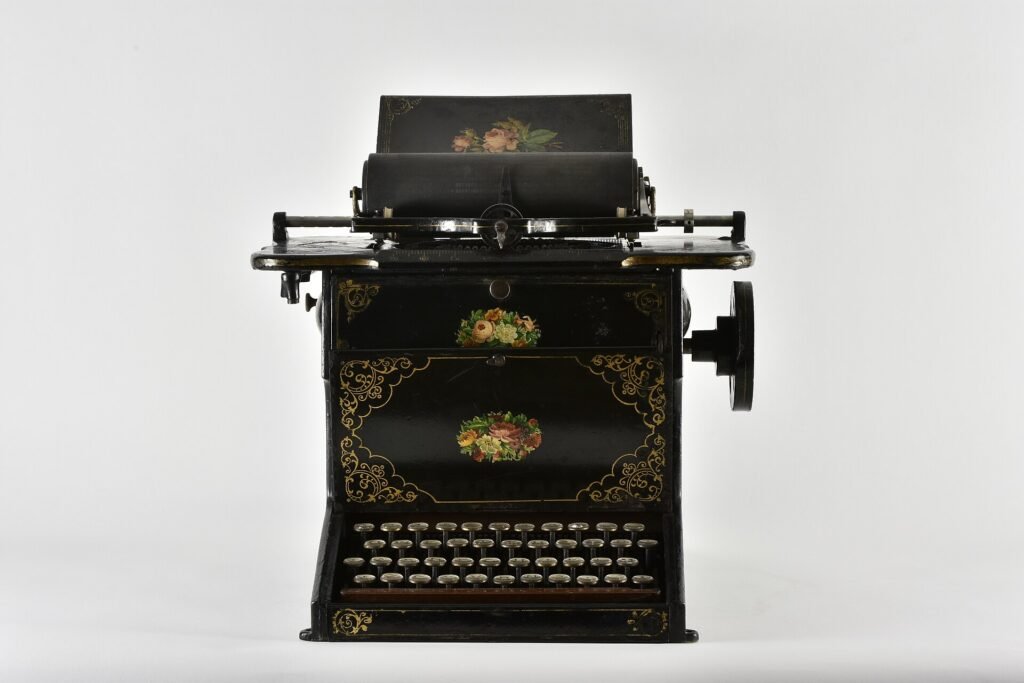
A typewriter is a keyboard machine that presses inked type onto paper one character at a time. The Sholes and Glidden machine, sold from 1874 by E. Remington and Sons of Ilion, New York, was the first commercially successful model and introduced the QWERTY key layout. It was the work of a group rather than one person, and many earlier inventors had tried and failed to make a practical writing machine.
History of the typewriter
The first recorded step was an English patent. In 1714 Queen Anne of Great Britain issued a patent for a writing machine. Over the following century inventors in Europe and America took out many typewriter patents, but none reached commercial production, and since the 1820s people had worked on personal printing machines. In 1857 S. V. Francis of New York built a typewriter with an inked ribbon that was not a commercial success.
Christopher Latham Sholes of Milwaukee had already built a newspaper addressing machine and a page-numbering device in 1864. In 1867 Carlos Glidden encouraged him to build a writing machine, and with Glidden, Mathias Schwalbach and Samuel Soulé he had a working model by the fall of that year. Their design was patented in June and July 1868. The prototype had no space bar and no shift key, and its type-bars struck an inked ribbon against paper on a platen.
James Densmore, who financed the work, saw the machine in March 1868 and built about fifteen in Chicago that summer, but judged the design not yet marketable. In 1869 Sholes switched to a cylindrical platen, and in early 1872 a redesign allowed paper of any length. Densmore signed a contract with E. Remington and Sons on March 1, 1873. Remington’s mechanics William Jenne and Jefferson Clough rebuilt the machine for mass production with a metal housing, and sales began in 1874. The first practical typewriter, by one account, took five years, dozens of trial runs and two patents to achieve.
The business terms were modest. Densmore’s Milwaukee production had proved too costly, and Yost recommended Remington. Densmore agreed to pay $10,000 for manufacturing plus a royalty for the mechanics’ services, and Remington agreed to produce at least 1,000 machines and possibly up to 24,000 at its own discretion. Densmore borrowed the advance payment, and Remington did not acquire the patent rights. Philo Remington’s company was then best known for rifles, and sales rose only after several years of improvements by its engineers.
Inventor and origins of the typewriter
Sholes is credited with the first practical typewriter, but his design had several authors. Glidden helped from the start, Soulé contributed a simplified key-striking arrangement, Schwalbach built the refined keyboard, and Densmore financed the effort and pushed for changes. Sholes reviewed earlier inventors’ work and concluded they had failed to meet key requirements of simplicity, reliability, speed and low cost.
Sources date the first patent differently. The Smithsonian Libraries blog says Sholes was granted the patent in 1866, an MIT archive page places patent number 79,265 about a year after 1866, and the American Society of Mechanical Engineers gives June and July 1868. The commercial machine, not the first patent, is what the 1873 agreement with Remington turned into a product.
How a typewriter works
The Sholes and Glidden machine was an upstrike design. Each key worked a lever that swung a type-bar upward against the underside of the platen, so typists could not see what they had just typed. An inked ribbon sat between the type and the paper, and a cylindrical platen moved the sheet. The carriage was later changed so that it could swing up to let the typist check the page.
Many parts were borrowed from other devices. The escapement that advances the carriage came from clockwork, the keys from telegraph machines and the type hammers from pianos. The one wholly original feature was the keyboard layout.
The QWERTY keyboard
Sholes and Densmore arranged the keys in a non-alphabetical order to reduce collisions between type-bars. Densmore proposed splitting up letters that are often used together so that neighboring bars would not jam. Other manufacturers widely adopted the layout, and it remains the standard on keyboards today. An MIT archive page summarizes the layout as designed to slow typing, which is another way of saying that it kept frequently paired letters apart so the bars would not jam. In early 1872 the platen was also redesigned to accept paper of any length and to give modern letter and line spacing.
Types and variants of typewriters
Competitors followed quickly. By 1885 the Hall, Caligraph, Crandall and Hammond machines were on the market and led to patent litigation. The magazine The Stenographer counted 47 typewriter makes in 1891, and at least 89 manufacturers existed by 1910, many influenced by the Sholes and Glidden design. Electric typewriters and noiseless models appeared later, but the core functions stayed the same.
Impact of the typewriter
The typewriter changed office work. Less than four percent of U.S. clerical workers were women in 1874, and by 1900 about 75 percent were. Underwood alone had produced more than five million typewriters by 1939, and a photograph from about 1913 shows the order department of Sears, Roebuck and Company using Oliver typewriters.
It also joined a chain of communication machines. The printing press had made books, the telephone carried the voice, and the typewriter gave businesses a fast way to produce legible letters and records during the Industrial Revolution.
Uses of typewriters today
Manual and electric typewriters are now rare in offices, but the keyboard layout they introduced is used on computers and phones. The original machine from the Sholes and Glidden group is preserved at the Smithsonian Institution.
More in Mechanical Engineering
Key facts
- Queen Anne of Great Britain issued a patent for a writing machine in 1714.3
- Sholes, Glidden and Soule were granted patents in June and July 1868.2
- Densmore signed a contract with E. Remington and Sons on March 1, 1873.2
- The Sholes and Glidden Type Writer went on sale in 1874.1
- About 75 percent of U.S. clerical workers were women by 1900, up from under four percent in 1874.2
Related concepts
Quick checkWhy is the keyboard laid out as QWERTY?Show answer
Sholes and Densmore arranged the keys in a non-alphabetical order to reduce collisions between the type-bars, and other manufacturers widely adopted the layout, which is still the standard.
Sources
- Lemelson-MIT, Christopher Sholes, https://lemelson.mit.edu/resources/christopher-sholes
- American Society of Mechanical Engineers, Sholes and Glidden Type-Writer landmark document, https://www.asme.org/wwwasmeorg/media/ResourceFiles/AboutASME/Who We Are/Engineering History/Landmarks/249-Sholes-Glidden-Type-Writer.pdf
- Smithsonian Libraries blog, typewriter history, https://blog.library.si.edu/?p=815
Editorially reviewed by Specialty Digest Editorial TeamLast reviewed November 4, 2026Researched and drafted with AI assistanceReport an issue