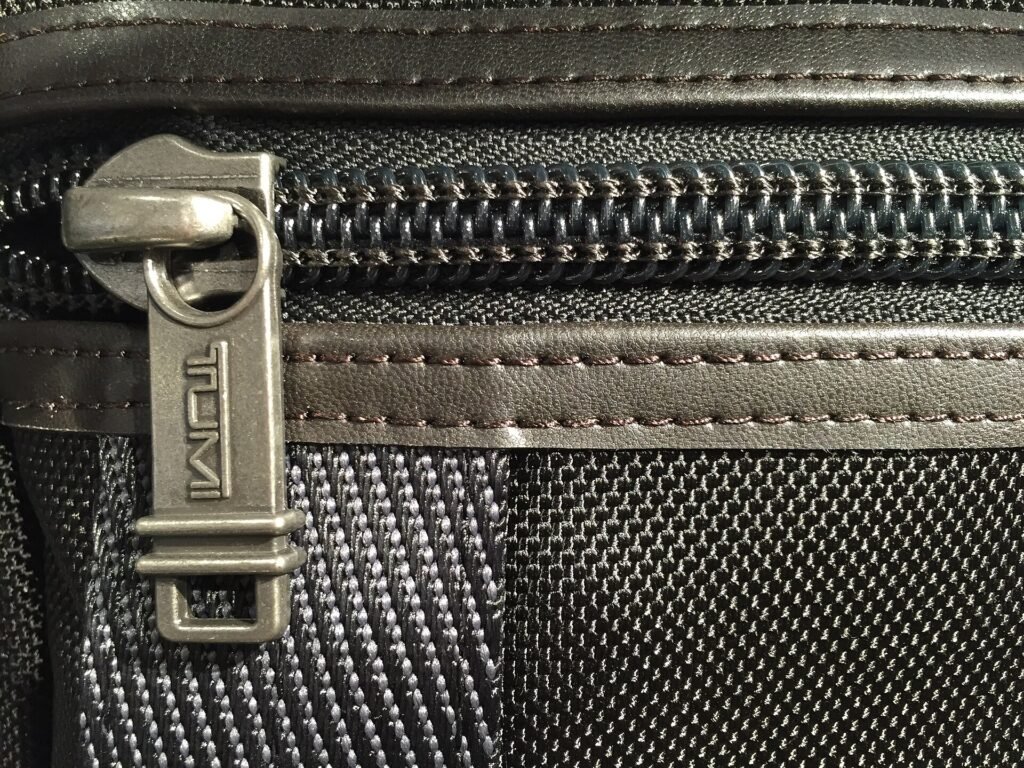
A zipper is a fastener made of two rows of interlocking teeth carried on fabric tapes, joined or separated by a slide that moves along them. It closes clothing, bags, boots and many other products. Its development took decades and passed through several inventors, and Gideon Sundback’s patent of 1917 describes the design still used today.
History of the zipper
The first idea came from Elias Howe, better known for his lockstitch sewing machine of 1846. In 1851 he patented an Automatic, Continuous Clothing Closure, a drawstring-style clasp that was never sold.
Whitcomb L. Judson patented a clasp locker in 1893. It used hooks and eyelets joined in sequence by a mechanical slide. Judson and his partners Harry Earle and Lewis Walker introduced it at the World’s Columbian Exposition in Chicago, where it drew little notice among roughly 27 million visitors. Around 1905 machines were developed to attach the hooks and eyes to fabric tape so they could be sewn into garments. Judson later opened the Automatic Hook and Eye Company in New Jersey, but he lacked the capital to continue.
Gideon Sundback was born in Sweden, trained as an electrical engineer in Germany and came to the United States in 1905 to work for Judson. In 1913 Walker and investors from Meadville and Erie, Pennsylvania, bought Judson’s company for $75,000 and moved it to Meadville as the Hookless Fastener Company. Walker, a lawyer admitted to the Crawford County bar in 1884, had met Judson in North Dakota and became the zipper’s chief promoter and salesman. Sundback filed his patent application on August 27, 1914, and it was granted on March 20, 1917, as US Patent 1,219,881 for a separable fastener. Production began before the patent was granted. No existing machine could produce the fastener’s sliding portion, so the machine shop, led by Sundback with eight to ten toolmakers, built the chain machines itself. A customer service department also advised manufacturers on how to apply the fastener and sent technicians to production sites.
The B.F. Goodrich Company was among the first to use the new fastener, on rubber galoshes, and in 1923 it coined the name zipper for the boots. The word later came to mean the fastener itself. The company chose Talon as its trademark in 1928 and kept slide fastener as the generic term.
Inventor and origins of the zipper
The zipper has no single inventor. Howe patented the idea of a continuous closure but never sold it, Judson made the first commercial clasp locker, and Sundback created the interlocking-tooth form that is essentially the one in use today. Walker acted as the chief promoter and salesman, and a team of toolmakers led by Sundback built the machines to produce the chain because none existed.
Sources disagree on one detail. A local history of the Talon company says Judson demonstrated his fastener at a Chicago fair in 1883, while the other sources describe the 1893 Columbian Exposition. The patent record and the other accounts point to 1893 for the clasp locker.
How a zipper works
Two rows of joinable elements run along the edges of opposing sides of a textile, and a slide moves along them to join or separate the elements in sequence. Patent classification describes this as a slide fastener with a series of separate interlocking members secured to each stringer tape.
The spacing of the elements matters. Judson’s hooks and eyelets numbered about 4 per inch, while Sundback’s uniformly sized metal teeth numbered about 10 per inch. The denser, interlocking teeth made the closure stronger and less likely to pull apart.
Types and variants of the zipper
The two historic forms are Judson’s hook-and-eyelet fastener and Sundback’s hookless fastener with interlocking teeth. The patent record shows that Sundback’s patent was assigned to the Hookless Fastener Company and that it expired in 1934. Sundback’s design gave the Hookless Fastener Company its name, and the company became Talon Incorporated in 1937.
Materials changed with events. In April 1942 the War Production Board banned copper and copper alloys in slide fasteners, which shut down Meadville zipper plants and laid off about 1,500 workers, although two plants stayed open for war production. Metal shortages also made zippers shorter and smaller, but the industry survived because zippers were considered essential to the military during World War II.
Impact of the zipper
Manufacturers promoted zippers for children’s clothing in the late 1920s and early 1930s because they made dressing easier and encouraged independence. The fastener then spread to adult fashion, first in trouser flies, and Talon became a top seller in the home-sewing market.
The zipper also shaped a town. The machine shop’s apprentices later opened their own tooling companies, which earned Meadville the nickname Tool City. By 1942 Talon employed about 4,000 workers, and after the war it was the largest employer in Crawford County. In 1930, at the height of the Depression, Meadville’s population grew 14.6 percent over the previous year and Talon was hiring.
Competition arrived from Japan. The manufacturer YKK acquired a chain machine in 1950 and began taking market share from Talon in the late 1950s. Talon moved part of its production to Mississippi in 1957, and its Meadville operation closed in 1993. Ownership changed several times: Textron agreed to acquire Talon in April 1968, Nucon Holdings of Boston bought it in 1981, and the British textile company Coates Viyella bought it in 1991. Tag-It Pacific acquired it in 1996, and the company became Talon International in 2007.
Uses of zippers today
Zippers remain a standard closure for clothing, luggage and boots, and their steady use shows how a small part of industrial design can become an everyday object. The principle has not changed since Sundback: a slide, two tapes and rows of elements that lock together.
More in Design
Key facts
- Whitcomb L. Judson patented a hook-and-eyelet clasp locker in 1893.12
- Gideon Sundback filed his separable fastener patent on August 27, 1914; US Patent 1,219,881 was granted on March 20, 1917.4
- B.F. Goodrich coined the name zipper in 1923 for its rubber boots.23
- Sundback's design had about 10 teeth per inch against about 4 hooks per inch in Judson's.1
- The War Production Board banned copper and copper alloys in slide fasteners in April 1942.3
Related concepts
Quick checkWho invented the zipper?Show answer
No single person did. Elias Howe patented a continuous clothing closure in 1851, Whitcomb Judson introduced a hook-and-eyelet clasp locker in 1893, and Gideon Sundback patented the interlocking-tooth fastener in 1917.
Sources
- Sapiens, A Brief History of the Zipper, https://sapiens.org/culture/zipper-history
- Threads magazine, A Brief History of the Zipper, https://www.threadsmagazine.com/2021/04/29/a-brief-history-of-the-zipper
- Journal of Erie Studies, Talon and the Zipper (Lynch), https://www.jeserie.org/uploads/Lynch%20Talon%20Quick%20Read.pdf
- Google Patents, US1219881A Separable fastener (Gideon Sundback), https://patents.google.com/patent/US1219881A/en
Editorially reviewed by Specialty Digest Editorial TeamLast reviewed November 4, 2026Researched and drafted with AI assistanceReport an issue