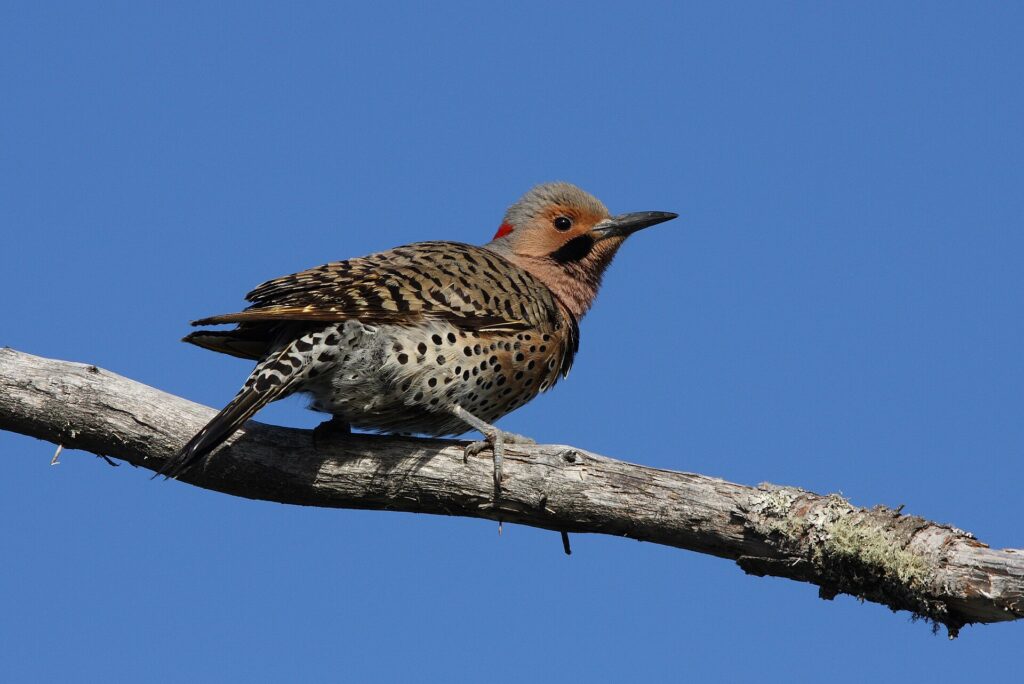
The yellowhammer is the state bird of Alabama and the common local name for the northern flicker (Colaptes auratus), a medium-sized woodpecker. It is unusual among woodpeckers because it often feeds on the ground, where it hunts ants and beetles. Its bright yellow wing and tail linings give it the name used across Alabama, and the bird in turn gave the state its best-known nickname [1][3]. This article covers identification, habitat, behavior, conservation and the bird’s place among the state’s symbols.
| Scientific name | Colaptes auratus |
|---|---|
| Family | Picidae (woodpeckers) |
| Official status | State bird of Alabama, adopted 1927 |
| Length | About 11 to 12 inches |
| Diet | Ants, beetles, seeds and berries |
| Range | Most of North America |
| Nesting | Cavities in dead trees |
What is a yellowhammer?
In Alabama, “yellowhammer” is the traditional name for the northern flicker. Elsewhere the bird has dozens of regional names, including “clape” and “wake-up.” The word “yellowhammer” also names an unrelated European bunting, so the Alabama usage can confuse readers abroad. In the United States it refers to the flicker found in the eastern part of the continent, which scientists sometimes call the yellow-shafted form [3].
Appearance and identification
The northern flicker is brown with black bars across its back, a cream breast covered in black spots and a bold black crescent on the chest. In flight, a white rump patch shows clearly. Eastern birds, including those in Alabama, have yellow shafts in the wing and tail feathers, and the underside of the wing flashes yellow. Males have a black “mustache” stripe near the bill, while females do not. The bill is slightly curved, a feature that helps the bird probe soil [3].
Birders often identify flickers by sound before sight. The call is a loud, repeated note, and a long rolling series of notes carries far through woodland. Field guides and apps such as eBird can help new observers confirm a sighting and record it for science.
Habitat and range
Flickers live in open woodland, forest edges, parks, farmland and suburban yards. They nest in cavities that they excavate in dead trees or large branches, and other birds often use the abandoned holes later. Some northern populations migrate south in autumn, so Alabama has both year-round residents and winter visitors. In winter, flocks can gather in fields and lawns where ants and other insects remain active [3].
Behavior and diet
Unlike many woodpeckers, the flicker spends much of its time on the ground, probing soil for ants with a long, barbed and sticky tongue. In autumn and winter it also eats berries and seeds. Like other woodpeckers, it drums on trees, and sometimes on metal objects, to mark territory and attract a mate. This drumming is a form of communication and should not be confused with feeding behavior, which is quieter [3].
Breeding
Pairs form in spring, and both parents help to excavate the nest cavity, which is often several feet deep. The female lays several white eggs, and both adults incubate them and feed the young. Nestlings leave the cavity after about a month. Because the species depends on dead or dying trees, it benefits from forest management that leaves some snags standing [3].
The yellowhammer as an Alabama symbol
The Alabama Legislature named the yellowhammer the state bird in 1927. The choice reflected a popular tradition that linked the bird’s yellow markings to the name “yellowhammers,” long used for people from Alabama. The bird now appears on state publications, in school lessons and on products and teams. See also Alabama’s nicknames and the hub article Alabama State Symbols [1][2].
Conservation
The northern flicker remains widespread, but long-term surveys show gradual declines across parts of its range. Loss of nesting trees and open habitat are common concerns. Leaving dead trees standing where it is safe to do so, and avoiding heavy pesticide use on lawns, helps flickers and other cavity-nesting birds. Protecting habitat also supports wider biodiversity, because many species depend on the same woodland edges [3].
FAQs
Is the yellowhammer a real bird? Yes. In Alabama the name refers to the northern flicker, a woodpecker.
Why is the flicker called a yellowhammer? The eastern flicker shows bright yellow under its wings and tail, and the name became a popular term in Alabama.
What does a yellowhammer eat? Mostly ants and beetles, plus seeds and berries.
When did Alabama adopt the yellowhammer? The legislature named it the state bird in 1927.
Does the yellowhammer migrate? Northern populations do, while many southern birds stay year round.
Sources
- Encyclopedia of Alabama: State of Alabama
- Alabama Department of Archives and History: Alabama Emblems, Symbols and Honors
- Cornell Lab of Ornithology: Northern Flicker Overview, All About Birds
More in Biology
Key facts
Quick checkWhat bird is the yellowhammer?Show answer
It is the northern flicker, a ground-feeding woodpecker.
Sources
- Encyclopedia of Alabama. State of Alabama. n.d. (accessed 2026-11-10)
- Alabama Department of Archives and History. Alabama Emblems, Symbols and Honors. n.d. (accessed 2026-11-10)
- Cornell Lab of Ornithology. Northern Flicker Overview, All About Birds. n.d. (accessed 2026-11-10)
Editorially reviewed by Specialty Digest Editorial TeamLast reviewed November 10, 2026Researched and drafted with AI assistanceReport an issue