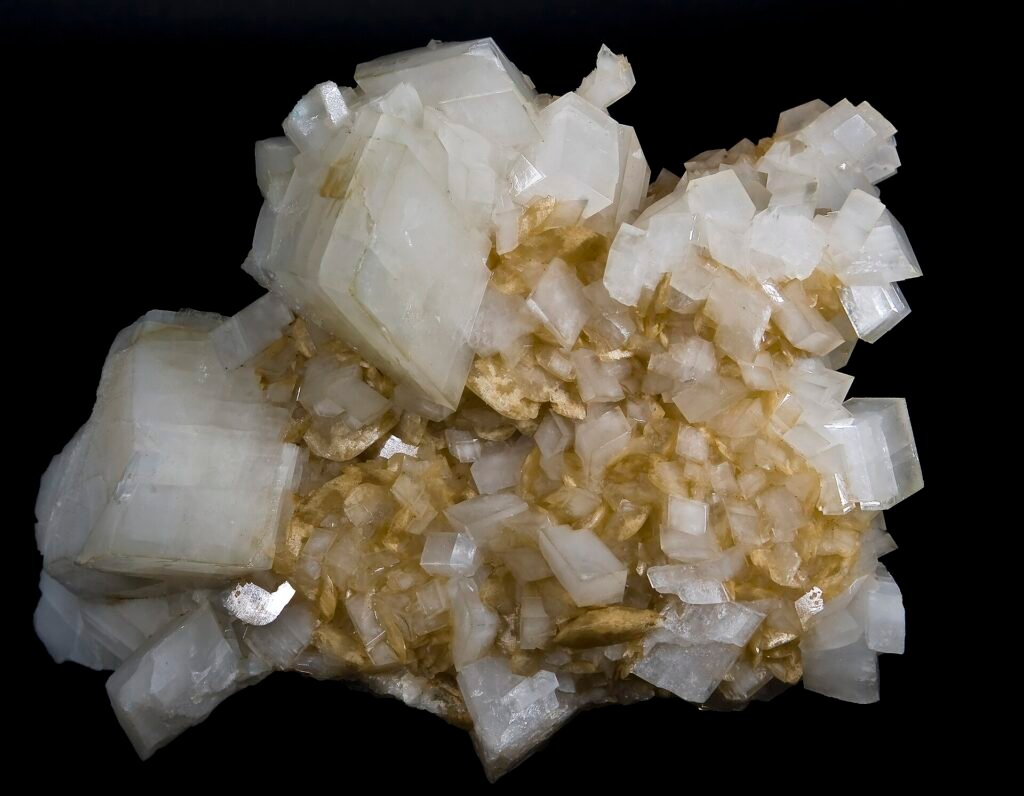
Magnesium compounds in 2025 included world magnesite mine output of about 21 million metric tons, gross weight, according to the U.S. Geological Survey’s Mineral Commodity Summaries 2026. China mined about 60% of it. The United States relies on imports for an estimated 59% of its magnesium compound use, and China supplied most of them. This article summarizes the USGS chapter, explains the main numbers and flags what it does not say.
Who mines magnesite?
Magnesite is the main mined source of magnesia. The USGS lists estimated 2025 mine production, in thousand metric tons, gross weight:
- China: 12,700
- Brazil: 1,800
- Russia: 1,700
- Turkey: 1,600
- Austria: 650
- Spain: 640
- Australia: 400
- Slovakia: 330
- Canada: 230
- Iran: 200
By our own arithmetic, China’s share is about 60% of the rounded world total of 21,000. U.S. output is withheld to protect company data. Several 2024 values carried merged footnote marks in the copy we read, so we compare no 2024 country figures here. China’s own 2024 and 2025 figures, 12,900 and 12,700, were clearly printed and show a small fall.
How much magnesite is left?
The USGS puts world reserves at 7,800,000 thousand tons. Russia is listed at 2,300,000, Slovakia at 1,200,000, China at 700,000, Australia at 280,000, Greece at 280,000 and Brazil at 200,000. By our arithmetic, China’s reserves are only about 9% of the world total although it mines about 60%, so the producer and the reserve holders differ. At the 2025 rate, world reserves equal well over 300 years of output.
How is magnesia made in the United States?
The USGS lists the 2025 sources of domestic production. Seawater supplied plants in California and Delaware. Well brines supplied a plant in Michigan, and lake brines supplied two companies in Utah. One company mined magnesite in Nevada, and one used stockpiled olivine in Washington. Production was an estimated 400 thousand tons of magnesium oxide content, against 398 in 2024, and the value of shipments, excluding magnesium chloride, was $350 million against $349 million.
What are magnesium compounds used for?
The USGS says about 78% of U.S. consumption was caustic-calcined magnesia, magnesium chloride, magnesium hydroxide and magnesium sulfates. Their major uses, in descending order, were environmental, deicing, chemical and agricultural. The rest went to refractories, which are heat-resistant materials, made from dead-burned magnesia, fused magnesia and olivine. The chapter says alumina, chromite and silica can replace magnesia in some refractory uses. Our reports on bauxite and alumina in 2025 and iron ore in 2025 cover related materials.
How dependent is the United States on imports?
Net import reliance was an estimated 59% in 2025, against 52% in 2024 and 56% in 2021. Imports rose from 496 thousand tons to an estimated 640, about 29% by our own arithmetic, and apparent consumption rose from 832 to 980, about 18%. Exports were 60 thousand tons. Total imports for 2021 to 2024 came from China (58%), Brazil (8%), Canada (8%) and Israel (8%), with others supplying 18%.
Where does each product come from?
Import sources differ by product, for 2021 to 2024:
- Caustic-calcined magnesia: China 74%, Canada 21%
- Crude magnesite: China 91%, Japan 5%
- Dead-burned and fused magnesia: China 69%, Brazil 17%
- Magnesium chloride: Israel 56%, Netherlands 21%, Austria 7%
- Magnesium hydroxide: Mexico 61%, Netherlands 14%, Israel 13%
- Magnesium sulfates: China 53%, Germany 12%, India 11%, Mexico 7%
China is therefore the leading source for four of the six products.
What changed in China?
The USGS says China was the leading producer and the principal import source in 2025. Through August 2025, U.S. imports of caustic-calcined magnesia from China rose 66% to 201,000 tons, and imports of dead-burned and fused magnesia rose 9% to 77,200 tons. Liaoning Province concentrates most of China’s output, and the number of magnesite-mining enterprises there fell from 114 in 2020 to 63 in 2024. Consolidation was expected to cut the number to 56 by yearend 2025.
What new supply does the chapter mention?
In October 2025, 14,000 tons of magnesite were mined from a trial open pit in Australia and shipped to a steel refiner based in Japan. The chapter reports this as a trial and does not say whether larger output will follow.
How has U.S. demand changed since 2021?
Apparent consumption was 984 thousand tons in 2021, fell to 899 in 2022 and 830 in 2023, stayed near 832 in 2024, then jumped to an estimated 980 in 2025. Imports followed the same path, from 647 to 490 and back to 640. Domestic production barely moved, at 432, 412, 428, 398 and 400. By our own arithmetic, the 2025 rebound was met almost entirely by imports. Plant employment held at 270 to 280 people throughout, which points to a stable domestic base.
How to read the numbers
U.S. figures are in magnesium oxide content, with conversion factors for each compound, while world magnesite is gross weight. Those two bases should not be compared directly. Estimates for 2025 are first reads that the USGS may revise.
How does magnesium connect to other coverage?
Magnesia serves steel and construction chains. See our reports on aluminum in 2025, tungsten in 2025 and the USGS summary of U.S. mineral production.
What should readers watch for next?
Readers can watch Chinese consolidation, new Australian output and the next USGS edition, which replaces estimates with reported data.
Glossary
- Magnesite: a magnesium carbonate mineral mined for magnesia
- Magnesia: magnesium oxide, a heat-resistant white solid
- Refractory: a material that withstands very high heat
- Caustic-calcined magnesia: magnesia fired at lower heat for chemical uses
- Net import reliance: imports minus exports, as a share of apparent consumption
These definitions are general explanations and are not quoted from the USGS.
What is not covered here?
We omit 2024 country figures that were hard to read, the tariff schedule and any price forecast.
Key facts at a glance
- World magnesite output, 2025: about 21 million tons
- China: 12.7 million tons, about 60%
- U.S. net import reliance: 59%
- China: 58% of U.S. imports, 2021 to 2024
- Liaoning mining firms: down from 114 to 63
Frequently asked questions
Which country mines the most magnesite?
China, at an estimated 12.7 million tons in 2025.
What is magnesia used for?
Environmental, deicing, chemical and agricultural uses, plus refractories.
Does the United States import magnesium compounds?
Yes. The USGS puts net import reliance at about 59%.
More in Business
- Antimony in 2025: USGS Shows a $25 Price as U.S. Import Reliance Hits 91 Percent
- Molybdenum in 2025: USGS Shows China Mines 37 Percent as U.S. Output Rises 18 Percent
- Niobium in 2025: USGS Shows Brazil Mines 93 Percent and the U.S. Imports All It Uses
- Tantalum in 2025: USGS Shows Congo Mines 52 Percent as U.S. Use Jumps 58 Percent