Some anniversaries are kept quietly, with names read aloud and flowers laid in long rows. July 11 is one of them. On this date in 1995, the Bosnian Serb army overran the town of Srebrenica in eastern Bosnia and Herzegovina, a place the United Nations had declared a safe area. In the days that followed, thousands of men and boys were murdered, in what international courts have ruled was genocide. Since 2024, the United Nations has observed July 11 each year as the International Day of Reflection and Commemoration of the 1995 Genocide in Srebrenica. This article sets out what happened, what the courts found, what the numbers say, and why remembrance is treated as a form of prevention. It is written with care and relies on the findings and statements of the United Nations and its tribunals.
A safe area that was not safe
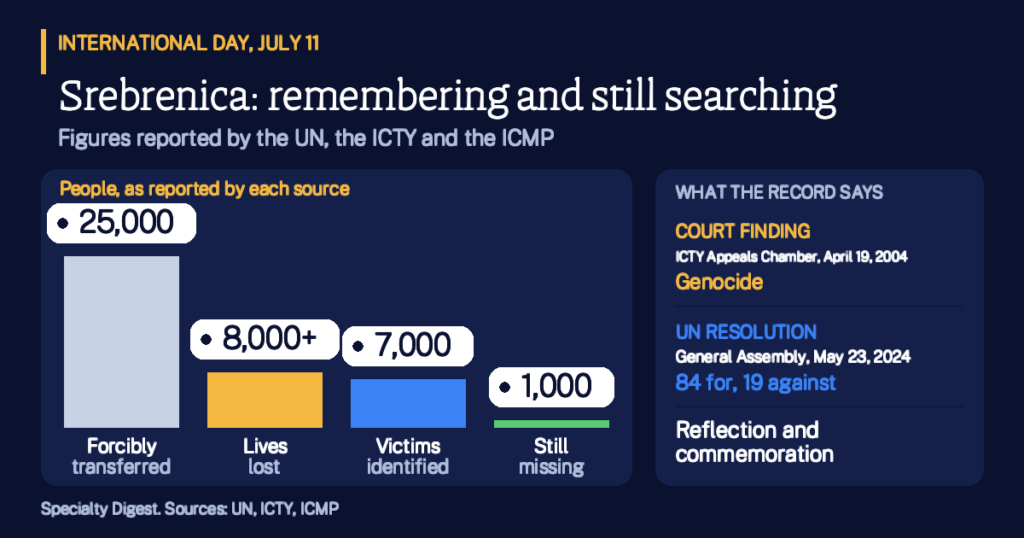
The war that followed the breakup of the former Yugoslavia claimed more than 100,000 lives in Bosnia and Herzegovina between 1992 and 1995. In 1993, the Security Council declared Srebrenica a safe area in its Resolution 819, meant to shelter civilians from attack. In July 1995, the Bosnian Serb army overran it. According to the United Nations, approximately 25,000 women, children and elderly people were forcibly transferred out of the enclave, and thousands of men and teenagers were murdered. The UN describes it as the largest massacre in Europe since the Holocaust.
The phrase safe area is the heart of the memory. People had gathered in Srebrenica because they were told it was protected, and that gap between a promise and what followed is a central reason the United Nations keeps this day.
What the courts decided
Remembrance rests on legal findings, so the words matter. Under the 1948 Genocide Convention, genocide requires an intent to destroy a protected group in whole or in part. On April 19, 2004, the Appeals Chamber of the International Criminal Tribunal for the former Yugoslavia (ICTY) unanimously found that genocide was committed in Srebrenica in 1995. It held that by seeking to eliminate a part of the Bosnian Muslims, Bosnian Serb forces committed genocide, and it stated that between 7,000 and 8,000 Bosnian Muslim men and boys were murdered. In the Chamber’s words, they targeted for extinction the 40,000 Bosnian Muslims living in Srebrenica, a group emblematic of Bosnian Muslims in general.
The case before the Chamber concerned Radislav Krstic, a senior Bosnian Serb army officer. His conviction was changed to aiding and abetting genocide, and his sentence was reduced from 46 years to 35 years. The UN observance page also notes that the International Court of Justice recognized the massacre as genocide.
Example 1: why “in part” matters. Imagine a community of 1,000 people living in one town, and an attacker who kills 200 of them, mostly men and boys, and expels most of the rest. No one has to harm all 1,000 for the aim to be the destruction of the group. The numbers are round and made up, but the idea echoes the Chamber’s reasoning that a part of a group can be targeted when that part is emblematic of the whole.
The numbers, and why they differ
Sources give slightly different counts because they measure different things at different times. The ICTY and UN News, reporting in 2004, cite between 7,000 and 8,000 men and boys murdered. The UN observance page says more than 8,000 lives were lost. In the 2024 General Assembly debate, Germany’s representative cited 8,372 people executed. Work to account for the dead continues. In July 2026, the International Commission on Missing Persons (ICMP) reported that more than 90 percent of the more than 8,000 victims have been accounted for, that it has helped identify approximately 7,000 victims, and that approximately 1,000 people remain missing. It also announced that ten newly identified victims would be buried on July 11, 2026 at the Srebrenica Memorial Cemetery in Potocari.
Example 2: why the last cases are hardest. Suppose a team is searching for 1,000 missing people and has resolved 900 of the cases. The remaining 100 are the ones with the least evidence left, so each tends to take longer than the last. The numbers are round and illustrative, but they help explain why identification work still continues three decades later.
The 2024 General Assembly resolution
On May 23, 2024, at its 82nd meeting of the 78th session, the General Assembly adopted by recorded vote a resolution sponsored by Germany and Rwanda, designating July 11 as the International Day of Reflection and Commemoration of the 1995 Genocide in Srebrenica. The vote was 84 in favor, 19 against and 68 abstentions. According to the UN press release, the resolution condemns any denial of the Srebrenica genocide as a historical event and actions that glorify those convicted of war crimes, crimes against humanity and genocide by international courts.
Not every state agreed. During the debate, speakers raised the question of individual versus collective responsibility. Serbia’s president urged a vote against and argued that individual legal liability had already been delivered, while Montenegro proposed preamble language emphasizing that accountability for genocide is individual. Those positions are reported here as stated, and the resolution text is the UN record.
Example 3: counting a vote. As a general rule, abstentions do not count as votes cast. Suppose 100 members vote on a measure and 40 say yes, 10 say no and 50 abstain. Of the votes that count, 40 are yes and 10 are no, so the measure passes. The numbers are round and illustrative, and they show why a large number of abstentions can sit beside a clear result.
Why remembrance is treated as prevention
The UN observance page notes that UN Special Advisers have expressed concern about unabated denial of the Srebrenica genocide and glorification of convicted war criminals. The 2024 resolution responds by condemning both. In the UN’s framing, remembrance is not only grief. It keeps a documented record in public view and honors families who are still searching. The day also stands beside other observances that ask the world to remember mass atrocity, such as the International Day of Commemoration and Dignity of the Victims of the Crime of Genocide.
Readers affected by these events, or by the loss of a relative in conflict, can find support through local community organizations, faith communities and mental health services.
How the day is marked
The General Assembly asked the Secretary-General to establish an outreach program titled “The Srebrenica Genocide and the United Nations,” beginning with preparations for the thirtieth anniversary in 2025. That anniversary was marked with an observance in the General Assembly Hall on Tuesday, July 8, 2025. In Bosnia and Herzegovina, the memorial at Potocari remains the place where victims are laid to rest as they are identified, and in 2026 the ICMP announced burials there on July 11.
Key Takeaways
- A promise was broken. Srebrenica was a UN safe area under Resolution 819 of 1993 when it was overrun in July 1995.
- Courts have ruled. The ICTY Appeals Chamber unanimously found in 2004 that genocide was committed in Srebrenica, and the UN notes the ICJ also recognized it.
- Counts differ by source. The ICTY cites 7,000 to 8,000 men and boys, while the UN says more than 8,000 lives were lost.
- The search is unfinished. About 1,000 people remain missing as of July 2026, according to the ICMP.
- The day is recent. The General Assembly designated July 11 on May 23, 2024, by 84 votes to 19, with 68 abstentions.
- Remembrance guards the record. The resolution condemns denial of the genocide and the glorification of convicted war criminals.
How solid is this? Casualty counts differ by source and by year, and the identification figures are ICMP approximations as of July 2026. Legal findings are quoted from the ICTY and attributed to the named bodies, and statements from the debate are attributed to their speakers. The three worked examples use round, made-up numbers to show an idea. See also the International Days hub and the International Days Calendar.
More in History
- United Nations, International Day of Reflection and Commemoration of the 1995 Genocide in Srebrenica
- UN Meetings Coverage, GA/12601: General Assembly adopts resolution on Srebrenica genocide, May 23, 2024
- United Nations, General Assembly resolution A/RES/78/282, May 30, 2024
- UN News, UN establishes International Day of reflection for Srebrenica genocide, 2024
- ICTY, Appeals Chamber Judgement in the Case the Prosecutor v. Radislav Krstic, April 19, 2004
- UN News, Srebrenica massacre was genocide, UN tribunal for former Yugoslavia confirms, 2004
- International Commission on Missing Persons, Thirty-One Years After the Srebrenica Genocide, July 2026