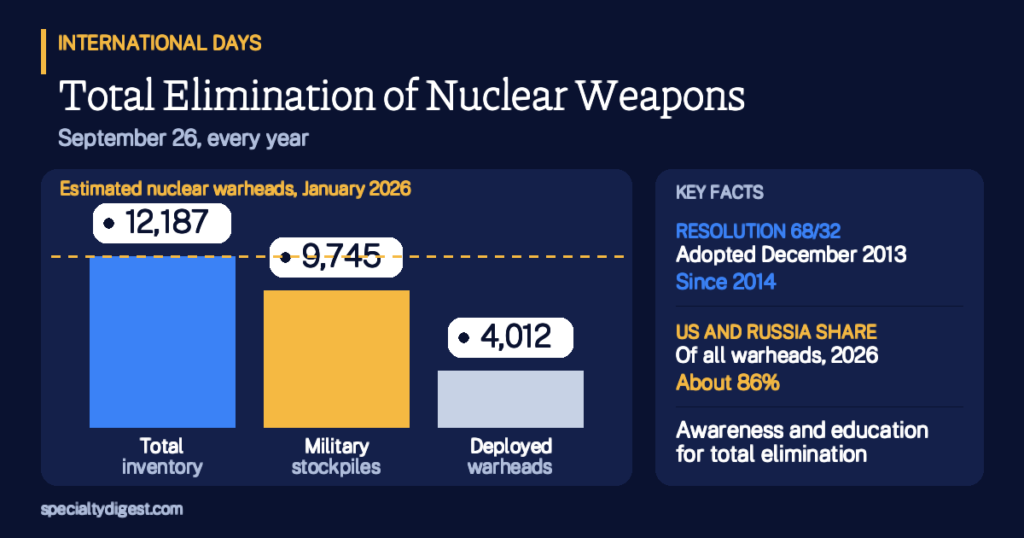
Few objects in history carry as much destructive power as a nuclear weapon, and few subjects are as hard to discuss calmly. Every September 26, the United Nations asks the world to do exactly that. The International Day for the Total Elimination of Nuclear Weapons exists, in the words of the UN, to further the objective of total elimination through enhanced public awareness and education about the threat these weapons pose to humanity and the necessity for their elimination. It is a day for facts, memory and public conversation, and it sits naturally beside the International Day of Peace, which the UN marks only a few days earlier.
How the day came to exist
The day grew out of a high-level meeting on nuclear disarmament held at the General Assembly in New York on September 26, 2013. In December 2013, the Assembly adopted resolution 68/32, which declared September 26 the International Day for the Total Elimination of Nuclear Weapons. The UN says the day has been observed annually since 2014. The Assembly has returned to the subject in follow-up resolutions since then, including 69/58 in 2014 and 80/49 most recently.
The sources checked for this article give the month of adoption, December 2013, but not the exact day, so none is stated here. They also name no single annual theme. Instead, the day is built around a fixed purpose: to let governments reaffirm their commitment to nuclear disarmament and to raise public awareness.
What “total elimination” means
The phrase has a precise meaning. It does not call for reducing arsenals a little, or managing them better. It calls for a world in which nuclear weapons no longer exist, verified and agreed by the states that hold them. Several treaties form the framework around that goal. The Partial Test Ban Treaty was opened for signature in 1963, and the Comprehensive Nuclear-Test-Ban Treaty in 1996. The Treaty on the Non-Proliferation of Nuclear Weapons, known as the NPT, was extended indefinitely in 1995. On July 7, 2017, states adopted the Treaty on the Prohibition of Nuclear Weapons.
The UN also records that the 2022 Review Conference of the NPT did not reach consensus on a substantive outcome document. The Eleventh Review Conference was scheduled for April 27 to May 22, 2026. This article does not describe its outcome, because the sources checked do not report one.
The numbers behind the day
Counting nuclear weapons is difficult because states guard the details, so the figures below are expert estimates, not official declarations. The best-known source is the Stockholm International Peace Research Institute, SIPRI. At the start of 2026, SIPRI estimated that nine states together possessed about 12,187 nuclear weapons. Of these, about 9,745 were in military stockpiles and considered potentially operationally available. An estimated 4,012 were deployed with operational forces, and between 2,100 and 2,200 of those were thought to be kept on high alert on ballistic missiles.
Example 1: counting by share. Imagine a world with 100 warheads in total. SIPRI reports that the United States and Russia together hold almost 86 percent of the real total, so in this made-up world 86 would belong to those two states, leaving 14 for the other seven. The numbers are round and illustrative, but they show how concentrated the arsenals are.
A long decline that has stalled
For decades after the Cold War, the number of nuclear weapons fell, mainly because Russia and the United States dismantled retired warheads faster than they built new ones. SIPRI said in 2025 that this trend was likely to be reversed in the coming years. Its two most recent yearbooks show why that warning matters: the total fell slightly, from about 12,241 at the start of 2025 to about 12,187 at the start of 2026, but the number in military stockpiles rose from about 9,614 to about 9,745, and the number deployed rose from about 3,912 to about 4,012.
Example 2: a shrinking pile that starts growing. Suppose a stockpile holds 100 weapons, and each year 5 old ones are dismantled while 3 new ones are added. The total falls by 2 a year. If the additions rise to 6, the total starts to grow by 1 a year, even though dismantling continues. The figures are invented, but this is the pattern experts mean when they say the era of reductions may be ending.
Why the world observes it
The reason is human, not statistical. The UN states that the atomic bombs that destroyed Hiroshima and Nagasaki in 1945 are estimated to have killed a total of 213,000 people immediately. Survivors, known in Japan as hibakusha, have carried that memory for generations, and their testimony is central to how the UN frames the issue. In his message for the 2025 observance, the Secretary-General said that nuclear weapons deliver no security, only the promise of annihilation, and called on states that possess them to lift that shadow.
The UN page also records that the New START treaty, the last major agreement limiting United States and Russian strategic forces, expired on February 5, 2026 without a successor arrangement. That is a fact about the treaty framework, not a prediction, and it is part of the context in which the day is now observed.
Who is affected and how the day is marked
Everyone is affected by the risk, but the debate is shaped by two groups: the nine states that hold nuclear weapons, and the many states that do not. SIPRI names the nine as the United States, Russia, the United Kingdom, France, China, India, Pakistan, North Korea and Israel. China is the fastest-growing of these in SIPRI’s counts, rising from 600 to up to 620 warheads during 2025.
The main event each year is a high-level plenary meeting of the General Assembly in New York. Because September 26, 2026 fell on a Saturday, the 2026 meeting was set for Tuesday, September 29. Universities, schools, civil society groups and museums also take part, using the day for lectures, exhibitions and discussions about disarmament.
Example 3: why alert status matters. Imagine 4,000 deployed warheads, with 2,000 of them ready to launch quickly. That is half. SIPRI’s real estimate is just over half of the deployed total. Readiness, not only quantity, is why disarmament talks include questions about how fast a weapon could be used.
Anyone can take part in the day. Reading about the subject, listening to survivor testimony, and asking elected officials what their country’s position is are all ways to join the conversation. The topic can be distressing, and anyone who feels overwhelmed by it can reasonably talk to a trusted person or a local health professional.
Key Takeaways
- The day has a clear legal basis. General Assembly resolution 68/32, adopted in December 2013, set September 26 as the day, and it has been observed since 2014.
- The goal is total elimination. The UN frames the day around public awareness and education about the threat, not around any single country.
- The arsenal is large. SIPRI estimated about 12,187 nuclear weapons at the start of 2026.
- Two states hold most of them. The United States and Russia together hold almost 86 percent.
- Decline has stalled. The total fell slightly from 2025 to 2026, but stockpiled and deployed warheads rose.
- Memory drives the cause. The 1945 bombings are estimated to have killed 213,000 people immediately.
- Treaties matter. New START expired on February 5, 2026 without a successor, according to the UN.
How solid is this? Warhead counts are expert estimates from SIPRI, not official declarations, and each carries its own year. The 213,000 figure is the UN’s estimate of immediate deaths in 1945. The three worked examples use round, made-up numbers. The sources checked give no exact adoption day for resolution 68/32 and no annual theme, so none is stated. See the International Days hub and the International Days Calendar.
More in Society
- United Nations, International Day for the Total Elimination of Nuclear Weapons
- UN Meetings Coverage, Secretary-General message, SG/SM/22801
- SIPRI Yearbook 2026, Summary
- SIPRI press release, Yearbook 2025
- SIPRI Yearbook 2025, World nuclear forces
- United Nations, 2026 high-level plenary meeting
- UN Office for Disarmament Affairs, update on the 2017 observance