Tourism looks like leisure, but it is also one of the world’s largest sources of jobs and export income. World Tourism Day, observed every year on September 27, invites everyone to see the industry in both ways: as a force that can build livelihoods and understanding between peoples, and as one that can strain communities and places when it grows without care. The day is led by UN Tourism, the United Nations agency for the sector. Its 2026 theme asks how digital tools and artificial intelligence should reshape the way the world travels.
From a 1970 charter to a world day
The day has a clear paper trail. On September 27, 1970, the Statutes of the World Tourism Organization were adopted, the document that paved the way for the organization’s establishment five years later. In September 1979, at its third session in Torremolinos, Spain, the organization’s General Assembly decided to institute World Tourism Day, beginning in 1980. The date marks the anniversary of those Statutes. It also falls at the end of the high season in the northern hemisphere and the start of the season in the southern hemisphere, a natural moment for the industry to pause and reflect.
The first theme, in 1980, was tourism’s contribution to the preservation of cultural heritage and to peace and mutual understanding. Each year since, UN Tourism has chosen a theme and a host country for the main celebration. Themes have ranged from “Tourism Opens Doors for Women” in 2007 to “1 Billion Tourists 1 Billion Opportunities” in 2015, “Tourism and Jobs: a better future for all” in 2019 and “Tourism and Rural Development” in 2020. The 2025 observance carried the theme Tourism and Sustainable Transformation.
The numbers behind the day
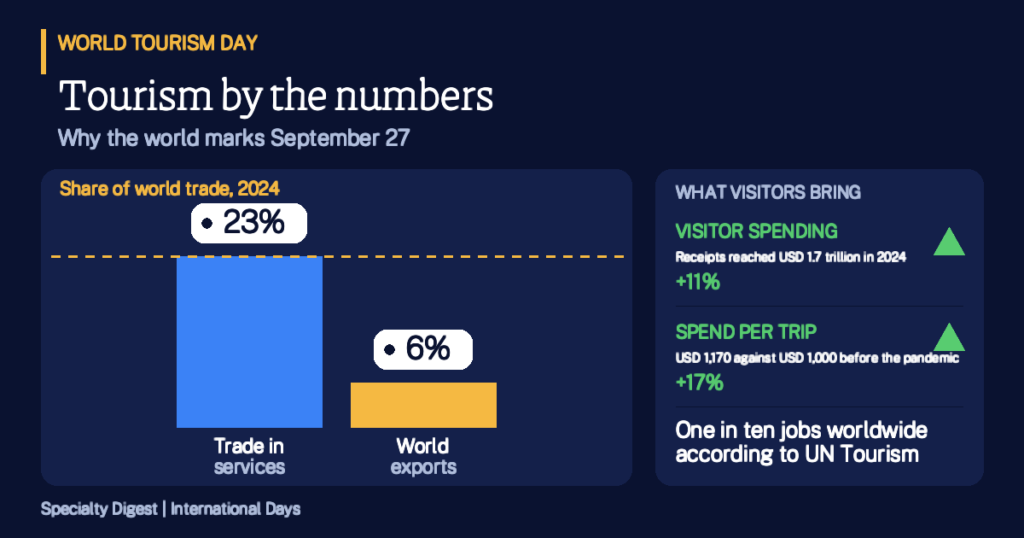
The clearest way to see tourism’s weight is through trade. UN Tourism reports that international tourism export revenues grew 11 percent in real terms to a record USD 2.0 trillion in 2024, about 15 percent above the pre-pandemic level. That is about 6 percent of world exports of goods and services and 23 percent of global trade in services. International tourism receipts, the money visitors spend in the places they visit, rose 11 percent to USD 1.7 trillion in the same year.
Visitors are also spending more. Average spending was USD 1,170 per international trip in 2024, against a pre-pandemic average of USD 1,000, in constant dollars.
Example 1: the same crowd, more income. Imagine a coastal town that welcomes 100,000 international visitors a year, each spending a round $1,000 on the trip. That is $100 million. If spending per trip rose by the same 17 percent as the global average, the same crowd would bring $117 million. The numbers are round and illustrative, but they show why tourism officials watch spending per visit and not only visitor counts.
Volume is recovering as well. In the first quarter of 2025, more than 300 million international tourists traveled, up 5 percent, about 14 million more than a year earlier and 3 percent above the same months of 2019. Asia and the Pacific grew 12 percent and reached 92 percent of its pre-pandemic level, while Europe, the largest region, welcomed 125 million visitors, up 2 percent.
- 10%of global GDP from travel and tourism, US$11.6 trillion in 2025 (World Bank)
- 366 millionjobs worldwide in the sector (World Bank)
- US$2 trillionin international visitor spending in 2025 (World Bank)
- 1 in 3new jobs globally come from the sector (World Bank)
Jobs and livelihoods
UN Tourism says tourism accounts for one in ten jobs worldwide, and that each core tourism job creates about one and a half additional, indirect jobs in the wider economy. The World Bank counts 366 million jobs in travel and tourism and says the sector generates one in every three new jobs globally. The two bodies use different definitions, so the figures should be read side by side, not added together.
The themes of 2019 and 2020 put jobs and rural development at the center of the day for a practical reason: visitor spending reaches far beyond hotels. It flows to farms that supply kitchens, drivers, guides, craft makers and the shops that serve them.
Example 2: counting the ripple. Suppose a small lodge employs 20 people directly. At 1.5 additional jobs per core job, the lodge supports about 30 more jobs among suppliers, farmers, drivers and guides, or about 50 in all. The lodge is imaginary and the arithmetic is rounded, but it shows how a single employer can sit at the center of a local web of work.
When travel stops
The pandemic showed how exposed those livelihoods are. UN material for the 2021 observance said that 100 to 120 million direct tourism jobs were at risk and that the crisis would cost the world economy more than 4 trillion dollars. It also estimated that arrivals in developing countries fell by between 60 and 80 percent in 2020. Those were projections and estimates made at the time, not final counts, but they explain why recovery is watched so closely.
Example 3: a village without visitors. Picture a mountain village that earns $200,000 a year from visitors. If arrivals fall 70 percent, which sits inside the 60 to 80 percent range described above, and spending per visitor stays the same, income drops to $60,000. A family that ran a guesthouse and sold weavings may have little else to fall back on. These figures are round and illustrative.
Who gains, and who is left out
Growth is uneven, and so are the gains. Visitors tend to gather in a few famous places and on a few big platforms, while smaller destinations and local businesses struggle to be seen. That concern runs through the 2026 message from the UN Secretary-General. He notes that artificial intelligence is changing how travelers choose destinations and how the industry operates. It can strengthen small businesses, he says, but left unchecked it can funnel tourists to the same few places and platforms.
His answer is that technology must serve humanity. Tourism workers, local communities and emerging destinations, he says, must help shape what comes next, which calls for investment in digital skills and wider access to technology. The message links the theme to Sustainable Development Goals 8, 9, 10, 11, 12 and 17. Tourism also leans on shared public resources, such as clean water, so it connects naturally to days like World Water Day.
How the day is marked
UN Tourism chooses the theme and a host country each year, and governments, destinations and companies run events around it. Travelers can join in simply: choose locally owned places to stay, buy from local makers and ask how a destination shares the benefits of tourism with the people who live there.
- 1980Tourism’s contribution to cultural heritage, peace and mutual understanding
- 20151 Billion Tourists 1 Billion Opportunities
- 2019Tourism and Jobs: a better future for all
- 2020Tourism and Rural Development
- 2025Tourism and Sustainable Transformation
- 2026Digital Agenda and Artificial Intelligence to Redesign Tourism
Key Takeaways
- The date has a paper trail. September 27 marks the 1970 adoption of the organization’s Statutes, and the day began in 1980.
- Tourism is a major export. Revenues hit a record USD 2.0 trillion in 2024, about 6 percent of world exports.
- Each trip is worth more. Average spending rose to USD 1,170 from USD 1,000 before the pandemic.
- Jobs reach far beyond hotels. One core job creates about one and a half more, according to UN Tourism.
- Shocks hit hard. The pandemic put 100 to 120 million direct jobs at risk, by UN estimates at the time.
- Benefits must be shared. The 2026 message warns that unchecked technology can crowd visitors into the same few places.
- Travelers have a role. Choosing local businesses spreads the gains to the people who host you.
How solid is this? Trade and spending figures are UN Tourism estimates for 2024 and early 2025 and are revised as data arrive. Jobs and GDP figures from the World Bank and UN Tourism use different definitions. The 2021 job-risk and arrival-drop figures were projections and estimates made during the pandemic. The three worked examples use round, made-up numbers to show an idea. See also the International Days hub and the International Days Calendar.
More in Society