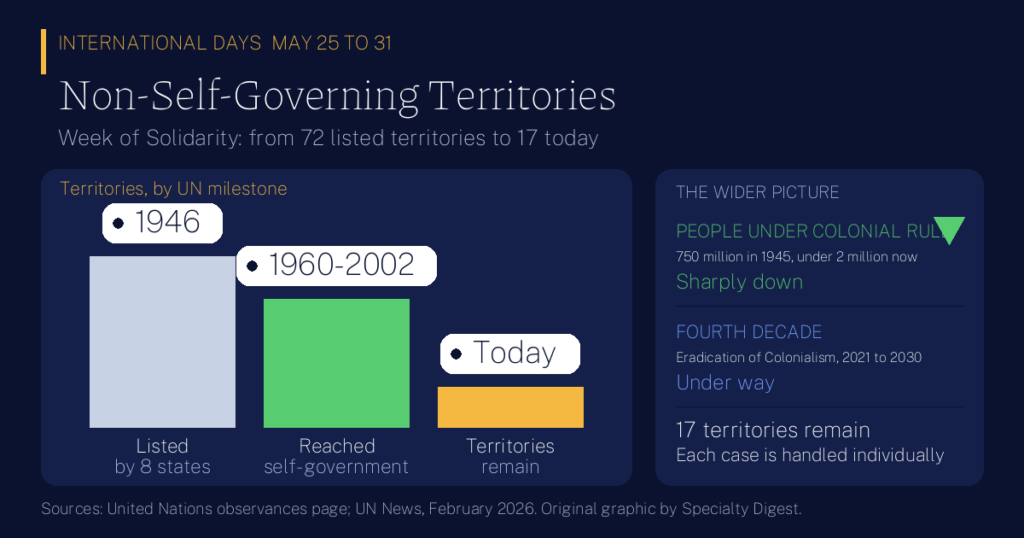
In 1945, about 750 million people, nearly a third of humanity, lived in territories governed by colonial powers. Today fewer than 2 million do, spread across 17 places that the United Nations still calls Non-Self-Governing Territories. Every year from May 25 to 31, the Week of Solidarity with the Peoples of Non-Self-Governing Territories asks the world to remember that decolonization is a story that is largely told but not yet finished. It is a close companion of the International Day against Colonialism in All its Forms and Manifestations.
A promise written into the Charter
The idea starts in the UN Charter. Chapter XI, which includes Article 73, deals with territories whose peoples have not yet attained a full measure of self-government. The countries that administer them, called administering powers, accepted three duties. They recognize that the interests of the inhabitants are paramount and accept as a sacred trust the obligation to promote their well-being. They agree to help develop self-government and free political institutions. And they must transmit regularly to the Secretary-General information on economic, social and educational conditions in the territories. In 1946, eight member states listed 72 territories under this chapter. That list is the starting point for everything the UN has done on the subject since.
The Declaration that changed the calendar
On December 14, 1960, the General Assembly adopted resolution 1514 (XV), the Declaration on the Granting of Independence to Colonial Countries and Peoples. The vote was 89 to 0, with 9 abstentions. The Declaration states that the subjection of peoples to alien subjugation, domination and exploitation constitutes a denial of fundamental human rights, affirms that all peoples have the right to self-determination, and calls for all powers to be transferred to the peoples of the territories concerned.
To monitor progress, the Assembly created a Special Committee in 1961 through resolution 1654 (XVI), at first with seventeen members. A year later resolution 1810 (XVII) raised it to twenty-four, which is why it is often called the C-24. Since 1990 the UN has also declared four consecutive international decades for the eradication of colonialism. The fourth, running from 2021 to 2030, was declared in resolution 75/123.
Why there is a week
As the UN observances page records, the General Assembly requested the Week of Solidarity in resolution 54/91, adopted on December 6, 1999. The same resolution urged the administering powers to take effective measures to safeguard and guarantee the inalienable rights of the peoples of these territories. The week runs from May 25 to 31 each year. A week, rather than a single day, gives governments, schools and civil society room to hold meetings, seminars and discussions about places that rarely make the news.
The numbers behind the week
The shrinking of the list is the main fact of this story. Of the 72 territories listed in 1946, eight became independent before 1959, and from 1960 to 2002 a further 54 attained self-government. Today 17 remain. These counts come from separate UN tallies, and the UN also notes that the transmission of information was discontinued for 21 territories, so they do not form a simple subtraction. More broadly, the UN says that since 1945 more than 80 former colonies, comprising some 750 million people, have gained independence.
- 17Non-Self-Governing Territories remain on the UN list
- 2 millionfewer than this many people live in them
- 750 millionpeople lived in dependent territories in 1945
- 89 to 0vote adopting the 1960 Declaration, with 9 abstentions
Example 1: the arithmetic of scale. Picture a stadium of 75,000 seats where each seat stands for 10,000 people. The 750 million people under colonial rule in 1945 would fill it. Today’s figure of under 2 million would fill no more than about 200 seats. The numbers are round and illustrative, but the proportion is real: the remaining territories are small in population even when the questions they raise are large.
Who lives there, and what they face
The UN describes the 17 territories as ranging from Western Sahara in Africa to small island territories in the Caribbean and the Pacific. Secretary-General António Guterres noted in February 2026 that the majority are small islands, and UN News reports that Tokelau, one of them, is home to fewer than 2,000 people. Smallness brings practical challenges, among them exposure to storms and rising seas, limited budgets and few economic options.
Opening the 2026 session of the Special Committee on Decolonization, in remarks delivered by Chef de Cabinet Courtenay Rattray, the Secretary-General said the UN was created as a place where nations could meet as equals, not as rulers and ruled. He named three priorities: inclusive dialogue among the territories, administering powers, member states and other stakeholders, with each case addressed individually; the central role of young people; and the urgency of climate action, especially for island territories.
Example 2: reporting that makes a difference. Suppose an island territory has 2,000 pupils and 100 teachers. The yearly information its administering power sends under Article 73 would show 20 pupils per teacher, a simple number that lets the Special Committee and outside observers compare schooling over time. The figures are made up, but the principle, that conditions are reported openly, comes straight from the Charter.
Example 3: a storm on a small island. Imagine an island of 5,000 people and 2,000 homes. A hurricane damages 300 homes, or 15 percent. In a large country, 300 damaged homes would barely register nationally. On the island they are roughly one home in seven. The numbers are illustrative, and they show why the Secretary-General asked that resilience and adaptation sit at the heart of the discussions.
How the week is marked and what progress needs
The week is marked mainly through UN meetings, regional seminars such as the Caribbean regional seminar on decolonization that opened in 2026, and statements by the Secretary-General and member states. The UN does not treat the territories as one case. The 2026 remarks stress that each situation be addressed individually, through dialogue that includes the people who live there. Progress therefore depends on open information, on dialogue, and on the willingness of all parties to keep the question on the agenda. This article does not judge any individual territory. Readers can follow each case through the Special Committee’s work and the General Assembly’s resolutions.
The four international decades so far:
- 1990 to 2000International Decade for the Eradication of Colonialism
- 2001Second International Decade begins
- 2011 to 2020Third International Decade
- 2021 to 2030Fourth International Decade, resolution 75/123
Key Takeaways
- The duty is in the Charter. Article 73 treats the well-being of the people of these territories as a sacred trust.
- The list has shrunk sharply. The UN counted 72 territories in 1946 and 17 remain today.
- The human scale has changed. About 750 million people lived under colonial rule in 1945, and fewer than 2 million do now.
- A 1960 vote set the direction. Resolution 1514 (XV) passed 89 to 0 and affirmed the right to self-determination.
- The work is monitored. A Special Committee, now commonly called the C-24, reviews progress, and the Fourth Decade runs to 2030.
- Small islands face big risks. Climate action and resilience are among the Secretary-General’s 2026 priorities.
How solid is this? Figures come from UN pages and a UN News report of February 2026, and the territory counts come from separate UN tallies that are not meant to be subtracted from one another. The three worked examples use round, made-up numbers to show an idea. See also the International Day against Colonialism, the International Days hub and the International Days Calendar.
More in History
- United Nations. International Week of Solidarity with the Peoples of Non-Self-Governing Territories, 25-31 May.
- United Nations. Global Issues: Decolonization.
- UN Audiovisual Library of International Law. Declaration on the Granting of Independence to Colonial Countries and Peoples (resolution 1514 (XV), 1960).
- UN News. UN chief urges renewed push to complete decolonization as 17 territories remain (February 16, 2026).
- United Nations. Charter of the United Nations, Chapter XI: Declaration regarding Non-Self-Governing Territories.