Roughly half of the world’s people menstruate at some point in their lives, yet for generations the subject has been wrapped in silence, shame and myth. Menstrual Hygiene Day, observed every May 28, exists to unwind that silence. It is not a United Nations day backed by a General Assembly resolution. It is a civil society movement, run by a Berlin nonprofit, that grew until agencies, schools, clinics and companies joined in. Its message is simple: a period should never decide whether a girl learns, a woman works or anyone is treated with dignity. Like World Toilet Day, it rests on the idea that dignity starts with the basics.
A day that began as a campaign
WASH United, a nonprofit based in Berlin, started the day and still coordinates the movement as its international secretariat. The first observance took place on May 28, 2014. On that first day, 155 partner organizations took part and 89 media pieces about menstruation were published. The organizers explain the purpose in plain terms: menstrual health and hygiene had long been “buried under a thick layer of silence.” Their pages do not say why May 28 was chosen, so this article does not guess. What is clear is the intent, which was to give a taboo subject one date that anyone could join.
Unlike many days in this series, it has no annual theme. The movement now unites behind one long-term mission, Together for a #PeriodFriendlyWorld. For 2026 the organizers report a campaign period from April 29 to June 10 that reached 1.135 billion people, produced 28,301 media pieces and included more than 3,000 events. Those are the campaign’s own figures, not independent measurements.
Menstrual hygiene and menstrual health
The two terms are related but not identical. Menstrual hygiene is the practical side: clean materials to absorb or collect blood, a private place to change them, water and soap to wash, and a way to dispose of used items. Menstrual health is wider. The World Health Organization describes it as being informed and supported to menstruate with dignity before the first period, through the reproductive years and until menstruation ends in later life. Its conditions include timely access to accurate, age-appropriate information and freedom from stigma because of menstruation. Put simply, hygiene is about supplies and facilities, while health adds knowledge, care and respect.
Example 1: the cost of a monthly need. Suppose a pack of pads costs $1.50 and each girl in a household needs one pack a month. A home with three girls spends $4.50 a month, or $54 a year. The numbers are round and illustrative, but they show how a small price becomes a real choice in a household where every dollar is already spoken for.
The numbers behind the day
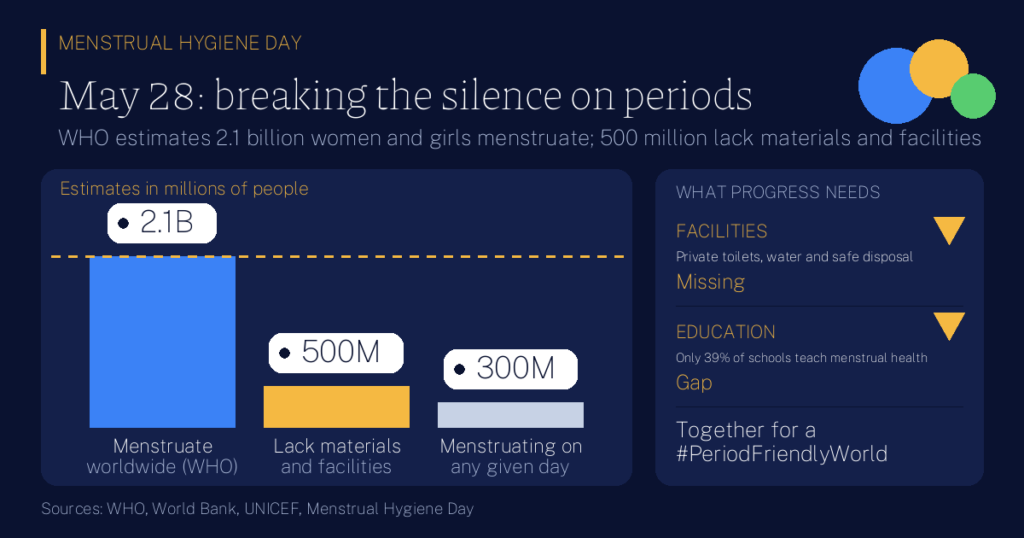
WHO estimates that 2.1 billion women and adolescent girls menstruate worldwide, citing the 2025 WHO/UNICEF Joint Monitoring Programme report. UNICEF’s page speaks of 1.8 billion people menstruating every month, and the World Bank notes that on any given day more than 300 million women are menstruating. The figures differ because they count different groups and moments, but all point to a very large share of humanity.
WHO also estimates that 500 million people who menstruate lack access to menstrual materials and appropriate facilities, drawing on data for 2000 to 2019. Pain is common: more than 2 out of 3 women and girls have pain with menstrual bleeding. Many also have heavy bleeding, which can lead to iron deficiency anemia, and a 2023 study in 10 cities in South Asia and sub-Saharan Africa found that almost half of menstruating women experience it.
- 2.1 billionwomen and girls menstruate, WHO estimate
- 500 millionlack materials and facilities, data 2000 to 2019
- 2 in 3women and girls have pain with menstrual bleeding
- 39%of schools provide menstrual health education
Why it matters: school and learning
Schools are where the gap shows first. WHO cites emerging national data indicating that about two out of five schools (39%) provide menstrual health education. The World Bank’s 2022 brief gathers local studies of what happens when facilities and information are missing. In one Kenyan study, 95 percent of menstruating girls missed one to three school days (2017). In South Sudan, 57 percent of surveyed adolescent girls stayed home during menstruation because schools lacked private changing rooms (2015). In India, a quarter of girls did not attend school during menstruation because of inadequate toilets (2016).
Each study covers one place and one group of girls, so none is a global average. Together they show a pattern: missing toilets, privacy, supplies and information keep some girls out of class. The World Bank adds that in low-income countries half of schools lack adequate water, sanitation and hygiene services, citing UNICEF data from 2015. That is the same gap described on World Toilet Day, seen through the experience of a single month.
Example 2: lost class days. Imagine a class of 40 girls in which 10 stay home one day each month because of a missing toilet door or pads. Over a ten-month school year that is 100 girl-days of lost learning in one classroom. The numbers are made up and round, but they show how a small barrier multiplies.
Health, information and the silence
Information is part of the infrastructure. A girl who has not been told what to expect may meet her first period with fear. In Bangladesh, a World Bank brief reports that only 36 percent of girls had prior knowledge about menstruation before their first period (2017). Pain and heavy bleeding are common, and when they are treated as too embarrassing to mention, it is harder for anyone to seek advice about them. WHO’s fact sheet is explicit that menstrual health covers the whole life course, not only the teenage years.
Who is left behind
UNICEF notes that gender inequality, taboos and poverty mean menstrual needs often go unmet. Girls in poor households, in schools without water or privacy, and in places where menstruation cannot be discussed are most likely to be left behind. The World Bank points to the same problem in school facilities: where toilets and water are lacking, no amount of goodwill makes a period manageable.
Example 3: a district plan. Suppose a district has 200 schools. If 39 percent teach menstrual health, that is 78 schools, and 122 do not. A plan that adds teacher training to 20 schools a year would take about six years to cover the gap. The figures are round and illustrative, but they show why steady investment matters more than a single campaign day.
How the day is marked, and what progress needs
Organizations mark the day with events, classroom lessons, media stories and online posts, using the hashtag #MHDay2026 in 2026. The long-term mission, Together for a #PeriodFriendlyWorld, points to what progress needs: affordable materials, private facilities with water and a way to dispose of waste, accurate education for everyone, and respect in homes, schools and workplaces. None of these is complicated. They simply have to be provided where they are missing.
Key Takeaways
- It is a movement, not a UN resolution. WASH United started the day in 2014 and still coordinates it.
- Hygiene is not the whole story. Menstrual health adds information, care and freedom from stigma.
- The scale is enormous. WHO estimates 2.1 billion women and girls menstruate, and 500 million lack materials and facilities.
- Schools are the pressure point. Local studies link missing toilets and privacy to absence, and about two in five schools teach menstrual health.
- Pain is common and often unspoken. More than 2 out of 3 women and girls have pain with menstrual bleeding.
- Silence is the first barrier. Breaking it is cheap, and it makes every other fix easier.
How solid is this? Population figures are estimates from WHO, UNICEF and the World Bank and differ by source, year and group. The school absence figures come from single local studies and are not global averages. The 2026 campaign reach figures are self-reported by the organizers. The three worked examples use round, made-up numbers to show an idea. See also the International Days hub and the International Days Calendar.
More in Health
- World Health Organization. Menstrual health (fact sheet, 2026).
- Menstrual Hygiene Day. About Menstrual Hygiene Day (WASH United, secretariat).
- Menstrual Hygiene Day. Together for a #PeriodFriendlyWorld.
- UNICEF. Menstrual hygiene.
- World Bank. Menstrual Health and Hygiene (2022).
- WHO and UNICEF Joint Monitoring Programme. Progress on household drinking water, sanitation and hygiene 2000-2024 (2025).