Hundreds of millions of people live on lands their ancestors knew long before modern borders were drawn. Their languages, laws and ways of caring for the natural world often predate the countries that now govern them. The International Day of the World’s Indigenous Peoples, observed every August 9, asks everyone else to notice. It is not a day about the past alone. The United Nations estimates that about 476 million Indigenous people live in some 90 countries, and many still face poverty, discrimination and the loss of their lands and languages. The day is a chance to learn who they are, what has been promised on paper, and what is still missing in practice.
A day born in a Geneva meeting
The date has a precise origin. August 9 marks the first meeting, in 1982, of the UN Working Group on Indigenous Populations in Geneva, an early United Nations forum devoted to Indigenous concerns. Years later, by resolution 49/214 of December 23, 1994, the General Assembly decided that the day would be observed on August 9 every year.
The decision came as the first International Decade of the World’s Indigenous People was getting under way. That decade ran from 1995 to 2004 under resolution 48/163, and a second followed from 2005 to 2014 under resolution 59/174. The effort reaches back further still, to the International Year of the World’s Indigenous People in 1993, which the Assembly proclaimed in 1990.
Who is counted, and how many
The United Nations has long relied on self-identification rather than one rigid definition of who is Indigenous, partly because histories and legal systems differ so widely. What the numbers show is scale and variety. The UN estimates about 476 million Indigenous people in 90 countries, representing some 5,000 different cultures. The International Labour Organization (ILO) also counts more than 476 million people in about 90 countries. Depending on the source, that is roughly 5 to 6 percent of the world’s population. These are estimates, and counts vary with how each country identifies its people.
- 476 millionIndigenous people worldwide, an estimate (UN, ILO)
- 90countries are home to Indigenous peoples
- 5,000different cultures (UN)
- 40%+of about 7,000 languages are at some level of endangerment (UN)
Example 1: a small share, a big difference. Imagine a country of 100 million people where Indigenous communities make up 5 million, or 5 percent. If they were also 15 percent of the people living in extreme poverty, that would be three times their share of the population. The figures are round and illustrative, but this is the kind of gap that the data below describe.
Rights on paper: the Declaration
The most important text behind the day is the United Nations Declaration on the Rights of Indigenous Peoples. The General Assembly adopted it in September 2007 by a recorded vote of 143 in favor, 4 against and 11 abstentions. The four votes against came from Australia, Canada, New Zealand and the United States. The UN press release on the vote shows that some abstaining states, including Colombia and the Russian Federation, explained their positions during the debate.
A declaration is not a treaty, so it does not bind states the way a ratified convention does. Its weight comes from moral and political authority and from how governments, courts and Indigenous organizations use it. A binding instrument does exist in ILO Convention No. 169, but only 23 of the ILO’s 187 member states had ratified it as of the ILO’s 2020 report. As a result, only about 15 percent of Indigenous peoples live in countries covered by it. The Declaration belongs to the wider human rights framework also celebrated on Human Rights Day.
Poverty, work and the gap that persists
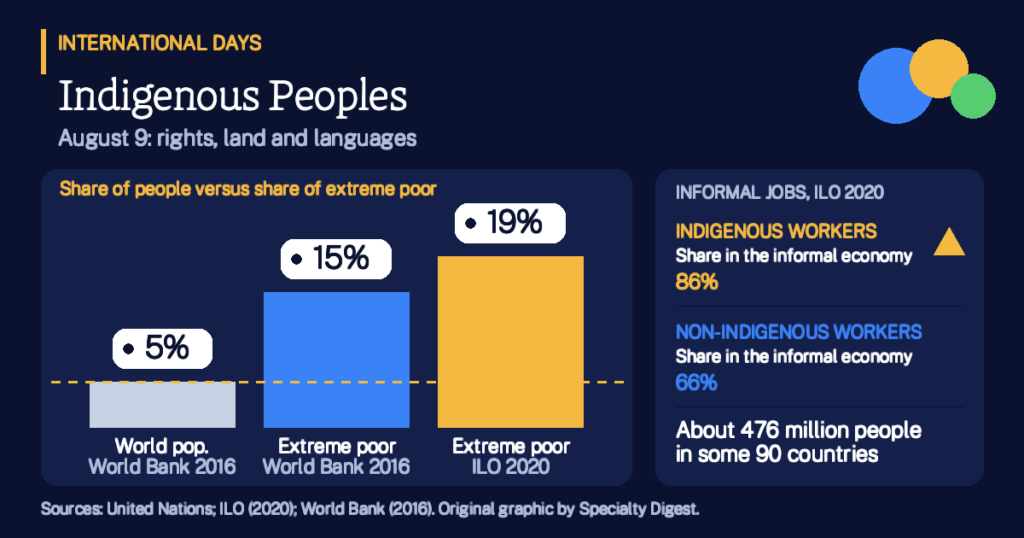
The ILO reports that Indigenous peoples are nearly three times as likely to live in extreme poverty as non-Indigenous people. It says they account for almost 19 percent of the extreme poor, meaning those living below $1.90 a day. A World Bank analysis published in 2016 put the figure at 15 percent, from about 5 percent of the world’s people, and a UN page says at least 15 percent. The sources differ in year and method, yet they point in the same direction.
Work tells a similar story. The ILO found that more than 86 percent of Indigenous workers are in the informal economy, compared with about 66 percent of non-Indigenous workers. Those in wage work earn about 18 percent less on average.
Example 2: what informality means. Picture 100 Indigenous workers and 100 non-Indigenous workers. By the ILO’s shares, about 86 of the first group and 66 of the second have no formal contract or social protection. That leaves 20 more people in each hundred exposed to a lost harvest, an injury or a sudden layoff with little to fall back on. The numbers are rounded for illustration.
Land, forests and the living world
Land is the thread that ties most Indigenous claims together. The UN says Indigenous territories cover 28 percent of the world’s surface and contain 11 percent of its forests, and it calls Indigenous peoples guardians of most remaining biodiversity. The World Bank reports that 36 percent of the world’s remaining intact forests lie on Indigenous lands, and that Indigenous communities safeguard 80 percent of remaining biodiversity (2023). Land estimates vary by method and definition, so treat them as approximations.
The pattern matters because secure rights and healthy ecosystems often go together. The World Bank notes that forests on Indigenous lands are better maintained and hold more preserved biodiversity. It also lists insecure land and property rights among the features of Indigenous poverty (2016). Protecting a community’s claim to its land can therefore serve its people and the wider planet.
Languages carry knowledge
A language holds more than words. It carries place names, medicine, law, stories and seasonal knowledge. A 2023 UN DESA policy brief says that of the 6,700 languages spoken worldwide, 40 percent are in danger of disappearing. Indigenous peoples make up less than 6 percent of the global population yet speak more than 4,000 of those languages. UN pages likewise state that at least 40 percent of an estimated 7,000 languages are at some level of endangerment.
That is why the General Assembly proclaimed the International Decade of Indigenous Languages, running from 2022 to 2032. The same concern drives International Mother Language Day.
Example 3: a language in one generation. Suppose a language has 500 speakers, most of them over 60, and local schools teach only a national language. If children learn it at home from no one, the number of fluent speakers falls with each passing year, and the language can fade within a generation or two. The numbers are made up for illustration, but the mechanism is what language experts describe.
The 2026 theme and how the day is marked
The 2026 theme is “Honouring Indigenous Midwives: Safeguarding Life and Well-being.” Because August 9 falls on a Sunday in 2026, the UN commemoration is held online on Monday, August 10. The theme draws attention to people who support birth and early life in their communities and invites health systems to work with them. Each year the day is marked with UN events, school lessons, film screenings and gatherings led by Indigenous communities. A simple way to take part is to listen to Indigenous voices directly and learn whose land you live on.
Key Takeaways
- The date has a history. August 9 marks the first meeting of the UN Working Group on Indigenous Populations in 1982, and resolution 49/214 set the day in 1994.
- The numbers are large. About 476 million people in some 90 countries are Indigenous, according to the UN and the ILO.
- The Declaration is a landmark. It passed in 2007 by 143 votes to 4, with 11 abstentions, but it is not a binding treaty.
- Poverty is concentrated. Indigenous peoples are nearly three times as likely to live in extreme poverty, says the ILO.
- Land and nature are linked. The World Bank says 36 percent of remaining intact forests are on Indigenous lands.
- Languages are at risk. About 40 percent of the world’s languages are in danger, and the 2022 to 2032 Decade aims to protect them.
- Listening is a first step. The 2026 theme honors Indigenous midwives, a reminder that community knowledge supports life and health.
How solid is this? Population, poverty and land figures are estimates, and sources differ in year and method, so the article names each source and year. Shares of the world population range from about 5 to 6 percent across UN, ILO and World Bank texts. The three worked examples use round, made-up numbers to show an idea. See also the International Days hub and the International Days Calendar.
More in Society
- United Nations, International Day of the World’s Indigenous Peoples
- United Nations, International Day of the World’s Indigenous Peoples: Background
- International Labour Organization, Urgent action needed to tackle poverty and inequalities facing Indigenous peoples (2020)
- UN General Assembly press release GA/10612 on the adoption of the Declaration (2007)
- UN DESA Policy Brief No. 151: Why Indigenous languages matter (2023)
- World Bank, Poverty and exclusion among Indigenous Peoples: the global evidence (2016)
- World Bank, Empowering Indigenous Peoples to protect forests (2023)