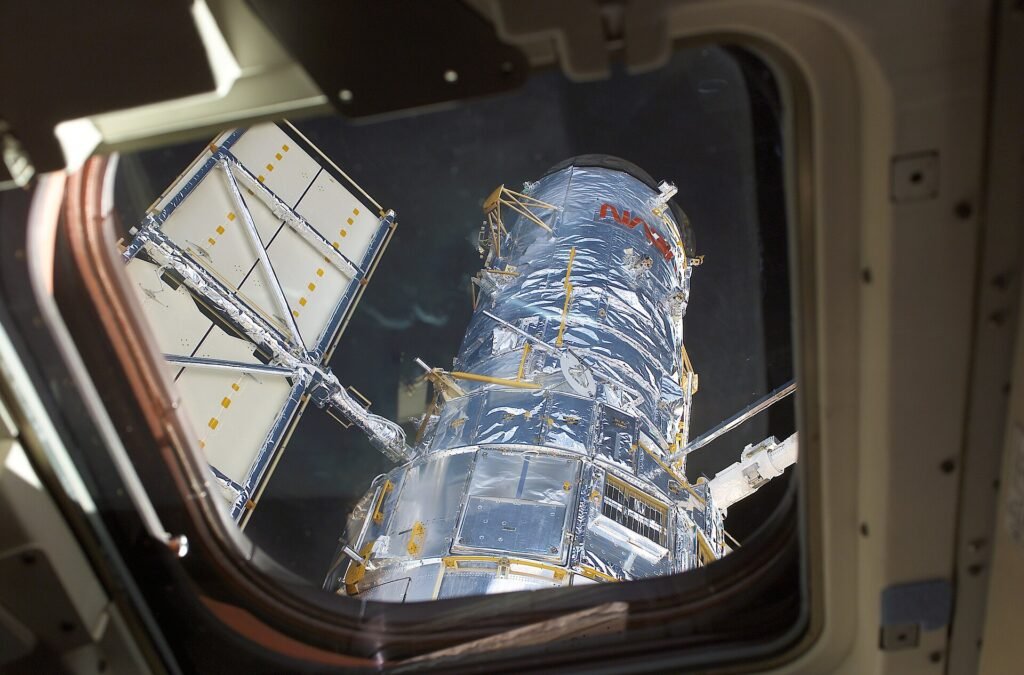
NASA has asked industry whether a company could boost, service or safely retire the Hubble Space Telescope. The agency issued a Request for Information on October 29, 2026, with responses due by 3 p.m. Eastern time on Monday, November 30. This article on commercial servicing for Hubble summarizes what NASA says about Hubble’s falling orbit, the three options it is exploring and what the page does not say.
What did NASA ask for?
A Request for Information, or RFI, is a way for an agency to learn what companies can offer before it decides whether to run a formal competition. NASA’s RFI seeks industry interest in three areas:
- Boosting Hubble to a higher orbit
- Servicing Hubble to enhance its capabilities
- Performing a controlled re-entry or orbital disposal at the end of the mission
The page names no companies that are bidding or have been selected. It notes only that Lockheed Martin Space already supports Hubble mission operations at NASA’s Goddard Space Flight Center.
Why is Hubble’s orbit a concern?
NASA says Hubble’s altitude is slowly decreasing because of atmospheric drag. The telescope has no propulsion system to maintain its own orbit, so a reboost would raise it to a higher altitude. If nothing is done, NASA’s predicted re-entry is in 2033 to 2034. The agency says a mission would need to take place by 2032 to act before that.
What is the timeline?
The page gives three dates: responses to the RFI are due by 3 p.m. EST on Monday, November 30, the earliest mission window ends in 2032, and the predicted re-entry falls in 2033 to 2034. By our own arithmetic, a 2032 mission is five to six years after the RFI response deadline, and the predicted re-entry is roughly seven years away. Those calculations are ours and are not NASA statements. The timeline gives NASA and industry several years but not unlimited time, given how long spacecraft take to design and build.
Who manages Hubble?
Hubble is a NASA and ESA project, managed by Goddard. NASA’s Science Mission Directorate associate administrator says NASA is also developing a flagship mission to follow Hubble. The page does not name that mission, and we do not guess at it.
How to read the announcement
An RFI is not a contract and does not commit NASA to a mission. It is a market survey. The three options are not ranked, and NASA does not say which it prefers. The stated risk is simple: the predicted re-entry if no action is taken. The page does not detail technical or cost risks. A reader should therefore treat the story as an early step, not a decision to extend or end Hubble’s life.
Why would anyone service a telescope?
Servicing can extend a spacecraft’s life, upgrade its instruments or refuel it. A general reason for interest is that a telescope that already works is valuable, and raising its orbit can add years of science. That is a general point and is not quoted from NASA. The page does not say what upgrades might be possible, so we do not list any.
What would a controlled re-entry mean?
A controlled re-entry is a planned descent in which operators steer a spacecraft so that any surviving pieces fall in a remote area, usually over an ocean. The alternative is an uncontrolled re-entry, where the spacecraft falls when drag finally brings it down and the landing area is less predictable. NASA lists controlled re-entry or orbital disposal as one of three options. Those two definitions are general and are not drawn from the NASA page.
What should readers watch for next?
The first milestone is the response deadline of November 30. After that, NASA would need to decide whether any proposal is worth a formal competition. The page does not describe that decision process, so the outcome and timing are unknown. Readers should also keep in mind that the predicted re-entry window depends on atmospheric conditions, and drag can change with solar activity. That last point is a general fact about low orbits and is not stated in NASA’s page, but it explains why NASA gives a range of years and not a single date.
Why does the choice matter for astronomers?
Hubble is a working observatory that still produces results, and NASA says it is developing a flagship follow-on. Whether Hubble continues to operate for several more years or is retired affects the pace of science in visible and ultraviolet light. The page does not weigh those trade-offs, and we do not either; it only reports that NASA wants to learn what industry could do.
How does it connect to other coverage?
The idea of working on spacecraft in orbit is the subject of our article on the NASA ISAM State of Play, which catalogs servicing, assembly and manufacturing hardware. Hubble’s recent science includes the finding in our article on missing oxygen in dwarf galaxies and the lens image in our report on a gravitational lens that prepares astronomers for Roman. The Roman Space Telescope article covers a newer observatory that will work alongside it, and our guide to the James Webb Space Telescope covers the infrared observatory that complements both.
Glossary
- Request for Information: a notice asking companies what they can offer, with no commitment to buy
- Reboost: raising a spacecraft’s orbit with a push from a propulsion system
- Atmospheric drag: friction from thin air that lowers a low orbit
- Controlled re-entry: a planned, steered return into the atmosphere
- Flagship mission: one of an agency’s largest and most expensive science missions
These definitions are general explanations and are not quoted from NASA.
What is not covered here?
NASA’s page does not give Hubble’s current altitude, the cost of any option, the names of interested companies or the process after the responses arrive. We have not added any of these. Readers should check NASA for the outcome of the RFI.
Key facts at a glance
- RFI issued: October 29, 2026
- Responses due: 3 p.m. EST, Monday, November 30
- Options: boost, service, or controlled re-entry or disposal
- Predicted re-entry: 2033 to 2034
- Mission needed by: 2032
Frequently asked questions
Is NASA planning to end Hubble?
No decision is announced. The RFI explores three options.
Why can’t Hubble raise its own orbit?
NASA says it has no propulsion system to maintain its orbit.
Who runs Hubble?
It is a NASA and ESA project managed by Goddard.
More in Technology