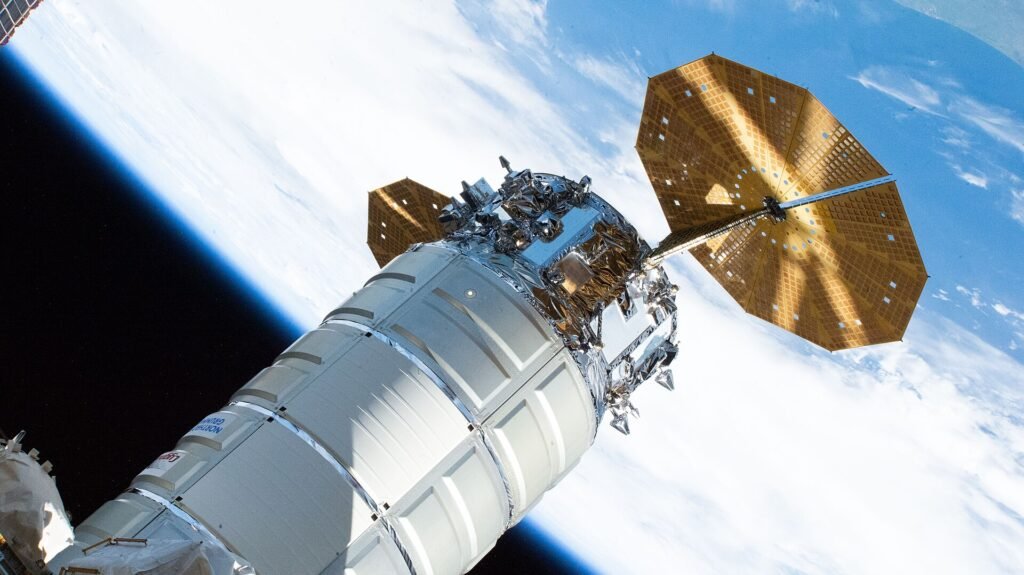
The CRS-25 launch is targeted for no earlier than 10:49 a.m. EST on Sunday, November 29, 2026, when a Falcon 9 rocket is due to carry Northrop Grumman’s Cygnus XL cargo spacecraft toward the International Space Station. NASA announced the plan in a media advisory issued on November 2. This article summarizes what NASA says about the mission, explains the terms and flags what the advisory does not cover.
What is CRS-25?
CRS-25 is Northrop Grumman’s 25th spacecraft built for NASA’s space station resupply contract, according to NASA. The Cygnus XL spacecraft will launch on a SpaceX Falcon 9 rocket from Space Launch Complex 40 at Cape Canaveral Space Force Station in Florida. NASA lists the launch time as a target, so it can move if weather or technical issues require.
How will Cygnus reach the station?
NASA says astronauts will use the Canadarm2 robotic arm to capture Cygnus and install it on the Earth-facing port of the Unity module, where the cargo will be unloaded. The advisory gives no docking date. Cygnus will stay at the station until May 2027, which by our own arithmetic is roughly five to six months after the planned launch.
What science is on board?
NASA lists four research items:
- Hardware for making tiny, DNA-inspired particles in space, which could improve drug delivery for cancer and osteoarthritis
- A study that predicts whether a patient’s cancer is likely to spread to other parts of the body, to guide treatment
- Human muscle cells and medications for testing treatments for muscle loss linked to spaceflight and aging
- A compact radiation sensor intended to improve crew safety on future missions
These are descriptions of research under way and are not medical advice or claims that any treatment works. The advisory does not state results, and it gives no cargo mass.
Why does research happen on the station?
The station provides long-term microgravity, which changes how cells grow and how materials form. That is a general explanation and is not quoted from NASA. It helps explain why several items on the manifest involve biology or particle formation, where gravity can affect the result. Our report on ISS science in 2025 covers the results NASA highlighted from last year’s research.
How do cargo missions fit into the program?
Commercial resupply missions carry supplies, equipment and experiments to the station, and they bring items back or dispose of waste when they leave. This description is general and is not taken from the advisory. NASA’s contract with Northrop Grumman is one of the ways the agency keeps the station supplied, and the 25th mission shows how long that arrangement has run.
What does no earlier than mean?
In launch announcements, no earlier than means the date is the first possible opportunity and not a promise. Launches slip for weather, range conflicts and hardware checks, and a later date is common. This is a general convention and is not a statement in the NASA advisory. Readers should treat November 29 as a target and look for NASA updates close to the day.
How long is the lead time?
The advisory was issued on November 2, the media application deadline for U.S. citizens is November 12, and the launch target is November 29. By our own arithmetic, the deadline falls 10 days after the advisory and 17 days before the target launch. The gap gives reporters time to be cleared for access before the launch.
What do the four research items have in common?
Three of the four items involve human health on Earth or in space: drug delivery particles, prediction of cancer spread and muscle loss. The fourth, the radiation sensor, concerns crew safety on future missions. This grouping is our reading of NASA’s list and is not a statement in the advisory. It shows that much of the cargo is aimed at biology and safety, though the advisory gives no detail on how each experiment will be run.
How to read the advisory
The document is a media advisory, so its purpose is to tell reporters how to cover the launch. It sets out the target time, the rocket and the research list, and it gives the application deadline for accredited media: 11:59 p.m. EST on Thursday, November 12, 2026, for U.S. citizens. It does not describe risks, costs or the detailed schedule after launch.
How does CRS-25 connect to other coverage?
Station science links to NASA’s wider plans. See our reports on the Atmospheric Waves Experiment, which finished its mission on the station, and the Starliner update, which covers another crew and cargo vehicle. For lunar plans, read about Artemis III in 2027 and Artemis II.
What should readers watch for next?
Readers can watch for launch confirmation, the capture by Canadarm2 and the unloading of the research items. NASA has not published results from these investigations in the advisory.
Glossary
- Cygnus: an uncrewed cargo spacecraft built by Northrop Grumman
- Canadarm2: the station’s robotic arm, used to capture visiting spacecraft
- Unity module: a connecting module of the station with several ports
- Microgravity: conditions in which objects seem nearly weightless
- Falcon 9: a SpaceX rocket used to launch cargo and crew vehicles
These definitions are general explanations and are not quoted from NASA.
What is not covered here?
We read the NASA advisory only. We have no details on cargo mass, on the exact orbit or on how the research items will be run. We report no launch result, because the launch has not happened.
Key facts at a glance
- Launch target: 10:49 a.m. EST, Sunday, November 29, 2026
- Rocket: SpaceX Falcon 9, Cape Canaveral SLC-40
- Spacecraft: Northrop Grumman Cygnus XL, the 25th for NASA
- Station stay: until May 2027
Frequently asked questions
When is the CRS-25 launch?
NASA targets no earlier than November 29, 2026.
What rocket carries Cygnus?
A SpaceX Falcon 9.
How long will Cygnus stay?
Until May 2027, according to NASA.
More in Science
- Extreme Debris Disks: Webb Studies 21 Young Systems Showing Planetary Collisions
- Second-Generation Planet Suspected Around White Dwarf as Hubble Data Reveal Niobium
- NGC 7129: Webb Image Shows Stellar Jets and Shocked Gas in a Stellar Nursery
- Trans-Neptunian Objects: Hubble and Webb Find 27 New Ones as Small as 3 Miles Across