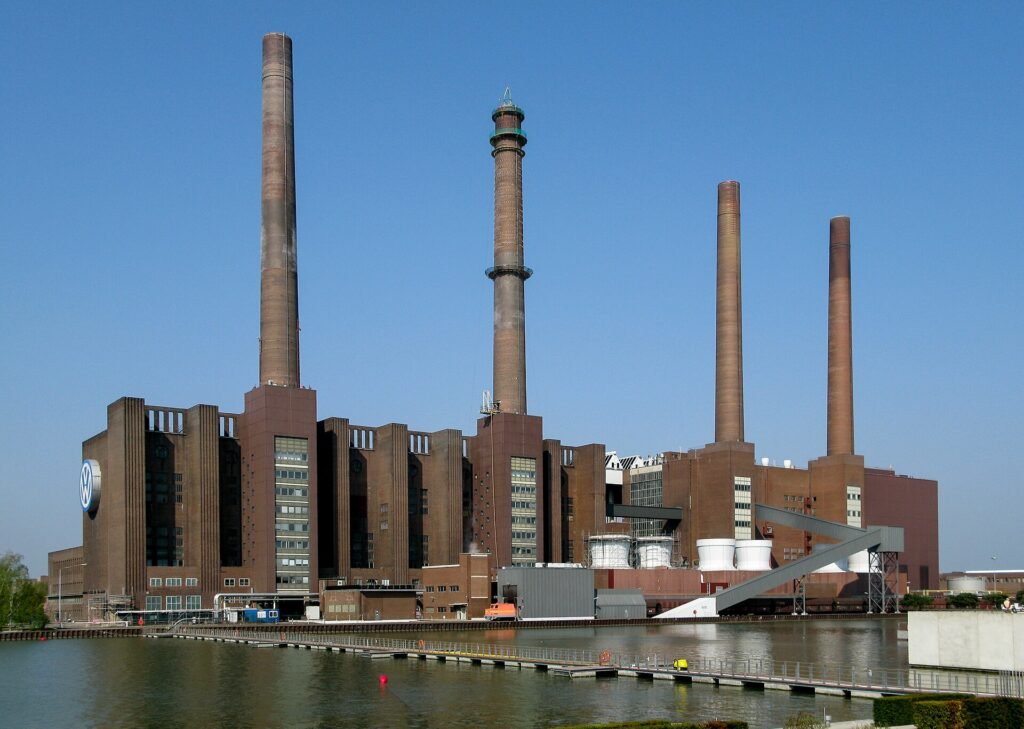
The Volkswagen Group is a German automotive group headquartered in Wolfsburg, Lower Saxony, that owns passenger car, motorcycle and commercial vehicle brands including Volkswagen, Audi, Porsche, Skoda and SEAT. Its annual report for 2025 gives deliveries to customers of 8.984 million vehicles and sales revenue of 321.9 billion euros.
History of the Volkswagen Group
Volkswagen was founded in 1937 by the German government to mass-produce a low-priced people’s car, which is what the name means in German. Ferdinand Porsche designed the original car, and the factory in Lower Saxony, which broke ground in 1938, became the town of Wolfsburg. The outbreak of the Second World War in 1939 came before mass production started, and the factory was converted to military production.
After the war the factory was rebuilt under British supervision, and mass production of the Volkswagen began in 1946. In 1949 control passed to the West German government and the state of Lower Saxony. The Transporter van was introduced in 1950, the Karmann Ghia coupe and Volkswagen of America followed in 1955, and an advertising campaign by the agency Doyle Dane Bernbach helped popularize the Beetle in the United States in 1959. In 1960 the company was mostly privatized when 60 percent of its stock was sold to the public.
In the early 1970s the company moved from the rear-engine Beetle to front-engine, front-wheel-drive cars. The Passat arrived in 1973 and the Golf in 1974, and the Golf became one of the best-selling cars in Europe. Production of the Beetle ended in 2019. In 2015 Volkswagen briefly became the world’s largest carmaker by volume, and it then faced the emissions scandal described below.
The advertising campaign of 1959, widely known by the slogan Think Small, is still studied in marketing courses because it presented an unusual, compact and plain car as a virtue in a market of large American sedans. The car then became a fixture of student life and of the 1960s counterculture in several countries.
Products and services
The group’s brands cover many market segments. They include Volkswagen passenger cars, Audi, Porsche, Skoda and SEAT, and luxury makers such as Bentley and Lamborghini. It also owns commercial vehicle businesses such as MAN and Scania, which are held through its Traton unit, and a motorcycle brand, Ducati.
Its products range from small city cars and family vehicles to sports cars, buses and heavy trucks. The group also offers financial services, including vehicle leasing, financing and insurance, which help customers buy its cars. As the industry moves to battery power, the group has expanded its range of electric vehicles, in addition to its petrol and diesel automobile models.
Corporate structure and operations
The Volkswagen Group is a publicly traded company, and its shareholders include Porsche Automobil Holding SE and the state of Lower Saxony. It is organized into brand groups with their own management teams, which share platforms, parts and technology to lower costs.
The annual report for 2025 gives these key figures:
- Deliveries to customers of 8,984 thousand vehicles.
- Employees of 663 thousand at December 31, 2025.
- Sales revenue of 321.9 billion euros.
- An operating result of 8.9 billion euros.
The operating result equals about 2.8 percent of sales revenue, a ratio worked out from the two reported figures. These figures show a business with a very large revenue base and a comparatively low operating profit relative to sales, as is common in vehicle manufacturing, where factories, tooling and development costs are high.
Impact of the Volkswagen Group
Volkswagen was a leader in showing that a small, affordable car could be built in very large numbers, and its Beetle remained in production in different forms for decades. The group is also an important employer in Germany and in the other countries where it has factories.
Its modular production systems and shared platforms are often cited in discussions of supply chain management, since a single platform can support many models across brands. Its decisions on electrification affect suppliers, dealers and governments, and its vehicles are a large part of the market for automobiles in Europe, China and North America.
Criticism and controversies
The most significant controversy was the diesel emissions scandal. On September 18, 2015, the U.S. Environmental Protection Agency issued a Notice of Violation of the Clean Air Act to Volkswagen AG, Audi AG and Volkswagen Group of America, alleging that software in 2.0 liter diesel cars circumvented emissions standards. The agency said the vehicles emitted up to 40 times more pollution than standards allowed.
The affected 2.0 liter models listed by the agency included the Jetta, Beetle, Golf, Passat and Audi A3. The agency described nitrogen oxides, the main pollutant at issue, as a serious health concern, and the broader subject is discussed under air pollution. A second notice on November 2, 2015, covered 3.0 liter diesel models, and on November 19, 2015, company officials told the agency that a defeat device had existed in all of its U.S. 3.0 liter diesel models since 2009. A defeat device is software designed to detect when a car is being tested and turn on full emissions controls only during the test. According to the EPA, the settlements resolved allegations concerning about 590,000 model year 2009 to 2016 diesel vehicles in the United States.
On June 28, 2016, the company entered into a multi-billion dollar settlement to partly resolve the allegations for the 2.0 liter engines. The settlements also covered 3.0 liter diesel vehicles, including the Touareg, the Porsche Cayenne and several Audi models such as the A6, A7, A8, Q5 and Q7, according to the EPA. The case led to recalls, buybacks, fines and changes in management and testing practices in several countries. The information here is general background and not investment advice.
More in Management
Key facts
- Volkswagen was founded in 1937 by the German government to build a low-priced people's car, and it is headquartered in Wolfsburg.3
- Volkswagen was mostly privatized in 1960 when 60 percent of its stock was sold to the public.3
- The group delivered 8,984 thousand vehicles to customers and had 663 thousand employees at December 31, 2025.1
- Sales revenue in 2025 was 321.9 billion euros and the operating result was 8.9 billion euros.1
- The EPA issued its first Notice of Violation on September 18, 2015, over diesel defeat devices.2
Related concepts
Quick checkWhat was the Volkswagen emissions scandal?Show answer
In 2015 the U.S. EPA said Volkswagen had installed software in diesel cars that turned on full emissions controls only during tests. The EPA later resolved the case through settlements covering about 590,000 U.S. vehicles.
Sources
- Volkswagen Group, Annual Report 2025, https://annualreport2025.volkswagen-group.com/
- U.S. Environmental Protection Agency, Learn About Volkswagen Violations, https://www.epa.gov/vw/learn-about-volkswagen-violations
- Encyclopaedia Britannica, Volkswagen AG, https://www.britannica.com/topic/Volkswagen-AG
Editorially reviewed by Specialty Digest Editorial TeamLast reviewed November 4, 2026Researched and drafted with AI assistanceReport an issue