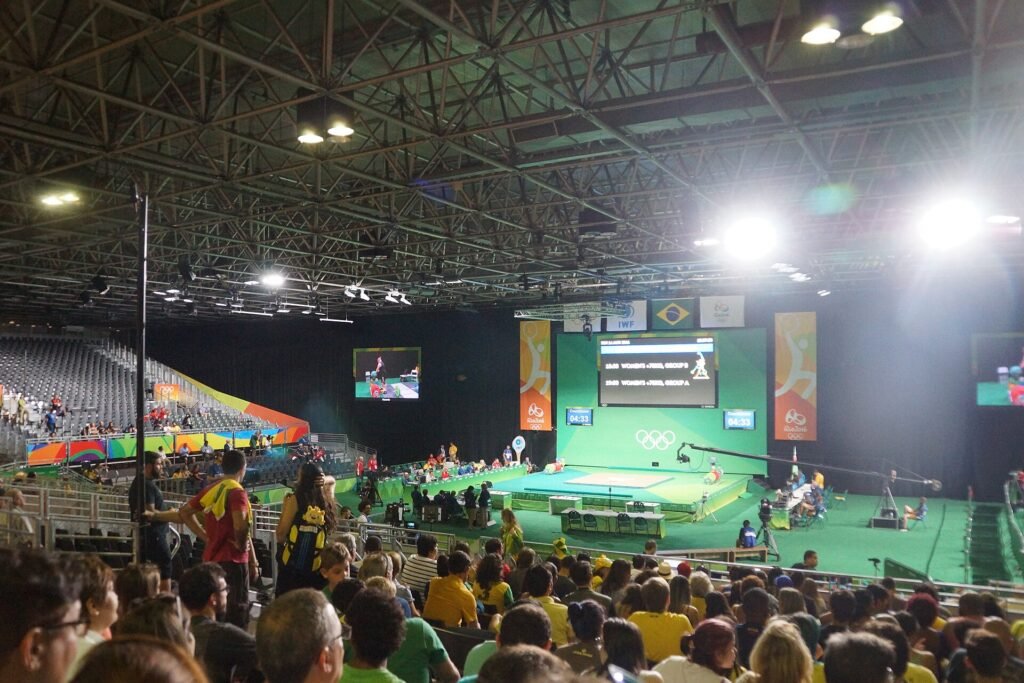
Weightlifting, also called Olympic weightlifting, is a strength sport in which athletes lift a loaded barbell from the floor to overhead in two lifts, the snatch and the clean and jerk. A lifter’s result is the sum of the heaviest successful lift in each, and the highest total in a bodyweight class wins. The International Weightlifting Federation (IWF) governs the sport, which appeared at the first modern Olympic Games in 1896.
History of weightlifting
The first international competition took place in London on 28 March 1891, with seven athletes from six countries. Two months later, on 31 May, the Austrian Athletes Federation in Vienna became the first national governing body for weightlifting. At the first modern Olympic Games, in Athens on 7 April 1896, six athletes from five countries competed in a one-hand snatch and a two-hand clean and jerk.
The sport was missing from some of the next Games and returned for good at Antwerp in 1920, when bodyweight categories were introduced. The IWF traces its roots to the Amateur-Athleten-Weltunion, founded in Duisburg on 10 June 1905, which governed both weightlifting and wrestling. It was called the Federation Internationale Halterophile from 1920 and received its present name between the 1972 and 1976 Olympics.
The list of lifts changed over time. The one-hand event left the Olympic program after 1924, and the IWF deleted one-hand exercises in 1962. At the 1928 Amsterdam Games the program was a three-lift contest of press, snatch, and clean and jerk, and the press was dropped after the 1972 Games, leaving the two lifts used today.
Women’s weightlifting was accepted in principle by the IWF in 1983. The first international women’s tournament was held in Budapest in 1986, with 23 athletes from five countries, and women made their Olympic debut at Sydney in 2000.
Rules and how weightlifting is played
In the snatch, the lifter raises the barbell overhead in one continuous motion. In the clean and jerk, the lifter first brings the bar to the chest, which is the clean, and then drives it overhead with straight elbows, which is the jerk, and holds it steady until a signal sounds.
Each lifter gets three attempts at each lift. The best successful snatch and the best successful clean and jerk are added together, and the highest total wins. After a successful lift the athlete may raise the weight for the next attempt. The lifter who chose the lowest opening weight goes first, and each lifter must begin an attempt within one minute of being called. Tie-breakers exist for equal totals, and the general rule favors the lighter lifter.
Success depends on strength and conditioning as well as technique. Competitors plan their peak around major events using methods such as periodization, which varies the load of training over weeks and months.
Lifters compete in bodyweight classes. At Paris 2024 the men’s classes were 61, 73, 89 and 102 kilograms plus an over-102 kilogram class, and the women’s classes were 49, 59, 71 and 81 kilograms plus an over-81 kilogram class. That was five classes for each sex, down from seven at Tokyo 2020. In 2018, in Tashkent, the IWF had approved ten new bodyweight categories each for men and women.
Equipment and venues
The equipment is simple. A steel barbell carries rubber-covered weight plates on each side, and lifters use chalk to keep their hands dry and prevent the bar from slipping. They may tape areas such as the wrists and thumbs for injury prevention.
A major equipment change came in 1910, when the IWF recorded the introduction in Frankfurt of a barbell with discs and a revolving bar.
Competitions take place in arenas, with lifters working on a platform, and the order of lifting follows the opening weights chosen by each athlete. Large events such as the Olympics use the same two lifts and the same scoring as local meets.
Governing bodies and major competitions
The IWF is the world governing body. It holds world championships every year except Olympic years. The first women’s world championship, held in Florida, drew 100 athletes from 22 countries. A first world championship for junior women took place in Warsaw in 1995, with 75 lifters from 17 nations. The IWF recognized the masters movement for older athletes in 1992 and celebrated its centenary in Istanbul in 2008.
Weightlifting joined the Youth Olympic Games when they opened in Singapore in 2010. The way federations set rules, qualify athletes and hold their members to account is a subject covered under sports governance.
Records and notable moments
At the Olympic Games, China leads the medal table with 43 golds, ahead of the Soviet Union with 39 and the United States with 17, according to Olympedia. Five individuals have won three Olympic gold medals: Pyrros Dimas, Halil Mutlu, Naim Suleymanoglu, Lasha Talakhadze and Akakios Kakiasvili.
The Soviet Union first competed in weightlifting at the 1952 Helsinki Games. Olympedia also notes that Bulgarian lifters had problems with drug testing at the 1992 Barcelona Games.
The 2000 Sydney Games were the first with women’s events. They had seven weight classes, and 85 athletes from 47 countries took part. At Paris 2024 women and men each had five classes, so the program now treats the two sexes equally.
Global reach of weightlifting
The sport started in Europe, where its first governing bodies formed, and is now organized worldwide. Olympedia lists 33 distinct events across Olympic and Youth Olympic history, 14 of them for men, seven for women, six for boys and six for girls.
The six athletes at Athens in 1896 came from five countries. By Sydney in 2000 the women’s field alone drew competitors from 47 countries, a sign of how widely the lifts are now practiced. The entry of the Soviet Union in 1952 and the rise of China to the top of the Olympic medal table show how the center of the sport has moved beyond Europe.
More in Sports Coaching and Performance
Key facts
- Weightlifting was on the program of the first modern Olympic Games in Athens on 7 April 1896.1
- Women's weightlifting made its Olympic debut at Sydney in 2000, with seven weight classes.3
- Each lifter gets three attempts at the snatch and three at the clean and jerk, and the best of each are added together.2
- At Paris 2024 each sex had five bodyweight classes, down from seven at Tokyo 2020.2
Related concepts
Quick checkWhat are the two lifts in Olympic weightlifting?Show answer
The two lifts are the snatch, in which the barbell goes overhead in one motion, and the clean and jerk, in which it is brought to the chest and then pushed overhead. The best of each are added together.
Sources
- International Weightlifting Federation, History, https://iwf.sport/weightlifting_/history/
- International Olympic Committee, Weightlifting in Olympics: rules, history, snatch, clean and jerk, https://olympics.com/en/news/weightlifting-olympics-rules-history-snatch-clean-and-jerk
- Olympedia, Weightlifting at the Olympic Games, https://www.olympedia.org/sports/WLF
Editorially reviewed by Specialty Digest Editorial TeamLast reviewed November 4, 2026Researched and drafted with AI assistanceReport an issue