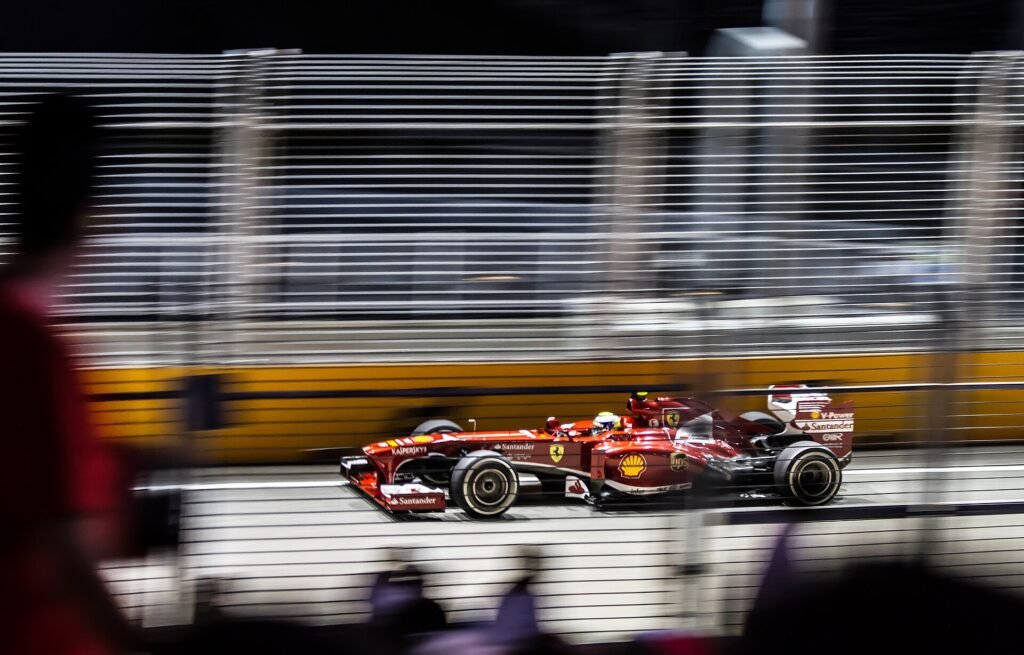
Formula One is the highest class of international single-seat motor racing, run as the FIA Formula One World Championship. Drivers and teams compete in a season of races called Grands Prix at circuits around the world, and points decide both a drivers’ title and a constructors’ title. The first world championship season was held in 1950.
History of Formula One
The first championship race was the British Grand Prix at Silverstone on 13 May 1950, and it counted as round one of the new World Championship. Nino Farina won for Alfa Romeo, whose factory team entered four supercharged 158 cars. A crowd estimated at more than 150,000 watched, and King George VI and Queen Elizabeth were among the royal guests. Twenty-one drivers took part, including Prince Bira of Siam. Ferrari sent no cars, and Juan Manuel Fangio retired with engine trouble. Farina scored the maximum nine points, eight for the win and one for the fastest lap, and went on to become the first drivers’ champion. The race programme called the day the greatest occasion in the history of motor racing in Britain.
The first scoring system gave 8, 6, 4, 3 and 2 points to the top five finishers, with one extra point for the fastest lap, and only each driver’s best results counted. A title for manufacturers was added in 1958. Vanwall won that first constructors’ title with 48 points, ahead of Ferrari on 40 and Cooper-Climax on 31, while Mike Hawthorn became the first British drivers’ champion, edging Stirling Moss by 42 points to 41. The scoring in 1958 still gave 8, 6, 4, 3 and 2 points to the top five and one for the fastest lap, but only the best six results counted.
Rules and how a race weekend works
A normal Grand Prix weekend runs from Friday to Sunday. It includes three one-hour practice sessions, with two on Friday and one on Saturday, followed by qualifying and the race. Qualifying is a three-stage knockout. The first stage lasts 18 minutes and sends the top 16 drivers through, the second lasts 15 minutes and sends the top 10 through, and the third lasts 13 minutes in the 2026 format. The fastest driver in the last stage takes pole position at the front of the grid. Since 2022, drivers may start the race on any tire they choose.
Race distance is regulated at a minimum of 305 kilometers, except in Monaco, where the minimum is 260 kilometers. A race is capped at two hours, and the chequered flag is shown at the end of the next lap once that mark passes. A red-flag stoppage extends the total limit to three hours, and time spent under a red flag does not count toward race time. In dry races drivers must use two different dry tire compounds, which requires at least one pit stop.
Points are awarded to the top ten finishers: 25, 18, 15, 12, 10, 8, 6, 4, 2 and 1. Sprint weekends were introduced in 2021 and replace two practice sessions at selected rounds. A sprint race of about 100 kilometers is held on Saturday, and it awards points of 8 down to 1 to the top eight finishers. On a sprint weekend, sprint qualifying is held on Friday in three stages of 12, 10 and 8 minutes, and the sprint has no mandatory tire change. The 2026 sprint rounds are China, Miami, Canada, Britain, the Netherlands and Singapore.
Cars and circuits
The cars are single-seat automobiles built by each team to technical rules that change over time. The cars of the first season, such as the Alfa Romeo 158, were powered by supercharged internal combustion engines, and the technical regulations have been rewritten many times since.
Each circuit sets the lap length, and the race lasts for the smallest number of whole laps that exceeds the minimum distance. Silverstone, the site of the first race, still hosts the British Grand Prix. Cars go into parc ferme conditions, which limit changes to their setup, after the third practice session.
Sprint races vs. Grands Prix
The sprint format was tried at three Grands Prix in 2021. The sprint covered 100 kilometers, which was 17 laps at Silverstone, and it lasted roughly 25 to 30 minutes. Drivers raced flat out and were not required to pit. In the trial, the top three finishers scored 3, 2 and 1 points, and the sprint result set the grid for the main race on Sunday.
The format has since changed. Sprint points now go to the top eight, and a separate sprint qualifying session decides the sprint grid. Sprint weekends replace two practice sessions and are held only at selected rounds, so the Sunday Grand Prix remains the main event.
Governing bodies and major competitions
The championship is organized under the Federation Internationale de l’Automobile, the FIA, which publishes the sporting and technical regulations that teams must follow. For how federations of this kind operate across sports, see sports governance.
Two titles are decided each year. The drivers’ championship is awarded to the individual who scores the most points, and the constructors’ championship goes to the team with the highest combined total from its two drivers. Constructors’ titles have been awarded since 1958.
Records and notable moments
Michael Schumacher won seven drivers’ titles, in 1994, 1995 and from 2000 to 2004. Lewis Hamilton equaled that total with a seventh title, confirmed at the Turkish Grand Prix on 15 November 2020, after wins in 2008, 2014, 2015 and 2017 to 2020. Juan Manuel Fangio won five titles, in 1951 and from 1954 to 1957, and Alain Prost, Sebastian Vettel and Max Verstappen have won four each, with Verstappen’s coming from 2021 to 2024.
Among teams, Ferrari has won 16 constructors’ titles, McLaren 10 and Williams 9, according to figures that run through the 2025 season.
Global reach of Formula One
The sport has been international since its first season, when drivers from several countries entered the Silverstone race. The calendar now includes events on several continents, and sprint weekends are scheduled in regions as varied as China, North America, Europe and Southeast Asia.
Key facts
- The first world championship race was the British Grand Prix at Silverstone on 13 May 1950, won by Nino Farina for Alfa Romeo.1
- The first points system gave 8, 6, 4, 3 and 2 points to the top five, plus one for the fastest lap.1
- The constructors' championship began in 1958 and was won by Vanwall.2
- Race points today run 25, 18, 15, 12, 10, 8, 6, 4, 2 and 1 for the top ten finishers.3
- Michael Schumacher and Lewis Hamilton share the record of seven drivers' titles.5
- A Grand Prix must be at least 305 kilometers long, except in Monaco, where the minimum is 260 kilometers.4
Related concepts
Quick checkWhen did the Formula One World Championship begin?Show answer
The first Formula One World Championship season was held in 1950, opening with the British Grand Prix at Silverstone on 13 May.
Sources
- Silverstone Circuit, The greatest occasion in the history of motor racing in this country (1950 British Grand Prix), https://www.silverstone.co.uk/news/greatest-occasion-history-motor-racing-country
- Wikipedia, 1958 Formula One season (first constructors' championship), https://en.wikipedia.org/wiki/1958_Formula_One_season
- ESPN, F1 points system explained (current race and sprint points, constructors' title history), https://africa.espn.com/f1/story/_/id/49582865/how-many-points-do-drivers-get-race-sprint-why
- Honda, 2026 F1 Explained (race weekend format and sprint rounds), https://global.honda/en/F1/features/f1-explained/03/
- ESPN, Which F1 drivers and teams have the most championships (records through 2025), https://africa.espn.com/auto/story/_/id/42251194/crossDomain
- Guinness World Records, Most Formula One World Championships (7 titles, Hamilton equaled on 15 November 2020), https://www.guinnessworldrecords.com/world-records/63895-most-formula-one-world-championships
- Wikipedia, Formula One race weekend (qualifying and tire rules, parc ferme), https://en.wikipedia.org/wiki/Formula_One_race_weekend
- Formula 1, Everything you need to know about the 2021 F1 Sprint format (100 km sprint and trial points), https://www.formula1.com/en/latest/article/everything-you-need-to-know-about-f1s-new-sprint-qualifying-format-including.1Lawf6r6Ab0y8ha0satSjx
Editorially reviewed by Specialty Digest Editorial TeamLast reviewed November 4, 2026Researched and drafted with AI assistanceReport an issue